



L.A. Metro updates sex trafficking awareness campaign
Includes 3,000 ads placed on buses and railcars across L.A. County. In addition, 85,000 brochures containing resources on how to help victims of human trafficking will be placed in Metro’s customer centers, stations, buses and trains.

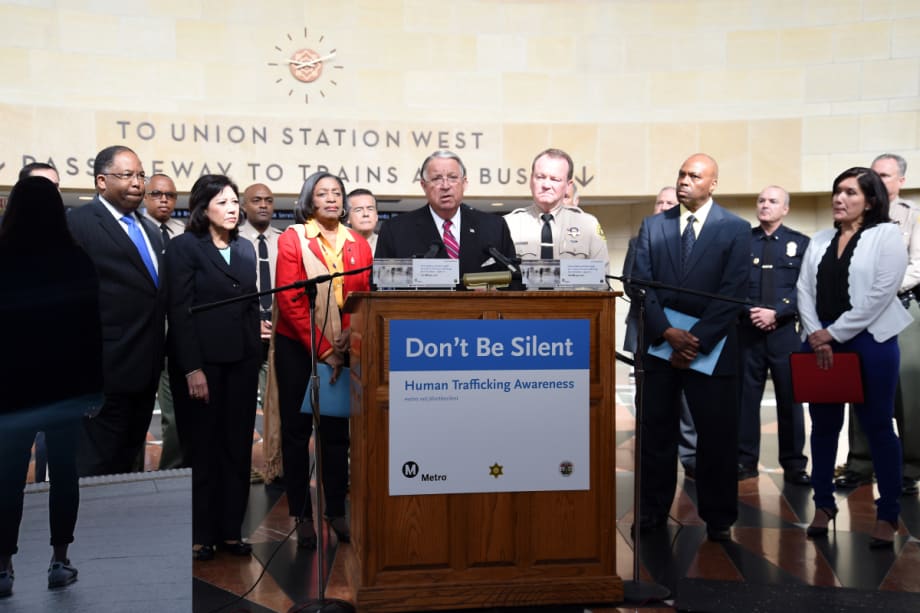
L.A. County Supervisor and Metro Board Member Don Knabe was joined by several local officials to launch Metro's new "Don't Be Silent" campaign. Photo: Luis Inzunza/Metro
L.A. County Supervisor and Metro Board Member Don Knabe was joined by several local officials to launch Metro's new "Don't Be Silent" campaign. Photo: Luis Inzunza/Metro
Los Angeles County Supervisor and Los Angeles County Metropolitan Transportation Authority (Metro) Board Member Don Knabe, Metro CEO Phil Washington, L.A. County Sheriff Jim McDonnell and advocacy group Peace Over Violence joined together to ask the public to speak out against human sex trafficking and to reiterate their collective efforts to crack down on the demand-side of the illicit child sex trafficking industry, as well as announce the launch of an updated countywide Metro and billboard awareness campaign.
“This new campaign is another great example of government and the private sector coming together to raise the public profile on a heinous crime affecting our most vulnerable children,” said Knabe. “Along with training thousands of Metro bus and rail operators and other employees, we are educating residents countywide — many of whom travel daily routes through the main trafficking hubs — to be aware of a child who may be a victim and is in need of rescue.”
Metro’s updated campaign includes 3,000 ads placed on buses and railcars across L.A. County. In addition, 85,000 brochures containing resources on how to help victims of human trafficking will be placed in Metro’s customer centers, stations, buses and trains. All ads and brochures contain a QR code that directs to the L.A. Transit Watch mobile app, a free app which allows anyone to report suspicious activity safely and anonymously.
Metro also is currently in the process of training all 10,000 employees, beginning with all frontline personnel, bus and train operators, maintenance and custodial personnel, on the devastating impact of human sex trafficking and how to report suspected crime and help victims who want to make a report.
Thanks to a generous donation by Clear Channel Outdoor, OUTFRONT Media and Lamar Advertising, Metro’s campaign material also will be shared on traditional and digital billboards across L.A. County this summer.
The campaign supports three “War on Child Sex Trafficking” laws passed in 2014: SB 1388, which increased fines and penalties for anyone convicted of pimping or purchasing a minor; SB 955, which added human trafficking to a list of offenses that will allow the use of wiretapping; and SB 939, which allows victims to testify against their traffickers in just one courtroom, rather than facing their exploiter in multiple jurisdictions.
More Management

METRO Opens Submissions for 2026 Motorcoach Awards
Nominations are now being accepted for METRO Magazine’s Operator of the Year and Innovative Operator of the Year awards.
Read More →
New York MTA Advances Final Contract for Second Avenue Subway Expansion
Contract Four is the largest in the Second Avenue Subway Phase 2 project and includes construction of station infrastructure, tracks, and signals for the subway expansion, MTA officials said. Work on Contract Four will begin in 2027.
Read More →
Transit Agencies Highlight Safety Gains at National Summit
Leaders from 15 major transit systems shared crime-reduction results and safety initiatives while discussing the role of continued federal support.
Read More →

NITA Names New Leadership, Expands Reduced-Fare Program at First Board Meeting
The new regional transit authority appointed its first board chair and interim executive director while extending reduced fares across CTA, Metra, and Pace for eligible riders.
Read More →
Beyond the Checklist: A Structured Approach to Transit Maintenance
Reliability-Centered Maintenance helps transit agencies move beyond routine checklists to focus limited resources on the assets and failures that have the greatest impact on safety, reliability, and service.
Read More →
APTA 2026 Nominating Committee Selects Leadership Slate, Names Chair and Vice Chair Nominees
Leadership changes will help shape the association’s priorities and its representation of the transportation industry during the 2026–2027 term.
Read More →
DART Launches Major Security, Fare Enforcement Initiative
The 90-day demonstration will deploy coordinated security teams at five light rail stations while testing controlled access and gathering data to guide future investments.
Read More →
Advancing Fare Collection Through Technology and Innovation
Learn about delivering 1300 gates at 91 stations while managing fare evasion. Explore the large scale deployment, solution customization and real-world results that affect the region. Prepare for deployment in your region now.
Read More →
Game Day in Motion: Moving Millions During the 2026 World Cup
Between packed transit stations and team motorcoaches, see how agencies and operators across North America tackled the transportation demands of the 2026 FIFA World Cup.
Read More →
Surface Transportation Extension Averts Shutdown, Leaves Transit Funding Gap
The stopgap keeps federal transportation programs moving, but missing advance funding could complicate the transit and rail projects agencies are planning next.
Read More →