



New MBTA app allows BRT riders to rate service
The app, named QualiT, allows individuals to anonymously share feedback with the T. The service is similar to ones provided on Uber and Lyft transportation systems, and provides crowd-sourced data to help improve service.

MBTA
MBTA
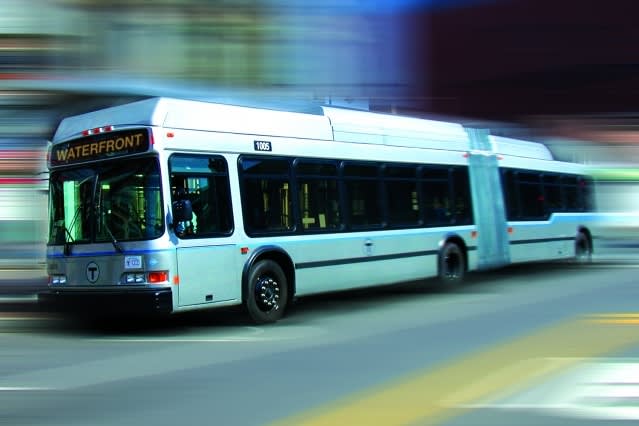
Passengers of MBTA's Silver Line bus rapid transit service are now able to share feedback on their riding experience by rating their bus trips using a new smartphone app from the Massachusetts Institute of Technology and the transit agency.
The app, named QualiT, allows individuals to anonymously share feedback with the T. The service is similar to ones provided on Uber and Lyft transportation systems, and provides crowd-sourced data to help improve service.
"We are working hard to enhance our channels of communicating information to our customers," said MBTA GM Frank DePaola. "And with this new app, we want to let our customers know they can contribute to translate their everyday riding experience into the kind of real-time information that can help us improve service."
QualiT works by activating a research platform called Future Mobility Sensing (FM Sensing), developed by researchers from MIT and the Singapore-MIT Alliance for Research and Technology (SMART). The tool seeks to better understand people’s travel paths and modes by collecting anonymous location data through smartphones’ sensors (such as GPS and WiFi).
Silver Line riders will also be able to see their own travels displayed on a map in the app — visible only to the individual. The app will automatically prompt users to rate their Silver Line trips onboard or immediately after exiting a bus.
Participation is voluntary, and riders may withdraw at any point by uninstalling the app. The app does not collect personally identifiable information, and the data system is highly encrypted and secured. Data collected will be used for research and service improvement only, and will never be shared with third parties.
"We have recently seen many innovations in urban transportation in the private market," said Corinna Li, a dual-degree master's student in city planning and transportation who worked on developing the app. "And we are inspired to help public transit systems leverage emerging technologies to better serve their riders."
For every trip a rider gives feedback on through the app, he/she will automatically earn one entry to a monthly sweepstake to win a monthly pass. The pilot program will operate for three months.
Riders can sign up for and download the FMSensing app online from the AppStore (iPhone) or Google Play (Android).
Other customer information-based initiatives deployed by the MBTA over the past year include the activation of 58 new countdown clocks on Green Line rail stops and eight clocks on the Silver Line. And last March, the MBTA unveiled its Dashboard, which, for the first time, allows the public to track the daily reliability levels of the four subway lines and all 170 bus routes. It also marks the first time that performance data for all four branches of the Green Line is publically available. It features monthly updates on ridership and budget information.
More Management

METRO Opens Submissions for 2026 Motorcoach Awards
Nominations are now being accepted for METRO Magazine’s Operator of the Year and Innovative Operator of the Year awards.
Read More →
New York MTA Advances Final Contract for Second Avenue Subway Expansion
Contract Four is the largest in the Second Avenue Subway Phase 2 project and includes construction of station infrastructure, tracks, and signals for the subway expansion, MTA officials said. Work on Contract Four will begin in 2027.
Read More →
Transit Agencies Highlight Safety Gains at National Summit
Leaders from 15 major transit systems shared crime-reduction results and safety initiatives while discussing the role of continued federal support.
Read More →

NITA Names New Leadership, Expands Reduced-Fare Program at First Board Meeting
The new regional transit authority appointed its first board chair and interim executive director while extending reduced fares across CTA, Metra, and Pace for eligible riders.
Read More →
Beyond the Checklist: A Structured Approach to Transit Maintenance
Reliability-Centered Maintenance helps transit agencies move beyond routine checklists to focus limited resources on the assets and failures that have the greatest impact on safety, reliability, and service.
Read More →
APTA 2026 Nominating Committee Selects Leadership Slate, Names Chair and Vice Chair Nominees
Leadership changes will help shape the association’s priorities and its representation of the transportation industry during the 2026–2027 term.
Read More →
DART Launches Major Security, Fare Enforcement Initiative
The 90-day demonstration will deploy coordinated security teams at five light rail stations while testing controlled access and gathering data to guide future investments.
Read More →
Advancing Fare Collection Through Technology and Innovation
Learn about delivering 1300 gates at 91 stations while managing fare evasion. Explore the large scale deployment, solution customization and real-world results that affect the region. Prepare for deployment in your region now.
Read More →
Game Day in Motion: Moving Millions During the 2026 World Cup
Between packed transit stations and team motorcoaches, see how agencies and operators across North America tackled the transportation demands of the 2026 FIFA World Cup.
Read More →
Surface Transportation Extension Averts Shutdown, Leaves Transit Funding Gap
The stopgap keeps federal transportation programs moving, but missing advance funding could complicate the transit and rail projects agencies are planning next.
Read More →