



MCI to deliver 5 Commuter Coaches to Va.'s PRTC
Will replace retirement-age equipment on its OmniRide routes, which play a critical role in transporting public- and private-sector employees to Washington, D.C., the Pentagon, and the surrounding employment core.

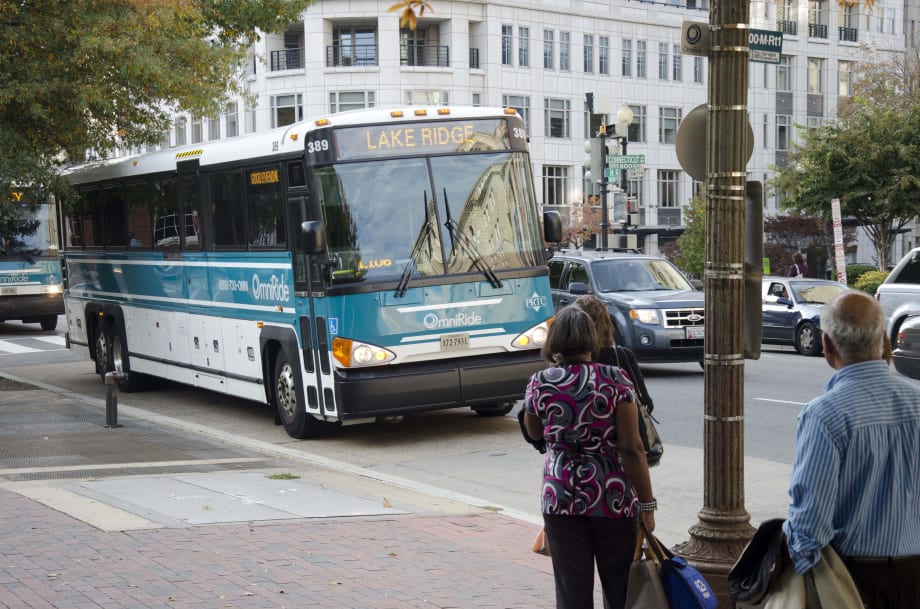
Motor Coach Industries (MCI), a subsidiary of New Flyer Industries Inc., will deliver five 2016 Commuter Coaches to Woodbridge, Va.’s Potomac and Rappahannock Transportation Commission (PRTC) to serve its OmniRide express routes. The coaches are set to arrive at the end of the year.
PRTC will mark its milestone 30th year in operation with a free community celebration from 11:30-4 p.m. Saturday, Oct. 8 at the PRTC Transit Center featuring family friendly entertainment, bus excursions, food trucks and ice cream with opportunities to support local charities.
”We’re always looking for ways to attract more non-drivers who want the frequency, dependability, safety and comfort our service provides,” said PRTC Interim Executive Director Eric Marx, noting that expansion of the region’s high occupancy lanes is driving transit expansion. Marx said PRTC is focused on “improving service while creating a modern-day system that makes transit attractive to everyone. We want to remain a cut above all other alternative modes of transportation.”
MCI’s latest Commuter Coaches will replace retirement-age equipment on its OmniRide routes, which play a critical role in transporting public- and private-sector employees to Washington, D.C., the Pentagon, and the surrounding employment core.
PRTC first took delivery of 38 MCI Commuter Coaches in 2002. With delivery of the five new coaches later this year, PRTC will have 99 MCI Commuter Coaches in its 152 vehicle fleet. All PRTC vehicles feature the latest technology to improve safety, operations, route planning, and customer satisfaction. PRTC pioneered transit GPS tracking in the U.S. and today applies TransTrack System’s data analytics package to monitor on-time performance and ridership by trip, bus stop and route to capture trends.
Features on the new 45-foot MCI Commuter Coaches include electronic stability control, 57 comfortable forward-facing seats with three-point passenger seatbelts, Trapeze TransitMaster mobile data terminals, automated stop announcements, and automatic passenger counters.
Passenger amenities include overhead parcel racks, personal reading lights, airflow controls, and a kneeling feature to lower the bus for boarding and alighting. With a reliability record that’s unmatched, the model is powered by Cummins ISX clean-diesel engine for low emissions, and is engineered with an air-ride suspension for a smooth, confident ride at highway speeds.
More Management

METRO Opens Submissions for 2026 Motorcoach Awards
Nominations are now being accepted for METRO Magazine’s Operator of the Year and Innovative Operator of the Year awards.
Read More →
New York MTA Advances Final Contract for Second Avenue Subway Expansion
Contract Four is the largest in the Second Avenue Subway Phase 2 project and includes construction of station infrastructure, tracks, and signals for the subway expansion, MTA officials said. Work on Contract Four will begin in 2027.
Read More →
Transit Agencies Highlight Safety Gains at National Summit
Leaders from 15 major transit systems shared crime-reduction results and safety initiatives while discussing the role of continued federal support.
Read More →

NITA Names New Leadership, Expands Reduced-Fare Program at First Board Meeting
The new regional transit authority appointed its first board chair and interim executive director while extending reduced fares across CTA, Metra, and Pace for eligible riders.
Read More →
Beyond the Checklist: A Structured Approach to Transit Maintenance
Reliability-Centered Maintenance helps transit agencies move beyond routine checklists to focus limited resources on the assets and failures that have the greatest impact on safety, reliability, and service.
Read More →
APTA 2026 Nominating Committee Selects Leadership Slate, Names Chair and Vice Chair Nominees
Leadership changes will help shape the association’s priorities and its representation of the transportation industry during the 2026–2027 term.
Read More →
DART Launches Major Security, Fare Enforcement Initiative
The 90-day demonstration will deploy coordinated security teams at five light rail stations while testing controlled access and gathering data to guide future investments.
Read More →
Advancing Fare Collection Through Technology and Innovation
Learn about delivering 1300 gates at 91 stations while managing fare evasion. Explore the large scale deployment, solution customization and real-world results that affect the region. Prepare for deployment in your region now.
Read More →
Game Day in Motion: Moving Millions During the 2026 World Cup
Between packed transit stations and team motorcoaches, see how agencies and operators across North America tackled the transportation demands of the 2026 FIFA World Cup.
Read More →
Surface Transportation Extension Averts Shutdown, Leaves Transit Funding Gap
The stopgap keeps federal transportation programs moving, but missing advance funding could complicate the transit and rail projects agencies are planning next.
Read More →