




Dig Deeper: Best (and Worst) Cities for Commuting on Public Transportation in the U.S.
The Most (& Least) Affordable Cities for Public Transit
In the wake of the increase in New York, where a monthly unlimited pass now costs $121, a new analysis shows the affordability of more than 70 transit systems across the U.S.
March 28, 2017
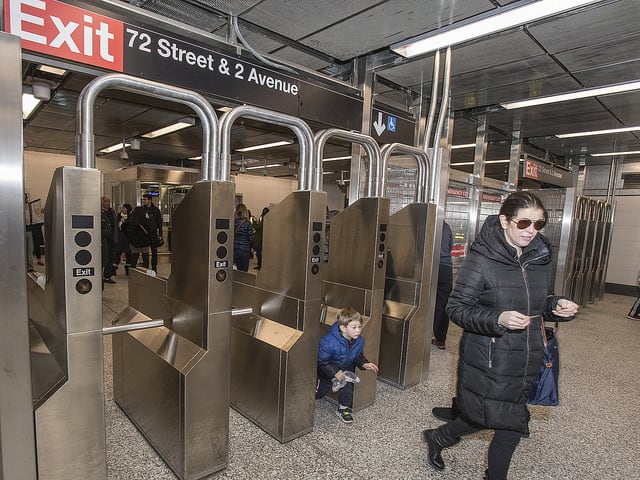
Encompassing cities large, small and mid-sized, the analysis considered not only the cost of fares (calculation based on the least-expensive monthly pass) but how deeply that expense cut into the average income of the city’s transit commuters.
Photo: Metropolitan Transportation Authority/Patrick Cashin
3 min to read
Transit systems across the country are feeling financially squeezed, and many are passing the pain along to riders through fare hikes.
New York’s Metropolitan Transit Authority, the nation’s largest system, has just raised the cost of its monthly passes, the second such increase for the city's straphangers in two years. The Metro in D.C. will raise rates on July 1, and some other systems across the country are considering following suit over the course of the year.
In the wake of the increase in New York, where a monthly unlimited pass now costs $121, Value Penguin analyzed the affordability of more than 70 transit systems across the U.S.
Encompassing cities large, small and mid-sized, the analysis considered not only the cost of fares (calculation based on the least-expensive monthly pass) but how deeply that expense cut into the average income of the city’s transit commuters.
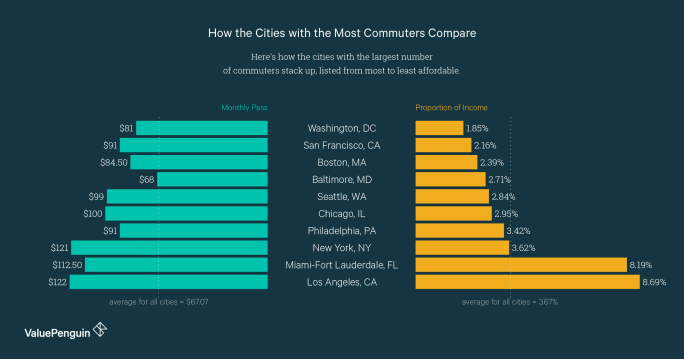
Both the cost of passes and incomes ranged widely from city to city, leading to big differences in how much of the average commuter’s paycheck goes towards taking the bus or train to work.
New Yorker Commuters Pay More and Make More
Despite this month’s hike in costs, New York isn’t the least affordable place to take the bus or train among the cities with the most transit commuters.
As the chart below reveals, it’s edged out for that dubious distinction by Los Angeles and Miami, where the least expensive monthly passes ($122 and $112.50, respectively) are well above the $67 average for all cities, and represent more than 8% of the average commuters’ income.
A pass in New York is similarly pricey, but the city’s straphangers have higher incomes than transit commuters in most cities. Consequently, that $121 MTA pass represents only 3.62% of their average monthly income--less than half the bite of buying a pass in Los Angeles and Miami and only a little above the national average of 3.2%.
In affordability, then, New York ranks in the middle of the pack among all the cities we analyzed; see the full list at the bottom of the article.
Where Commuting Takes The Biggest Financial Bite
There’s no single factor driving why cities made our least-affordable list. As the graphs below (which are organized by city size) reveal, some cities are relatively unaffordable because commuters who make far less than New Yorkers are forced to pay New York-like prices.
Examples include Cleveland, Portland, Atlanta, and Denver, where passes cost $100 or close to it. Other cities have below-average costs, but their commuters are notably poor; examples include El Paso, Springfield, Mass., and Dayton, Ohio.
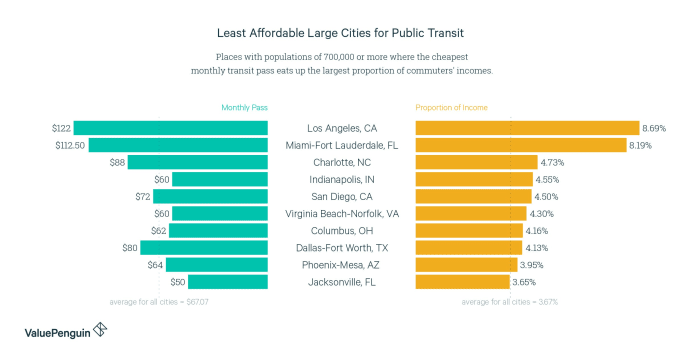
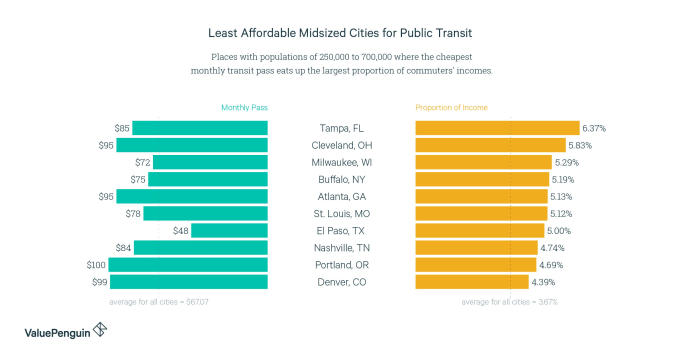
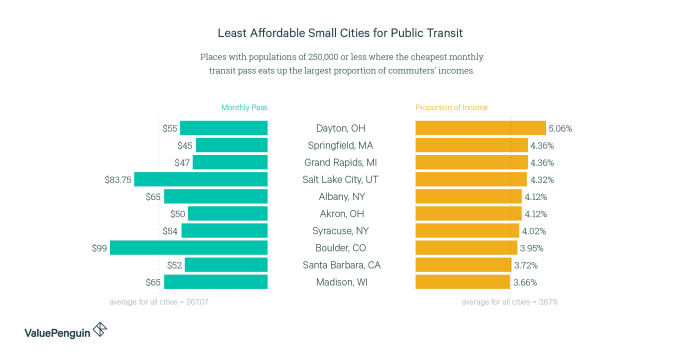
A note about classifications in the city-size graphs below. Cities are classified by the population living within city limits, which means a few centers where the city itself is notably small but is surrounded by a sprawling metropolitan area may appear to be in the wrong category. (For example, Salt Lake City has a city population of about 150,000, and a metro one of about 1 million.)
Where Taking The Bus Or Train Is Easiest On The Pocketbook
In the most affordable cities for commuters overall, riders ponied up between about 1% and 2% of their incomes.
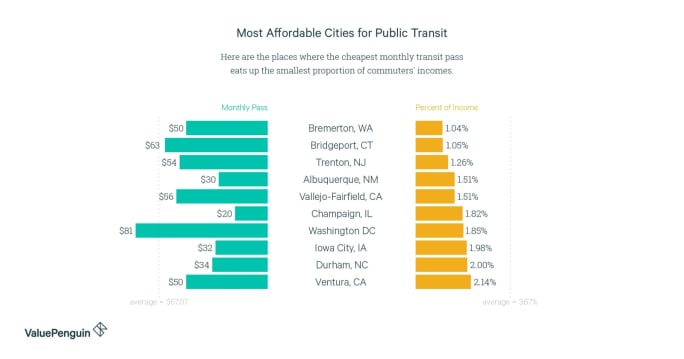
Only one big city made the list — Washington, D.C., which is another major center whose consumers are fairly affluent. The top three cities of all for affordability--Bremerton, Wash., Bridgeport, Conn., and Trenton, N.J. — were also fairly wealthy, but had relatively moderate costs for passes within the city.
Most of the others in the top 10 for affordability, including Albuquerque NM and Durham, N.C., were low to middling in affluence, but benefit from passes that cost less than half the national average — generally only $20 to $30 or so.
More Management
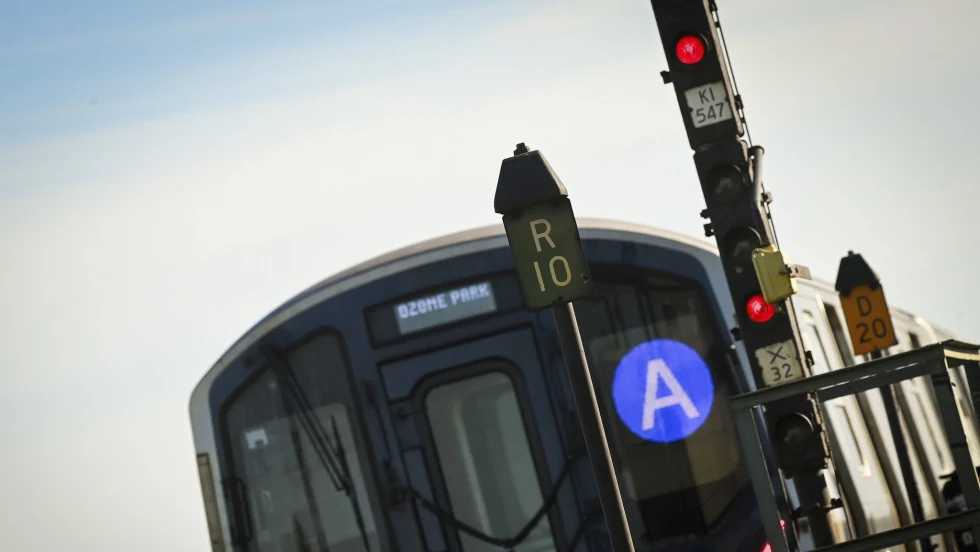
New York MTA Launches Historic $1.9B Signal, Track Modernization Project
Funded in part by congestion pricing revenue, the project will replace nearly century-old signals along the A and C lines in Brooklyn and Queens.
Read More →
Brian Dickson on Building Stronger, More Resilient Transportation Organizations
Bus Business Consultants Founder Brian Dickson discusses the leadership principles, operational discipline, and strategic planning that separate transportation companies positioned for long-term success from those stuck in survival mode.
Read More →
LA Metro Breaks Ground on Vermont BRT Project
The 12.4-mile corridor is projected to serve 66,200 daily riders, reduce travel times by up to 24%, and create the nation's busiest bus rapid transit corridor.
Read More →
Building Stronger Leaders, More Resilient Transit Teams
Dr. Carol Parker Walsh discusses leadership development, employee retention, workplace culture, and preparing transit’s workforce for AI and automation.
Read More →
Roman Cornell on ABC Companies’ Evolution and the Future of Passenger Transportation
The company’s CEO discusses carrying forward a third-generation family legacy, ABC’s continued evolution in passenger transportation, support for increasingly complex fleets, and how technology and continued investment could help operators improve uptime.
Read More →
CATS Launches West Charlotte Microtransit Zone, Expands Transit Services
The new microtransit zone connects residents to key destinations as Charlotte Area Transit System rolls out the first phase of its 2055 Transit System Plan.
Read More →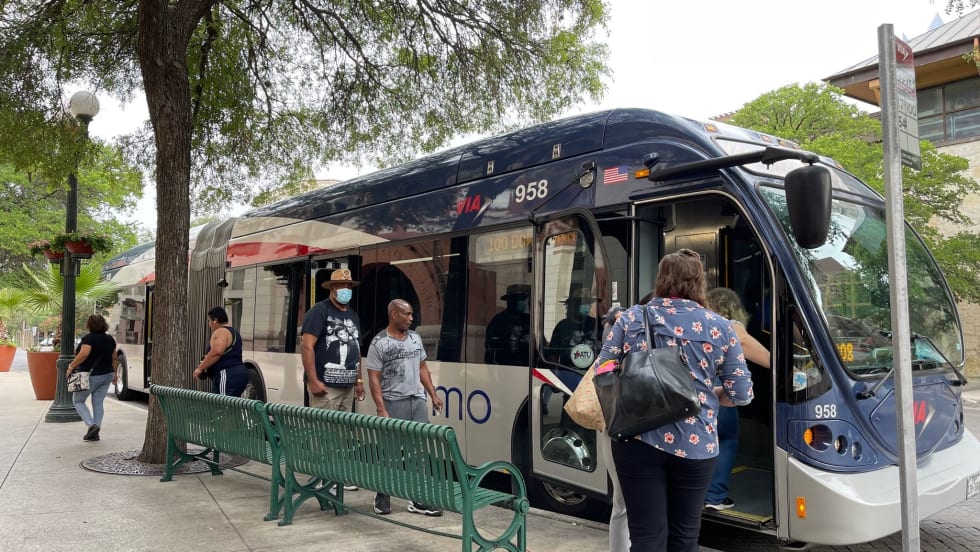
VIA Bus Ridership Grows 10.1% Through August 2026
San Antonio's VIA Metropolitan Transit reported the highest bus ridership growth among major Texas transit systems. Federal Transit Administration data ranked it second among the nation's 50 largest transit systems.
Read More →
CSA Group Releases Climate Resilience Standard for Transit, Passenger Rail
Developed with support from the Standards Council of Canada, CSA D700 guides assessing climate-related risks and planning adaptation measures for transit and passenger rail systems.
Read More →
ETA CEO John Maglio on Transit Technology, Innovation, and Building Agency Trust
ETA founder and CEO John Maglio explores the evolution of transit technology, the importance of reliable systems, and how stronger partnerships can help agencies improve operations and the passenger experience.
Read More →
COTA Launches First Customer Experience Action Plan to Improve Transit Service
The new plan outlines improvements to service reliability, accessibility, communication, and the overall rider experience across Central Ohio's transit system.
Read More →