




RELATED: San Joaquin RTD opens first all-electric BRT route in U.S.
Cleveland RTA partners with medical group to rebrand key route
Revenue from the MetroHealth Line sponsorship will be used to upgrade landscaping and bus stations along the route.
September 21, 2017
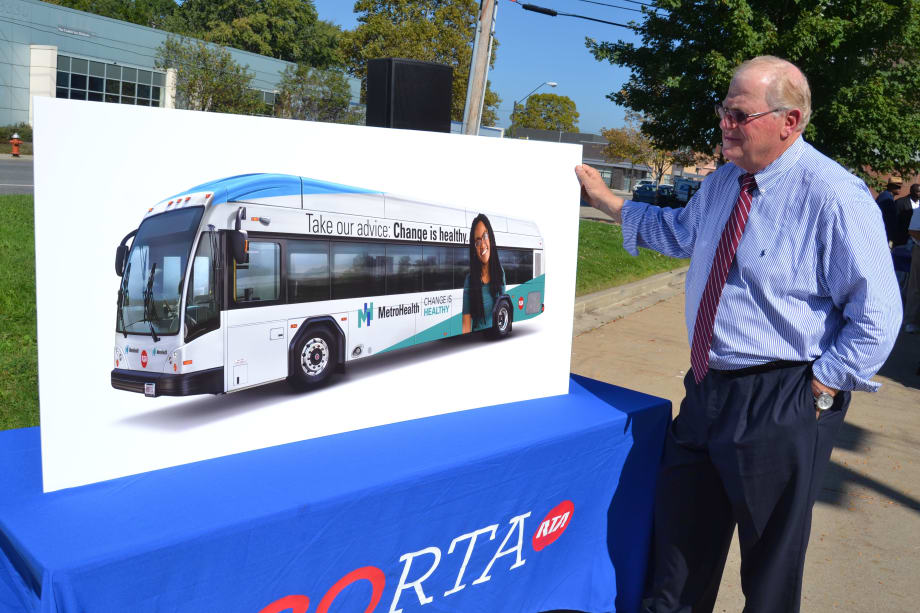
Greater Cleveland RTA CEO/GM Joe Calabrese checks out the rebranded vehicle imagery. Photo: GCRTA
2 min to read
Greater Cleveland RTA CEO/GM Joe Calabrese checks out the rebranded vehicle imagery. Photo: GCRTA
The Greater Cleveland Regional Transit Authority (RTA) today announced a new partnership with the MetroHealth System to rebrand one of its top routes.
Beginning this fall, the rebranded route 51 will offer commuters an upgraded ride on 20 new, specially designed vehicles fully branded with the MetroHealth logo. More than 400 bus stop signs and 37 shelters will also display the new logo along the routes.
The 51-A, 51-B and 51-C operate more than 200 bus trips per day and link the MetroHealth campus with both Downtown Cleveland to the north and the neighborhoods and suburbs to the south. MetroHealth has five health care facilities along the route.
“The number 51 bus route serves the West 25th Street Corridor and is among the most popular routes in the RTA system. It serves 2.1 million customers each year,” said RTA CEO/GM Joe Calabrese.
“Most of the routes run 24/7 and have the second-highest bus ridership in the RTA system, second only to the HealthLine,” Calabrese said.
Revenue from the MetroHealth Line sponsorship will be used to upgrade landscaping and bus stations along the route.
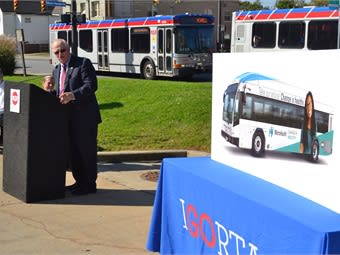
In 2008, RTA became the first transit system in the nation to sell naming rights sponsorships to its assets. Photo: GCRTA
RTA is also working with the funders, the City and the neighborhoods to add some exclusive rush-hour bus lanes and traffic signal prioritization, with the goal to make the MetroHealth Line faster and more reliable.
In 2008, RTA became the first transit system in the nation to sell naming rights sponsorships to its assets. That was for the HealthLine, Cleveland's inaugural BRT line, one of the first of its kind in the nation.
“Since its launch, the HealthLine has seen annual ridership increase by 60 percent and has generated more than $6.3 billion in economic development along Euclid Avenue,” Calabrese said.
In December 2014, RTA launched the Cleveland State Line BRT service, serving Downtown and several West Side communities. Since then, ridership has almost doubled.
More Management

LIT Marks 10-Year Milestone at Annual Summit
Hosted by the COTA from September 10 to 13, the Summit carried the theme “Celebrating 10 Years of Excellence, Leadership, and Impact,” with every part of the program honoring the people, agencies, and partners who built LIT over its first decade.
Read More →
People Movement: Dan Dipert Coaches Adds Third-Generation Leader, Keolis Names New Valley Metro VP/GM, and More
In this edition, we also cover recent appointments and announcements at the Wabtec, SilverRide, HNTB, and more, showcasing the individuals helping to shape the future of transportation.
Read More →
METRO Opens Submissions for 2026 Motorcoach Awards
Nominations are now being accepted for METRO Magazine’s Operator of the Year and Innovative Operator of the Year awards.
Read More →

New York MTA Advances Final Contract for Second Avenue Subway Expansion
Contract Four is the largest in the Second Avenue Subway Phase 2 project and includes construction of station infrastructure, tracks, and signals for the subway expansion, MTA officials said. Work on Contract Four will begin in 2027.
Read More →
Transit Agencies Highlight Safety Gains at National Summit
Leaders from 15 major transit systems shared crime-reduction results and safety initiatives while discussing the role of continued federal support.
Read More →
NITA Names New Leadership, Expands Reduced-Fare Program at First Board Meeting
The new regional transit authority appointed its first board chair and interim executive director while extending reduced fares across CTA, Metra, and Pace for eligible riders.
Read More →
Beyond the Checklist: A Structured Approach to Transit Maintenance
Reliability-Centered Maintenance helps transit agencies move beyond routine checklists to focus limited resources on the assets and failures that have the greatest impact on safety, reliability, and service.
Read More →
APTA 2026 Nominating Committee Selects Leadership Slate, Names Chair and Vice Chair Nominees
Leadership changes will help shape the association’s priorities and its representation of the transportation industry during the 2026–2027 term.
Read More →
DART Launches Major Security, Fare Enforcement Initiative
The 90-day demonstration will deploy coordinated security teams at five light rail stations while testing controlled access and gathering data to guide future investments.
Read More →
Sponsored•September 9, 2026
Advancing Fare Collection Through Technology and Innovation
Learn about delivering 1300 gates at 91 stations while managing fare evasion. Explore the large scale deployment, solution customization and real-world results that affect the region. Prepare for deployment in your region now.
Read More →