



EXCLUSIVE: The rollout of contactless ticketing in Europe
One of the basics in any transport system is ticketing. Efficiently collecting payment remains at the core of the role of most operators.


Oyster validator photo via TfL.

Oyster validator photo via TfL.
The world of transport continues its unprecedented rate of turbulence and change. This includes new business models, services, and globalization of ideas. Meanwhile, the basics of providing a reliable, safe, and efficient daily transport system in our communities is even more important to defend existing investments and allow our communities to function and prosper.
One of the basics in any transport system is ticketing. Efficiently collecting payment remains at the core of the role of most operators. This area has gone through rapid innovation in the last few years in most cities, and many operators have moved from cash to tickets with some form of visual inspection, magnetic tickets, in many cases SMS or barcodes, with many also deploying smart devices at present. This evolution continues.
This article briefly summarizes some of the recent progress in Europe and the pending trends for the industry.
London introduced smart cards just after the year 2000 and contactless ticketing in 2014. Based on earlier progress in cities such as Hong Kong with its Octopus card, London mapped out an early and long-term strategy to bring smart ticketing to its Underground network, and then, across all Transport for London (TfL) controlled public transport in the city, followed by London operating national rail services. This would offer Londoners a fully-integrated ticketing experience, simplify travel for the consumer, and provide a much lower cost ticketing solution for TfL. While the initial model was based on TfL’s own Oyster card product and technology, supplied by Cubic Transportation, it was realized that the longer-term strategy should be to move to a standardized banking solution that could be used with bankcards, as well as other devices, in particular, mobile phones. This was a bold strategy and required TfL to influence the UK, and international banking and payment industries, to adopt “contactless card” standards that would be appropriate for the low value, high frequency nature of public transport, as well as the hostile physical environment of the transport system fare gate. This was a challenging and long-term task for a large organization such as TfL and would have probably been outside of the realistic capabilities of most other transport providers. It should be remembered that public transport is the most-used mode of travel in Greater London and dominates much of the physical infrastructure and public spending in transportation. Public transport is also a very attractive brand for marketing and trend-setting purposes and this is particularly the case for London Underground. Thus, the banking and mobile phone industries were keen to be working with TfL on this program.
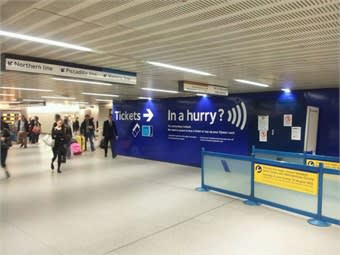
Ticketing halls in London Underground.
Giles Bailey
Replicating TfL model
TfL’s capabilities and progress have not been readily replicated across the UK’s other cities or many other locations around Europe.
London’s public transport ticketing system is extremely well-regarded by Londoners and visitors to the city and has very high customer satisfaction scores. This is the result of a well-funded and well-managed program. Across the rest of the UK, the London solution is well-known, and in many cities, some form of replication of the service is usually desired. This has proven to be problematic for a number of reasons. Briefly, these include: a deregulated bus industry outside of Greater London that complicates single pan-urban area ticketing products; up until recently the lack of citywide authorities to develop, implement, and support multimodal ticketing; regional rail systems that while a very important means of transport in many cities concentrated on regional and national transport needs and were responsible to national government rather than local urban areas; the inability to agree and implement a long-term business case and product that fundamentally provided customer benefits — along with business benefits — that would take many years to come to fruition. In fact, London’s transport funding settlement from the national UK government is so radically different, and higher, than other UK cities it almost has precluded the development of a comprehensive multimodal ticketing solutions in other UK cities.
A national UK standard for smart card technology has been developed and introduced and many of the concessionary ticketing products across the country have been moved to these types of cards. In addition, the national ITSO standard is regularly seen, if not regularly used, on national rail services in cities around the country.
However, the overall integrated multimodal public transport ticketing product is someways off in most of the UK. This product would: offer best value across all modes in a city; not need to be necessarily pre-loaded with value; would already be in your pocket/wallet before arrival in the city; and is supported by full online and offline customer service throughout your journey.
However, progress has been made more widely in cities across Europe. Most European cities offer an integrated public transport solution of local bus services and various higher-capacity modes. In medium- and larger-sized cities, this typically includes a light rail or tram service. These services are sometimes historically continuous and have operated since the 19th century, with more recent updates to service and equipment, or are as a result of a completely new or rebuilt light rail service implemented over the last few decades. In addition, many of the larger cities have implemented heavy rail systems. National heavy rail systems, which often cater to interurban as well as intra-urban demand, are usually managed by a national government service monopoly, although, EU policy is to encourage competition or franchising for these services through a public sector authority with regional input. Cities are also considering, encouraging, or supporting new mobility solutions, such as bike-sharing, car- and ride-sharing, walking policies, and more.
Looking to the multimodal future
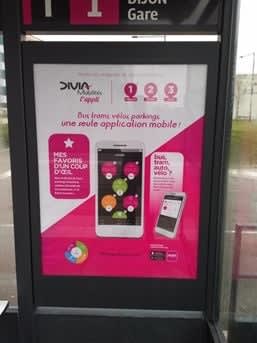
Integrated transport options poster in Dijon, France.
Giles Bailey
The above situation is relevant in order to give a basis for which renewed ticketing systems are being considered by cities across the continent. The new or, renewed light rail services, or a major investment in a comprehensive bus network, are being used as the ideal point to fundamentally redesign ticketing solutions and offer integrated smart card products.
Examples are numerous, but would include Dijon, France. A medium-sized city in eastern France, Dijon has a recently built tram system, comprehensive local bus network, cycle hire, and commuter parking, as well as regional rail services provided by SNCF. Linking these services together, with the exception of national rail, is a multimodal smart card scheme.
In some cities the new ticketing solution has not been focused on smart cards, but on smartphones and SMS/barcode/QR code ticketing. This is particularly the case in Scandinavia. The SMS products were earlier to arrive to the market, and in some ways like “contactless” bankcards, took advantage of the widespread customer pre-investment in a ticketing device — the smartphone. And, thus were relatively low cost and quick to deliver to the market. Examples of this strategy can be seen in Oslo, Norway and Helsinki, Finland.
Bar codes are also increasingly seen by the national and regional heavy rail operators as a lower cost, more efficient means of providing some “online” ticketing products. This technology is widely seen on, for example, SNCF and Deutsch Bahn.
In some cases, the debate about transport ticketing has moved away from the city-based solution to a single national ticketing platform that can be interchangeably used in any city, or rural area, for all modes of public transport. This solution in seen, for example, in The Netherlands, via OV-Chipkaart, and in Denmark, via Rejsekort. While potentially very customer focused in design, these types of national systems are by their nature complicated to deliver and support, due the range of stakeholders and user cases involved. These types of solutions would preclude for the short term detailed discussions about wider partnerships with alternative smartcard providers. However, this ambition could still be a longer-term ambition.
Most cities are taking the view that transport ticketing is still a city-delivered product that sits within the public transport (or transport) realm. The broad-based move to a range of industry-provided ticketing platforms is rare, with the possible exception of the above mentioned SMS solution. This is somewhat odd considering the success and praise that London has experienced following its contactless ticketing strategy.
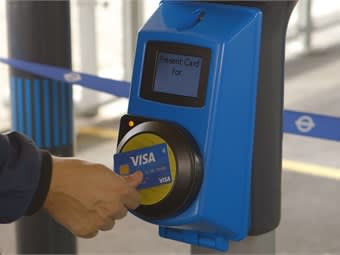
MasterCard, Visa, Apple, Samsung, and more have been active over the last few years in developing and promoting their cards and devices as enablers of a more seamless, efficient, and connected world.
Photo Courtesy Visa
Partnering
The role of the banking industry and/or the telecoms industry working with smartphone manufacturers in bringing the next wave of innovation to transport payments needs to be considered. MasterCard, Visa, Apple, Samsung, and more have been active over the last few years in developing and promoting their cards and devices as enablers of a more seamless, efficient, and connected world. This world would do away with the costs of managing cash. Technologically-enabled services would be used to perform tasks such as topping up balances on the go or providing a consolidated payment account for the user, as well as route planning, journey status, and general communications. In addition, the system providers argue that they can lower the cost of ticket management for the transport industry versus cash, as well as local proprietary ticketing systems.
The suppliers have been seen widely at transport industry events learning about the detailed needs of cities and advocating for their role in providing seamless, wide-scale, multimodal ticketing for public transport that avoids the need to pre-purchase a local ticketing product. They also strongly support and advertise the popularity and success of the London solution.
The world of mobility is changing, and potentially changing faster than we have seen in our business lifetimes. New players and solutions are coming into the marketplace, while we are also trying to maintain the relevance of existing investments. This inevitably means challenging reviews of ticketing products and strategies. Does this mean an inevitability of London-type contactless solutions in public transport? While probably not, it does mean that ticketing solutions that attempt to “ring fence” the user in a selected group of modes in the public transport world will be challenged by consumers, who otherwise experience and expect seamless portability in a digital and connected world.
Giles K. Bailey is a director at Stratageeb Ltd., a London-based consultancy assisting businesses think about their strategic vision and innovation.
More New Mobility

From Hardware to Digital Partner: Luminator Charts Its Next Chapter
CEO Magnus Friberg discusses Luminator’s shift toward becoming a digital partner, the growing importance of software and interoperability, and how AI can help agencies improve operations and passenger experience.
Read More →
Biz Briefs: Alstom Lands Canadian Contract, LYT to Supply California TSP, and More
In METRO's latest installment, we take a look at recent news from Complete Coach Works, Beep, FlixBus, and more partnerships making headlines across the transportation sector.
Read More →
CharterUP’s Armir Harris on Technology, AI, and the Future of Group Mobility
In a recent episode of METROspectives, CharterUP Founder/CEO Armir Harris discussed the company’s evolution from an online charter bus marketplace into a technology platform supporting public- and private-sector mobility and much more.
Read More →
Jacksonville’s NAVI Project Charts a New Course for Autonomous Public Transportation
Through its NAVI program, JTA is showing how autonomous vehicles, intelligent infrastructure, and coordinated operations can work together to deliver everyday public transportation.
Read More →
Biz Briefs: Luminator Marks Milestone and More
From manufacturers and suppliers to transit agencies and motorcoach operators, these updates offer a snapshot of the projects, partnerships and business moves driving the industry forward.
Read More →
New Tricks for Old Bureaucracies: Joshua Schank on Making Transit Innovation Stick
Former LA Metro Chief Innovation Officer Joshua Schank discusses why good ideas aren't enough, how transit agencies can overcome resistance to change, and why today's challenges demand more innovation.
Read More →
How DART's GoPass Is Redefining Regional Mobility
Serving 14 transit agencies, GoPass simplifies multimodal travel by allowing riders to plan, pay for, and manage an entire trip through one app.
Read More →
Biz Briefs: OCTA Taps Clean Energy for Hydrogen Station, Stadler to Supply Via Rail Vehicles, and More
From manufacturers and suppliers to transit agencies and motorcoach operators, these updates offer a snapshot of the projects, partnerships and business moves driving the industry forward.
Read More →CharterUP Expands Into New Mobility and Autonomous Transportation
Vice President of New Mobility Stephen Joos discusses how CharterUP is leveraging its nationwide transportation network, technology platform, and autonomous vehicle partnerships to expand into workforce mobility, campus shuttles, and transit solutions.
Read More →
METRO Magazine Announces 2026 Innovative Solutions Awards Winners
Projects Recognized for Advancing Mobility Through Technology, Accessibility, Workforce Innovation, and Operational Excellence
Read More →