



What Motorcoach Operators Need to Know about Web Responsiveness
Mobile devices are surpassing PCs in popularity, becoming the new method for customers to access information about your operation. Responsive web design ensures customers using mobile devices get quick, easy access to all the information on your site.



Smartphones and tablets are everywhere now, requiring motorcoach operators to be certain their websites are as accessible as possible to every customer and potential customer. In response, some carriers are taking the next step and making their websites responsive to be easily read on mobile devices.
According to Internet news blog Mashable, 2012 was an “unusual year in the PC market” because “For the first time since 2001, PC sales are projected to be lower than they were in the previous year.” Consumers are instead purchasing tablets. Tablet sales are expected to exceed 100 million this year. Additionally, according to Nielsen, the majority of U.S. mobile subscribers now own smartphones.
Responsive Web Design (RWD) is the process of creating websites that provide optimal viewing — including reading and navigation with the user having to do very little to adjust their screen, such as resizing, panning and scrolling.
Upgrading to RWD makes it easier for the growing number of customers and potential customers using mobile devices to access your website, especially since most of them are starting their product and service research online, according to Eric Elliott, GM of bus operator and travel provider directory BusRates.com.
“[The majority of] consumers now start everything they do online before they even call,” he says. “[Your] website…gives your customers the ability to see who you are, so when they call you, they’re more of a pre-qualified customer to you, as opposed to just giving you a call, asking questions and requesting pictures.”
That means operators need to develop different, optimized views of their sites on iPhones, Androids and tablets — even views for laptop or desktop monitors of different sizes — to make sure customers are getting to view site in ways that are optimal for them.
Development
BusRates.com is currently in the process of “reskinning,” or, updating the graphical look and feel, of its website, Elliott says. That includes rebuilding it from multiple platforms to implement RWD. The site will be responsive in about four months.
CodeGreen Development built the current BusRates.com website and is adding RWD. David Schohl, partner, CodeGreen, says that the upgrade improves search engine optimization (SEO), getting the operator a higher search ranking, for example, in Google search results. That also lowers the bounce rate.
BusRates and CodeGreen came up with a plan for a responsive site design and created an app for Apple iOS users. Part of that entailed using PhoneGap, an open source framework used to create mobile apps, which allows users to download a free app version of the BusRates site through Android or Apple’s iTunes marketplace. Whether accessing BusRates through the app or going directly to the responsive site, it is the same experience, increasing the usability.
Currently, the BusRates website displays appropriately on a smartphone, but there isn’t anything customized to that device, Elliott explains.
Now, BusRates is in the wireframing phase, which Elliott likens to creating a storyboard or blueprint.
“We’re figuring out what a normal screen resolution is going to be for a basic website visit,” Elliott explains. “From there, [we’ll] design the smartphone, tablet, and website [views and] experiences. If you’re on a lesser or a higher resolution, the goal is to make each user, no matter how they access your site, have the most optimal experience.”
The wireframe phase ensures that the layout of the website is correct. Schohl describes it as stackable black boxes that define where various pieces of information will go. That happens before the design phase, which includes making sure the brand is correct and focusing on the most important aspects, such as the search.
“We want to make sure, in the wireframe, from an architecture standpoint, that the search is in a predominant spot, and [in] the design, the users’ eyes go there,” Schohl says.
For operators looking to start the RWD process, Schohl says the first step is to take the time to carefully choose a developer. Make sure they have examples of previous work to share and a strategy for building the website.
Second, he urges, to make sure your site has well-written copy. “Otherwise, the website is not going to do well in the search engine. People are not going to read it,” Schohl says.
Elliott advises other operators to employ RWD as soon as possible, given the number of users who are starting their research for products and services through mobile devices.
He adds that it’s better to build a website with five or 10 very sound pages that are completely filled out and have good photos of the operator’s vehicles, than to have 20 or 30 pages.
“If you’re going to create a page, provide the information so the user can really understand who you are, because it all works into that pre-qualification and pre-selling process before they even call you,” he says.
Cost
The cost to implement RWD is based on the level of functionality the company chooses. A basic “brochure” website, with just the company overview and its buses, for example, runs at about $5,000, Schohl says.
Operators should expect to pay between $5,000 and $10,000 to work with a company to build a site that meets their requirements to grow their business and achieve their goals.
“You have a lot of companies who think they can get something for $2,500 to $7,000, but just seeing that work, as opposed to people spending $5,000- to $10,000-plus, it really is night and day as far as what the product ends up being,” Elliott adds. That range provides a responsive site that has a good format and customized design and strategy to make sure companies are able to generate more business and leads, and have something they’re really proud of, Schohl says.
“Certainly, you could do a responsive Wordpress template, for $500,” Schohl says. “Is that really going to work for you? You get what you pay for.”
In terms of staffing, typically, one or two people are all that is needed. The timeline is generally three to four months, but for some bus operators, who are just looking for a Web presence with about five or six content pages and a simple design, they can roll out a redesign in about one to three months.
“BusRates is a large website, compared to, say, a mom-and-pop operation running two buses, that is not going to do any scheduling or anything online,” Schohl says. In that case, a brochure website may be the best way to go.[PAGEBREAK]
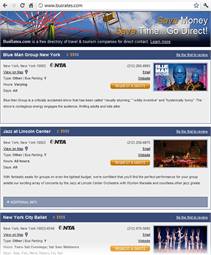
A responsive website can generate more leads and revenue since more people will have quicker access to it. BusRates.com is in the process of making its website responsive.
ROI
A responsive website can generate more leads and revenue since more people will have quicker access to it. It will also end up saving money in the long run if an operator already has a mobile-friendly site, similar to BusRates.
To ensure a bump in business and leads, each version of the site should also have the same, most up-to-date content, so there’s no concern about customers viewing one version of it and not getting the right information, or leaving because they didn’t get the information they needed, or the format was difficult to access.
“You’re going to get more people being able to use the website effectively and improve search engine optimization, [if you] have the same content no matter what view [they’re using,]” Schohl says.
Additionally, because a responsive site is modularly built, it’s easier to make additions, such as a Facebook module or Twitter feed, making it more flexible for updating, he adds. “Before, you might have been locked into a very strict architecture. The responsiveness makes it a more fluid site,” Schohl says.
Post-rollout
While the RWD process was easy with support from the company that handles its advertising, it’s important to stay on top of the process after the rollout, Maureen Penfold, director of marketing, VIP Tours of Portland, Maine, says.
Getting ahead of the curve by adding RWD, VIP optimized the website viewing experience for its users with mobile devices.
“For us, it’s all about having easy reading and navigation of our site,” Penfold says. “Whatever device somebody is using, it’s easy for them to find what they’re looking for.”
VIP had been hearing about RWD for the last couple of years, but was only recently able to set aside the time to learn how to utilize it. Staff members started looking into it last November and rolled it out for customers at the beginning of 2013.
“It wasn’t a very long process,” Penfold recalls. “The information is readily available, and there are a lot of companies now that offer services to help you.”
VIP used the multimedia company LocalEdge, Hearst Media Services Co., which had previously been its representative for phone books for the last few years but had since moved into digital media.
“We discussed their new option and decided to move forward with a new advertising package to take the place of our phone book ad,” Penfold says.
That includes a mobile website for optimized viewing, a landing page — a page that appears when a user clicks on a SEO-optimized search result or ad — and a video for VIP to put on its landing page to advertise specific tours. The operator uses the landing page to get its audience to find what it’s promoting with certain keywords.
VIP provided LocalEdge with photos and the most pertinent information for its customers to access phone numbers, key services and a way to submit quote requests.
The operator pays a monthly fee of about $225 a month for its service package.
After only a few months in use, the benefits are already apparent; VIP has seen a spike in the number of charters booked through the mobile website and landing page. Additionally, the operator can see which mobile devices the email inquiries are coming from.
The only challenge, Penfold says, was remembering to take the extra step to ensure the technology was working correctly, so customers weren’t submitting inquiries and then not getting responses. Customer email inquiries from the mobile site to VIP’s email inbox were getting lost for a couple weeks, she explains.
“We did miss a few potential leads [before] we realized we had an issue and worked it out.”
For other operators planning RWD, Penfold suggests taking the time to learn about and test the technology.
“[At first] we didn’t realize we weren’t getting mobile quote requests until we tried it out on our end and realized we weren’t getting the response in emails,” she recalls. “You have to test and understand what you’re working with to know that you’re not missing something,” Penfold says. “You have to get comfortable with it so you can work with your customers. The last thing any of us want to do is not get back to our customers. It’s all about having effective responses for [them].”
[PAGEBREAK]Tips for the RWD Process
Wondering where to start your RWD project? David Schohl, partner, CodeGreen Development, shares some tips here.
Review the developer’s experience and look at samples of their work. Also, make sure the websites are indeed responsive and not just being constricted. A responsive site should use the dimensions of the browser window, not the device itself.
Remember the return on investment. You can get a template site up and live for a few hundred to a couple thousand dollars. However, you will get what you pay for. Building a website, especially a responsive one, must have a solid strategy behind it. It also must have the view for each layout created specifically for the company. Otherwise, they are just using what worked for someone else but will not necessarily work for them. A website should achieve goals, including driving new leads and revenue opportunities. The best way to do that is make the investment and build the site correctly the first time.
Write good content with the mobile/smallest view in mind. Long content does not work on a mobile phone; it doesn’t work that well for larger versions either. Also, make sure the content is written according to best SEO practices.
Ask questions if you do not understand something.
If you choose to build a new website, make sure to keep evolving it, whether with content or new features. You do not want to have a stale website.
More Motorcoach

METRO Opens Submissions for 2026 Motorcoach Awards
Nominations are now being accepted for METRO Magazine’s Operator of the Year and Innovative Operator of the Year awards.
Read More →
Biz Briefs: Alstom Lands Canadian Contract, LYT to Supply California TSP, and More
In METRO's latest installment, we take a look at recent news from Complete Coach Works, Beep, FlixBus, and more partnerships making headlines across the transportation sector.
Read More →
Biz Briefs: RIPTA Unveils New Frontrunners, Clevland RTA Adds New Siemens, and More
In METRO's latest installment, we take a look at recent news from Siemens, Prevost, Dodge, and more partnerships making headlines across the transportation sector.
Read More →
People Movement: Holly Arnold Joins Transdev and More
In this edition, we also cover recent appointments and announcements at Pace, CamTran, MCI, and more, showcasing the individuals helping to shape the future of transportation.
Read More →
ABA Report: Motorcoach Travel Generates $161.6B Economic Impact
The 2025 analysis finds motorcoach travel supported nearly 900,000 jobs and generated $28 billion in federal, state, and local taxes.
Read More →
CharterUP’s Armir Harris on Technology, AI, and the Future of Group Mobility
In a recent episode of METROspectives, CharterUP Founder/CEO Armir Harris discussed the company’s evolution from an online charter bus marketplace into a technology platform supporting public- and private-sector mobility and much more.
Read More →
People Movement: ABC Names John Walsh as Chief Commercial Officer
In this edition, METRO also covers recent appointments and announcements at the DART, STV, and more, showcasing the individuals helping to shape the future of transportation.
Read More →
From Surviving to Thriving: Building Stronger Transportation Organizations
Bus Business Consultants founder Brian Dickson shares lessons on leadership, organizational health, and creating options for long-term success in a changing transportation industry.
Read More →
Biz Briefs: Luminator Marks Milestone and More
From manufacturers and suppliers to transit agencies and motorcoach operators, these updates offer a snapshot of the projects, partnerships and business moves driving the industry forward.
Read More →
ABAF Study Reveals Growing Insurance Crisis for Motorcoach Operators
Preliminary findings show 98% of operators faced premium increases over the past five years, while shrinking insurer participation is putting added pressure on businesses and customers.
Read More →