




RELATED: S.F. to charge employee shuttle operators to use public stops
S.F. Muni to restrict larger commuter shuttle buses, require greener fleet
The new regulations create an ongoing program that builds off an 18-month pilot set to expire at the end of January 2016. The fee charged to shuttle operators will increase to pay for stepped-up enforcement.
November 19, 2015
SFMTA
3 min to read

SFMTA
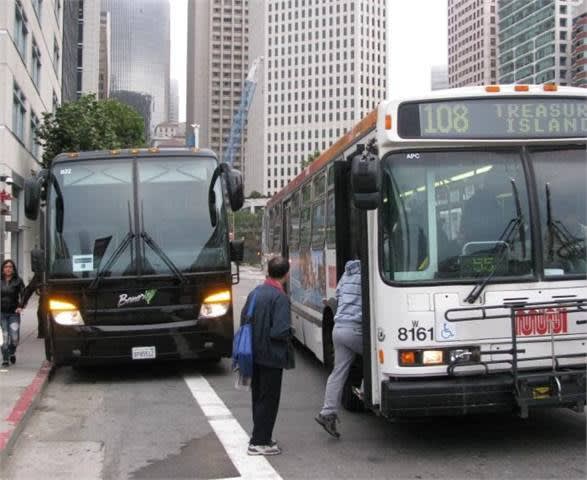
The San Francisco Municipal Transportation Authority (SFMTA) approved enhanced regulations for commuter shuttles that will restrict larger shuttle buses from smaller streets, require greener fleets to reduce emissions and put in place rules to prevent labor disruptions.
The new regulations create an ongoing program that builds off an 18-month pilot program set to expire at the end of January 2016. Under the ongoing program, the fee charged to shuttle operators will increase to pay for stepped-up enforcement. The higher fee will also help cover the cost of street improvements like boarding islands and sidewalk bulbs that will also improve Muni performance and enhance pedestrian safety.
Under state law, the fee is limited to the cost of running the program. The updated amount will depend on a number of factors, but it will be higher than the $2.4 million per year collected from shuttle companies under the pilot program.
In January 2014 the SFMTA Board of Directors approved an 18-month Commuter Shuttle Pilot Program to regulate and better understand the hundreds of commuter shuttles using the city’s streets to take people to work or school either in San Francisco or to Peninsula and South Bay destinations. The voluntary program included charging private shuttles to stop in Muni bus zones, concentrated enforcement and extensive data collection on the frequency and location of shuttle loadings.
Under the new regulations, which take effect February 1, 2016, commuter shuttles over 35 feet long must stay on Caltrans arterial street network.
All shuttle vehicles not already approved for use in the pilot as of January 31, 2016 must be either model year 2012 or newer, or be equipped with a power source that complies with emissions standards applicable to the 2012 class of vehicle. As of January 1, 2020, all shuttle vehicles used in the program must be model year 2012 or newer. After 2020, all shuttle vehicles must be no more than 8 years old.
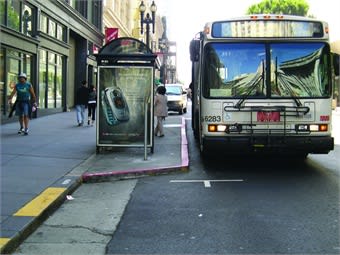
Photo courtesy NACTO.org
Shutt le operators must also comply with the San Francisco Board of Supervisors’ March 2015 Labor Harmony Resolution, including the submission of a Service Disruption Prevention Plan that describes the shuttle operators’ efforts to ensure efficient and consistent service in the event of potential disruptions, including labor disputes.
The new regulations also require increased data sharing from participating shuttle operators to better understand where their vehicles are operating and assist in enforcement.
An analysis of the pilot program found that conflicts with Muni buses were reduced by about 35% on a per-stop basis, and the number of commuter shuttle stop locations were halved from about 250 before the pilot to 124 during the pilot.
The analysis also found:
Shuttles in the permit program had about 17,000 daily boardings on average weekdays, or 8,500 people taking a daily roundtrip from or within San Francisco
Nearly half (45%) of shuttle rider survey respondents do not own cars
45% of those who do not own cars cited shuttles as the “main reason” they did not own one
If the shuttles are not an option, nearly half (47%) of survey respondents said they would drive alone to work. That would translate to almost 8,000 more one-way car trips a day, the equivalent of every car that uses 24th Street daily. That’s more than 2 million one-way car trips a year on what are already congested streets.
Only 5 percent of shuttle riders said they would move closer to work
By taking cars off the road, shuttles remove nearly 4.3 million vehicle miles traveled from the streets each monthWith limited exceptions, shuttles are free to use San Francisco’s streets regardless of an SFMTA regulatory program. The agency’s regulatory efforts are an evolving process that has and will continue to take into account community concerns.
With limited exceptions, shuttles are free to use San Francisco’s streets regardless of an SFMTA regulatory program. The agency’s regulatory efforts are an evolving process that has and will continue to take into account community concerns.
More Motorcoach

METRO Opens Submissions for 2026 Motorcoach Awards
Nominations are now being accepted for METRO Magazine’s Operator of the Year and Innovative Operator of the Year awards.
Read More →
Biz Briefs: Alstom Lands Canadian Contract, LYT to Supply California TSP, and More
In METRO's latest installment, we take a look at recent news from Complete Coach Works, Beep, FlixBus, and more partnerships making headlines across the transportation sector.
Read More →
Biz Briefs: RIPTA Unveils New Frontrunners, Clevland RTA Adds New Siemens, and More
In METRO's latest installment, we take a look at recent news from Siemens, Prevost, Dodge, and more partnerships making headlines across the transportation sector.
Read More →
People Movement: Holly Arnold Joins Transdev and More
In this edition, we also cover recent appointments and announcements at Pace, CamTran, MCI, and more, showcasing the individuals helping to shape the future of transportation.
Read More →
ABA Report: Motorcoach Travel Generates $161.6B Economic Impact
The 2025 analysis finds motorcoach travel supported nearly 900,000 jobs and generated $28 billion in federal, state, and local taxes.
Read More →
CharterUP’s Armir Harris on Technology, AI, and the Future of Group Mobility
In a recent episode of METROspectives, CharterUP Founder/CEO Armir Harris discussed the company’s evolution from an online charter bus marketplace into a technology platform supporting public- and private-sector mobility and much more.
Read More →
People Movement: ABC Names John Walsh as Chief Commercial Officer
In this edition, METRO also covers recent appointments and announcements at the DART, STV, and more, showcasing the individuals helping to shape the future of transportation.
Read More →
From Surviving to Thriving: Building Stronger Transportation Organizations
Bus Business Consultants founder Brian Dickson shares lessons on leadership, organizational health, and creating options for long-term success in a changing transportation industry.
Read More →
Biz Briefs: Luminator Marks Milestone and More
From manufacturers and suppliers to transit agencies and motorcoach operators, these updates offer a snapshot of the projects, partnerships and business moves driving the industry forward.
Read More →
ABAF Study Reveals Growing Insurance Crisis for Motorcoach Operators
Preliminary findings show 98% of operators faced premium increases over the past five years, while shrinking insurer participation is putting added pressure on businesses and customers.
Read More →