



NASA, Unimodal partner for advanced transport vehicle
Small vehicles running on elevated, maglev guideways,will eventually travel up to 150 mph and move 14,000 people per hour, both locally and regionally.


Photo courtesy Unimodal Systems LLC.
[IMAGE]SkyTran-full.jpg[/IMAGE]NASA officials have signed an agreement with Unimodal Systems LLC to collaborate on the use of NASA-developed control software and human factors techniques to evaluate acceleration, jerk and vibration of an advanced transportation vehicle system.
"The control software was originally designed to control robots and other applications. The collaboration will help NASA better understand the software's usefulness, human performance and safety. This collaborative effort is anticipated to help NASA with its aeronautics and space activities, while Unimodal gets to develop the next generation high-speed transportation system," said Jeffery Smith, deputy chief of the Entrepreneurial Initiatives Division at NASA Ames Research Center, Moffett Field, Calif. "NASA will receive valuable feedback from our systems software usage."
Per the agreement, Unimodal will contribute its SkyTran vehicle, currently located at NASA Research Park, and its advanced transportation technology; NASA will provide its Plan Execution Interchange Language (PLEXIL) and Universal Executive (UE) software to control the vehicle.
In the future, SkyTran will use small vehicles running on elevated, magnetically levitated (maglev) guideways, which distinguishes it from other railed systems. The vehicles are lightweight, personal compartments that can transport up to three passengers. Travelers board the pod-like vehicles and type their destinations into a small computer. Using intelligent control system software, SkyTran will run non-stop point-to-point service without interrupting the flow of traffic.
These vehicles will eventually travel up to 150 mph and move 14,000 people per hour, both locally and regionally. SkyTran will serve as a feeder system to other transit systems, such as BART and high-speed rail.
"SkyTran's personal rapid transit has generated serious interest with local, regional and state transportation leaders who are considering funding the building of the Unimodal maglev PRT system in the NASA Research Park," said Michael Marlaire, director of NASA Research Park at Ames. "This construction and new R&D partnership may usher a new green technology maglev PRT system into Silicon Valley."
"We're working with NASA and aerospace engineers to ensure aerospace-level standards that exceed the safety records of current transportation systems," explained Christopher Perkins, chief executive officer of Unimodal Systems LLC, based in NASA Research Park.
Both organizations will mutually benefit. NASA will receive feedback on its software's
usefulness in ground-based propulsion systems, while Unimodal will develop a
transportation system designed to eliminate traffic congestion, mitigate greenhouse gases and reduce dependence on foreign oil.
"For cities across the nation, SkyTran will create greentech jobs and launch a new era of public-private partnerships that will make public transit affordable to install, and profitable to operate," said Perkins.
For more information about Unimodal SkyTran, visit: http://www.unimodal.com/
For more information about NASA's Innovative Partnerships Program, and NASA
technology infusion activities, visit: http://ipp.nasa.gov
More Rail
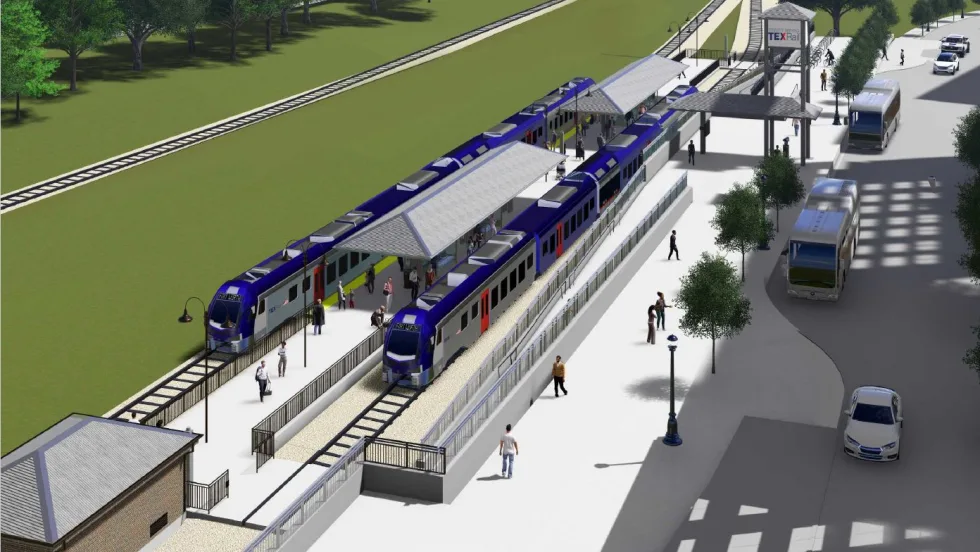
Trinity Metro Breaks Ground on $270M TEXRail Extension
The 2.1-mile extension will connect Fort Worth’s Medical District and Near Southside to downtown, surrounding communities, and Dallas-Fort Worth International Airport.
Read More →
Bringing Austin’s First Light Rail System to Life
Austin Transit Partnership CEO Greg Canally discusses the city's nearly 10-mile light rail project, its collaborative approach to project delivery, the importance of community engagement, and the milestones ahead as construction approaches in 2027.
Read More →
Metra Draft Plan Outlines Costs, Service Improvements for Regional Rail
The Systemwide Network Plan identifies infrastructure needs and potential investments to expand all-day, bidirectional rail service across the Chicago region.
Read More →
Amtrak Completes First Street Tunnel Upgrades, Restores Service
The nine-day construction project included replacing aging track infrastructure and modernizing switch systems near Washington Union Station.
Read More →
FRA Announces $2.3B for Passenger, Freight Rail Projects Nationwide
The CRISI Grant Program funding will support rail infrastructure improvements, safety upgrades, and projects aimed at improving freight and passenger rail service across 45 states and Washington, D.C.
Read More →
Caltrain’s Electrification Drives a New Era of Ridership Growth
The railroad’s shift to electric service has brought more frequent trains, stronger customer satisfaction, and increased ridership, earning it APTA’s Outstanding Public Transportation System award.
Read More →
FTA Advances $164M Broward County Commuter Rail Project
The proposed 10.5-mile commuter rail extension would connect Fort Lauderdale and Aventura, expanding passenger rail options in South Florida.
Read More →
New York MTA Launches Historic $1.9B Signal, Track Modernization Project
Funded in part by congestion pricing revenue, the project will replace nearly century-old signals along the A and C lines in Brooklyn and Queens.
Read More →
LA Metro Breaks Ground on East San Fernando Valley Light Rail Project
The 6.7-mile line will add 11 stations along Van Nuys Boulevard, expand access to jobs and regional transit connections, and support Metro’s broader efforts to improve mobility as rail ridership grows.
Read More →
CSA Group Releases Climate Resilience Standard for Transit, Passenger Rail
Developed with support from the Standards Council of Canada, CSA D700 guides assessing climate-related risks and planning adaptation measures for transit and passenger rail systems.
Read More →