



Argentina recycles San Diego transit trolleys
The Provincial Government of Mendoza purchased 11 vehicles from San Diego MTS for $3.3 million, signing a contract in September 2010. Four light rail vehicles were recently unveiled on the soon-to-open Metrotranvía Mendoza light rail system.

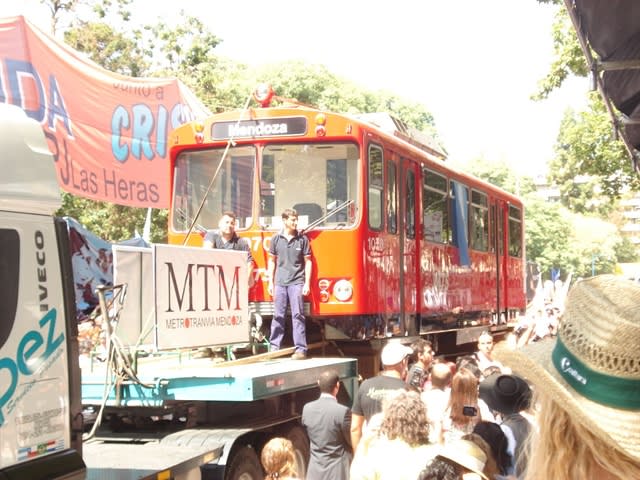
One of the San Diego Metropolitan Transit System Trolleys, which were sold to the Provence of Mendoza, was unveiled to the Mendoza public at its Festival de la Vendimia (Harvest Parade).
[IMAGE]SDMTSMendozaunveiling-2.jpg[/IMAGE]What was old is once again new as four trolley cars that plied the tracks in San Diego for almost 30 years operated for the first time thousands of miles away in Mendoza, Argentina.
The San Diego Metropolitan Transit System (MTS) sold the light rail vehicles (LRVs) to the city of Mendoza last year. They were successfully tested and then unveiled to the people of Mendoza on its soon-to-open Metrotranvía Mendoza light rail system.
Taking part in the ceremonies were San Diego County Supervisor and MTS Vice Chairman Ron Roberts, MTS Chief Executive Officer Paul Jablonski and MTS Chief Operating Officer of Rail Wayne Terry, who attended as the invited guests of the Mendoza government. The three met with Mendoza Gov. Celso Alejandro Jaque and its Minister of Infrastructure, Transportation and Housing Francisco Humberto Perez. All travel arrangements were made by the government of Mendoza at no expense to the County or to MTS.
Over the course of the visit, the San Diego representatives discussed with local transit and government officials best practices, and provided detailed information about San Diego Trolley’s operating procedures for training, safety and other critical components of light rail service delivery. MTS maintenance personnel also traveled to Mendoza to help reassemble the vehicles after transport and provide instruction to the Argentinean maintenance personnel.
“A piece of San Diego’s transportation history is being preserved in Argentina,” said Supervisor Roberts. “These vehicles had a long and successful run in San Diego and now they will be part of a new light rail system in another part of the world. It is great to see the excitement that these cars can generate as the people of Mendoza anticipate the convenience and speed of a light rail system.”
The Provincial Government of Mendoza purchased 11 vehicles from MTS for $3.3 million, signing a contract in San Diego in September 2010. The vehicles were delivered in January of this year. The vehicles are expected to be in operation in July. Mendoza may purchase more vehicles from MTS in the future.
MTS is replacing the sold vehicles and others with 57 of the newest generation of low floor LRVs from Siemens. MTS will begin taking delivery on the new cars this summer. The switch to low-floor trolleys is part of the Trolley Renewal Project, which is a $650 million project to rebuild the Blue and Orange Lines. The low floor cars will speed boarding for all passengers and enhance the on-time performance of the trolley system. The new cars will also reduce MTS operating costs as older, higher maintenance cars are replaced.
Roberts, in making comments to the people of Mendoza, drew many parallels between the Mendoza system and San Diego’s original line, which was built in 1981. Mendoza is starting its system on existing track, as San Diego did in 1981. Mendoza’s new line is about the same distance as the Blue Line on MTS was in 1981. Both areas have a similar population.
While on the trip, Roberts also met and spoke with Argentinean President Cristina Fernandez de Kirchner at the Grape Harvest Festival.
The LRVs were shipped to Argentina in January. To make the trip, the four U-2s were dismantled into two pieces and encased in plastic. They traveled by truck to Houston, by boat to Buenos Aires, and then by truck again the remaining distance to Mendoza.
MTS estimates that each car has carried more than two million passengers and traveled more than nine million miles.
“That these cars have an extensive life left after so many years of service in San Diego is a testament to our maintenance efforts,” said Jablonski. “It is very gratifying to see that these cars will continue to operate and provide a vital transportation alternative after almost 30 years of service in San Diego.”
Metrotranvía Mendoza is in the process of installing the overhead electrical wire on its light rail system. A generator was used to test the trolleys and they traveled approximately 50 meters.
More Rail

New York MTA Advances Final Contract for Second Avenue Subway Expansion
Contract Four is the largest in the Second Avenue Subway Phase 2 project and includes construction of station infrastructure, tracks, and signals for the subway expansion, MTA officials said. Work on Contract Four will begin in 2027.
Read More →
San Diego MTS Breaks Monthly Trolley Ridership Record
Agency officials said July’s ridership indicates MTS’s continued recovery from the pandemic.
Read More →
Report Examines NJ TRANSIT Reliability, Funding Challenges
The Garden State Initiative analysis examines the roles of Amtrak infrastructure, fleet management, and agency operations while recommending a more performance-based approach to improving reliability.
Read More →
Stadler, CapMetro Sign Long-Term Rail Fleet Support Agreement
Beginning in 2027, Stadler will provide on-site technical expertise, spare parts support, training, and obsolescence management to help extend the reliability and longevity of CapMetro’s GTW fleet.
Read More →
Biz Briefs: Alstom Lands Canadian Contract, LYT to Supply California TSP, and More
In METRO's latest installment, we take a look at recent news from Complete Coach Works, Beep, FlixBus, and more partnerships making headlines across the transportation sector.
Read More →
CATS Gold Line Marks 5 Years of Service, 2.8M Passenger Trips
With a six-mile expansion planned, the Charlotte streetcar is positioned to connect more neighborhoods and major transit hubs across the region.
Read More →
Why Simulating Pedestrian Movement Has Become Essential for Modern Rail Stations
Pedestrian microsimulation is helping rail planners identify bottlenecks, test station designs, and prepare complex transit hubs for growing passenger volumes.
Read More →
Amtrak Begins Major Construction at New York’s Sunnyside Yard
The new maintenance facility will support Amtrak’s Airo trainsets while improving maintenance efficiency and turnaround times in New York.
Read More →
Chicago Leaders Unveil Plans for O’Hare Airport Express Train
The privately developed project would offer a 15-minute trip between downtown and O’Hare’s Terminal 2, with trains operating every 15 minutes on a dedicated track. The service would use battery-electric trains and three existing freight rail rights-of-way.
Read More →
OCTA Maps Out 30-Year Strategy to Protect Coastal Rail Corridor
The draft feasibility report identifies strategies to protect the coastal rail line for decades as the agency continues near-term stabilization and sand placement efforts.
Read More →