



DART honors 250 millionth light rail customer
The daily DART Rail rider, Don Johnson, was greeted by DART President/Executive Director Gary Thomas and Michael Melaniphy, president/CEO of APTA.

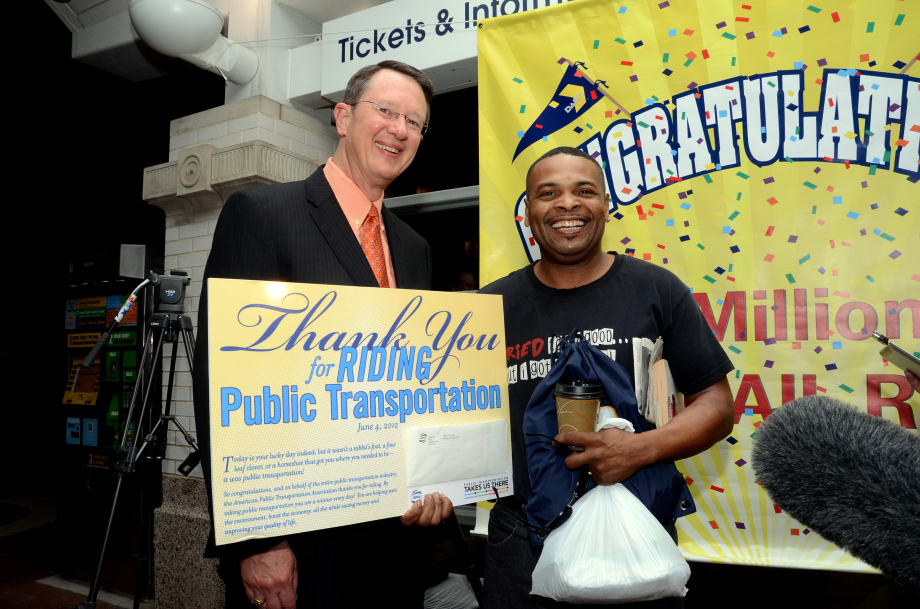
DART President/Executive Director Gary Thomas(left) with the agency's 250 millionth rail rider Don Johnson.
DART President/Executive Director Gary Thomas(left) with the agency's 250 millionth rail rider Don Johnson.
In conjunction with the annual American Public Transportation Association (APTA) Rail Conference, Dallas Area Rapid Transit (DART) honored its 250 millionth customer on its light rail system earlier this week.
The daily DART Rail rider, Don Johnson, was greeted by DART President/Executive Director Gary Thomas and Michael Melaniphy, president/CEO of APTA.
Johnson was randomly selected from Monday morning commuters by DART staff to represent all riders of the 72 mile, 55 station system throughout the past 16 years. DART Rail ridership is calculated on a variety of factors, including statistical sampling. As part of the recognition, DART will award the customer four monthly Regional passes good for use in July, along with tickets to popular destinations such as the Dallas Zoo, Children's Aquarium at Fair Park, Hawaiian Falls, Dallas Summer Musicals, and the Museum of Nature & Science.
"This is a great day and a neat milestone for us," Thomas said. "But, I'm also thinking about the individual trips and special moments that preceded this one. School kids made their first trips to the zoo, or a Mavericks' or Stars' game on DART. People have met, gone on first dates and found their spouses on DART. Our customers plan special outings around our service. We've really become woven into the fabric of the region and that's what's exciting to me."
DART also is offering a special way for all light rail customers to share their transit moments. Customers may post pictures of good times and great trips they've made on DART Rail via Twitter, by adding the hashtag #DART250. The photos also will be posted to a section of the agency's Facebook page.
DART began light rail operations on June 14, 1996, opening the first 11 miles of its 20-mile Light Rail Starter System. Through the years, the agency has expanded to operate the longest electric light rail system in the U.S.
The system is still growing. A five-mile section of the Orange Line, from Bachman Station in northwest Dallas to Irving, opens July 30. A second section of the line, as well as a five-mile extension of the Blue Line from Garland to Rowlett, will open Dec. 2, 2013. DART will have 90 miles in operation when it completes the Orange Line in December 2014 with a station at Terminal A of Dallas-Fort Worth International Airport.
More Rail
Amtrak, CN Reach Agreements to Strengthen Passenger Rail Service, Safety
The agreement resolves a more than decade-long proceeding before the Surface Transportation Board concerning the terms and conditions for Amtrak services, such as the City of New Orleans, Illini/Saluki, and Wolverine.
Read More →
New York MTA Advances Final Contract for Second Avenue Subway Expansion
Contract Four is the largest in the Second Avenue Subway Phase 2 project and includes construction of station infrastructure, tracks, and signals for the subway expansion, MTA officials said. Work on Contract Four will begin in 2027.
Read More →
San Diego MTS Breaks Monthly Trolley Ridership Record
Agency officials said July’s ridership indicates MTS’s continued recovery from the pandemic.
Read More →
Report Examines NJ TRANSIT Reliability, Funding Challenges
The Garden State Initiative analysis examines the roles of Amtrak infrastructure, fleet management, and agency operations while recommending a more performance-based approach to improving reliability.
Read More →
Stadler, CapMetro Sign Long-Term Rail Fleet Support Agreement
Beginning in 2027, Stadler will provide on-site technical expertise, spare parts support, training, and obsolescence management to help extend the reliability and longevity of CapMetro’s GTW fleet.
Read More →
Biz Briefs: Alstom Lands Canadian Contract, LYT to Supply California TSP, and More
In METRO's latest installment, we take a look at recent news from Complete Coach Works, Beep, FlixBus, and more partnerships making headlines across the transportation sector.
Read More →
CATS Gold Line Marks 5 Years of Service, 2.8M Passenger Trips
With a six-mile expansion planned, the Charlotte streetcar is positioned to connect more neighborhoods and major transit hubs across the region.
Read More →
Why Simulating Pedestrian Movement Has Become Essential for Modern Rail Stations
Pedestrian microsimulation is helping rail planners identify bottlenecks, test station designs, and prepare complex transit hubs for growing passenger volumes.
Read More →
Amtrak Begins Major Construction at New York’s Sunnyside Yard
The new maintenance facility will support Amtrak’s Airo trainsets while improving maintenance efficiency and turnaround times in New York.
Read More →
Chicago Leaders Unveil Plans for O’Hare Airport Express Train
The privately developed project would offer a 15-minute trip between downtown and O’Hare’s Terminal 2, with trains operating every 15 minutes on a dedicated track. The service would use battery-electric trains and three existing freight rail rights-of-way.
Read More →