



UT Profile: Students take the reins for U. of Montana transit system
Board is composed of all students who oversee an annual budget of $1 million. Students are also trained drivers.

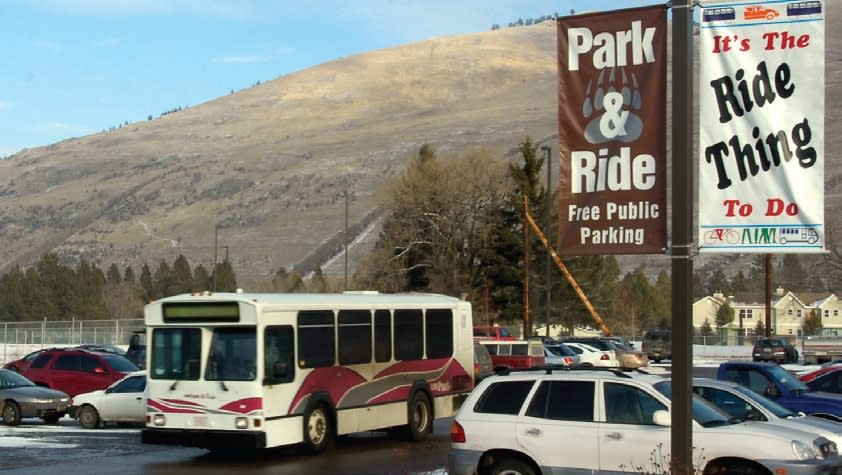
Initiated in 1999, the Associated Students of the University of Montana Office of Transportation (ASUM) began a unique transportation service for its students, staff, faculty and community.
“There was a recommendation from a campus and community wide transportation committee that we needed an office to promote transportation options,” explained Nancy Wilson, director of ASUM. “At the time, the university said they had no funding to do that, so the students imposed a $4 student fee on themselves and started ASUM Transportation to promote those transportation options.”
The creation of ASUM resulted in a small van service that eventually grew to a nine transit bus operation, which grew from serving 3,600 passengers in its first year to 445,000 in 2011.
So what’s so unique about ASUM’s program? It’s all student run.
“We have all student drivers, which is a great thing to do,” explained Wilson. “We have a top-notch, nationally-certified training program, and many of our students end up using their commercial licenses to pay for their education.”
ASUM’s board is also composed of all students who oversee an annual budget of $1 million.
“It really gets a lot of young people invested in the transit industry and the transportation options industry, and many of the students on that board end up going out into community planning jobs, transit agency jobs and higher degrees in the transportation sector,” said Wilson, who in her capacity, carries out what the students want, educates the ever-changing board, and attends community and university planning meetings.
One slight drawback of the program, said Wilson, is that, because the board is comprised of about 12 to 15 students, ranging from freshman to graduate program students each year, there is an obviously high turnover rate and learning curve.
“It takes the board about three months every year to get their feet under them, because transportation funding is complicated and the politics of transportation is complicated,” explained Wilson. “We try to get students that will be on the board more than a year, so we have some continuity.”
One of the positives to having a board that changes nearly every year, said Wilson, is that it allows ideas to sometimes be used and reassessed several times.
“We don’t get stuck in that place that a lot of transit agencies get into, where they say ‘we’ve tried that and it didn’t work,’” she said. “When you have a young board, and you say that, they usually will say, ‘let’s try again.’"
One example of that mentality is how the system began, when service was tried from a park & ride for the third time and accomplished success. ASUM now provides service from two park & rides south and two park & rides east of the university, as well as two shuttles between the Missoula College, formerly College of Technology, and main campus.
Like many universities today, ASUM also runs a successful late-night shuttle service, dubbed UDash, six nights a week. When UDash service hours were recently extended from midnight to 2:30 a.m. on Thursdays, ridership increased 133%, with Friday and Saturday night usage also increasing 58% in 2011, compared to the previous year.

Additionally, ASUM runs two successful bicycling programs that help their students get around its approximate one square mile campus. The Cruiser Co-Op program allows students to check out a bicycle for a two-day period free of charge with a valid school identification, while a semester bicycle program enables students to rent a bicycle, helmet, light and lock for an entire semester for only $35.
“The semester program is really nice for our international students,” said Wilson. “Currently, we have 35 bicycles available for that program and 50 for our Cruiser program, and would like to increase both of those numbers soon.”
Currently, ASUM has no plans expand services but is working with its local transit system, the Missoula Urban Transportation District, to grow their services in the community.
“We would like to see community-wide transit service every 15 minutes, until at least 11 p.m.,” Wilson explained. “So, we’d really like to work first with them to expand, and then, for us to expand as needed.”
More Bus

New York MTA Plans Largest Bus Fleet Upgrade in More Than a Decade
The agency is seeking manufacturers for 650 new CNG buses to replace aging vehicles, improve reliability, and advance its broader fleet modernization strategy.
Read More →
Building a Flexible Path to Transit Electrification
John Hroncich discusses BAE Systems’ modular and scalable approach, lessons learned from decades of real-world operations, and how agencies can identify electrification strategies that fit their fleets.
Read More →
Bus Tech Talk: Keeping Transit Technicians Ahead of the Technology Curve
LA Metro’s Obed Mejia discusses technician training, evolving maintenance technology, fleet replacement, and strategies for getting the most out of today’s transit fleets.
Read More →
Biz Briefs: RIPTA Unveils New Frontrunners, Clevland RTA Adds New Siemens, and More
In METRO's latest installment, we take a look at recent news from Siemens, Prevost, Dodge, and more partnerships making headlines across the transportation sector.
Read More →
People Movement: Holly Arnold Joins Transdev and More
In this edition, we also cover recent appointments and announcements at Pace, CamTran, MCI, and more, showcasing the individuals helping to shape the future of transportation.
Read More →
The High Cost of Transit Buses: Industry Leaders Look to Procurement Reform
Transit leaders and policymakers examine how standardized bus designs, streamlined procurement, and predictable funding could help agencies stretch budgets and deliver better service.
Read More →
The Business Voice Behind Public Transportation
As chair of APTA’s Business Members Board of Governors, Ray Melleady explains how more than 850 business members are partnering with transit agencies to advance funding, innovation, and industry-wide collaboration.
Read More →
From Surviving to Thriving: Building Stronger Transportation Organizations
Bus Business Consultants founder Brian Dickson shares lessons on leadership, organizational health, and creating options for long-term success in a changing transportation industry.
Read More →
Finding the ‘Happy Medium’: Optimizing Maintenance Without Sacrificing Reliability
The key to maintenance optimization isn’t doing less work—it’s doing the right work at the right time on the right assets.
Read More →
LA Metro, City of West Hollywood, and Partners Advance Smarter Bus Lane Enforcement
The award-winning partnership combines AI-powered detection with human oversight to improve bus reliability, accessibility, and enforcement efficiency.
Read More →