



NYCT to install 'Help Points' on subway
Created specifically for the subway environment, the unit is designed to be an easily recognizable communications tool for customers who need to either report an emergency or ask for travel directions.

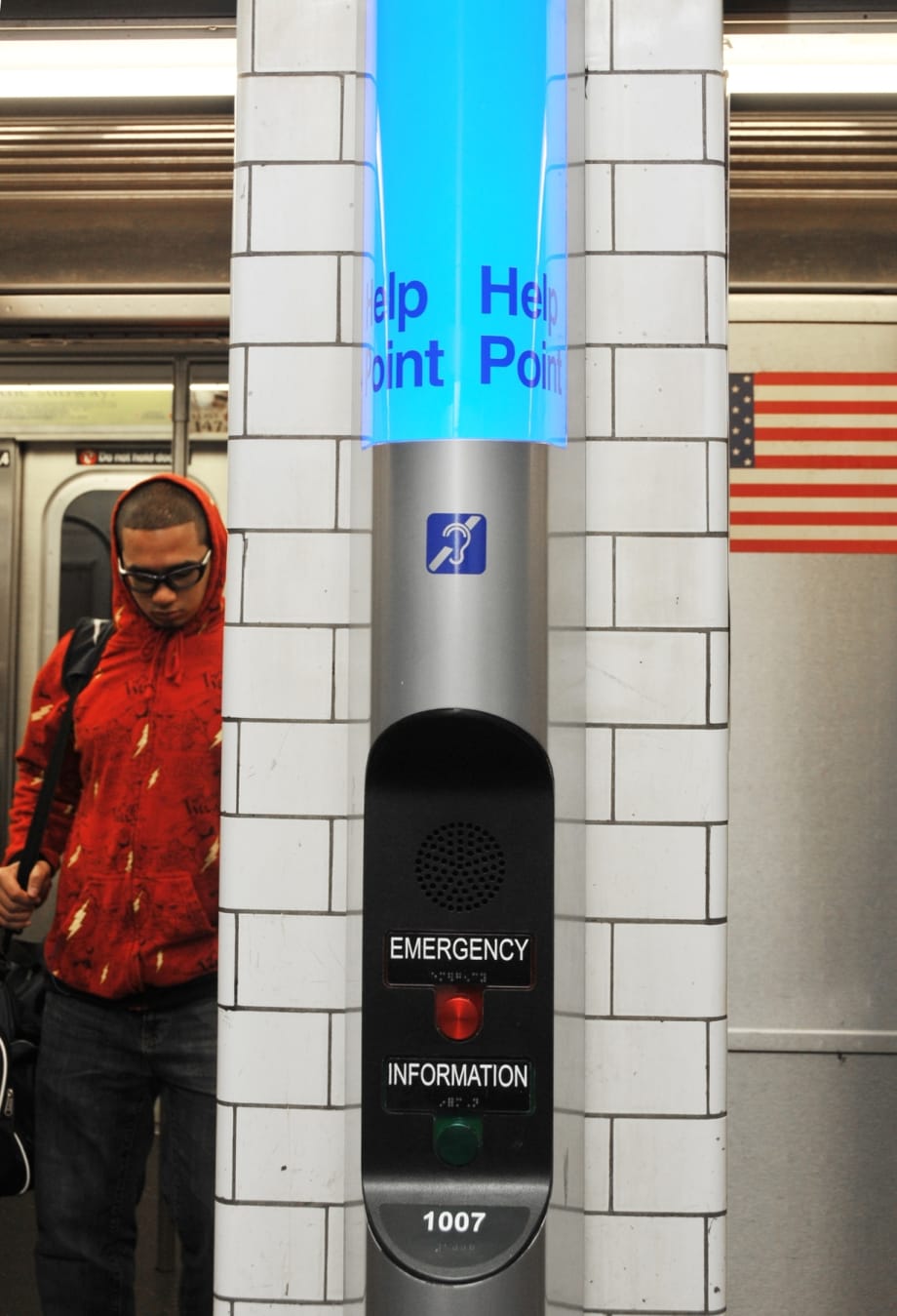
MTA New York City Transit will install Help Points, a digital communication tool for customers who need immediate assistance and information, to 102 stations.
For the first time, customers on the platform level of subway stations will have immediate access to the station booth and personnel at the Rail Control Center. Units will be positioned and spaced for easy access and high visibility. Created specifically for the subway environment, the Help Point is designed to be an easily recognizable communications tool for customers who need to either report an emergency or ask for travel directions.
The units will be easy to spot with a bright blue beacon light that will pulse when the unit is in action. This feature will help alert first responders in case there is an injured or sick customer at that location. When approaching the Help Points, customers will be greeted by two buttons, a green button which connects riders to the booth and a red button, linked directly to the Rail Control Center and to be used in the event of emergency.
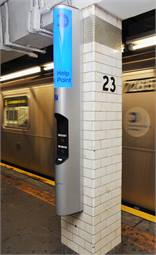
The eventual plan calls for the installation of the Help Points in all of the system’s 468 subway stations, replacing the Customer Assistance Intercoms units currently in use.
An initial pilot of the system was conducted at the 23rd Street and Brooklyn Bridge Stations on the Lexington Avenue Line and served to determine not only the usefulness of the units but also to evaluate the benefits of both hard-wired and wireless installations. Nine Help Points were installed at 23rd Street and another 10 at the Brooklyn Bridge Station. There is a second pilot currently underway at Rector Street on the Broadway Line and Burnside Avenue on the Jerome Line, in the Bronx.
Each Help Point is individually addressable, so that in the case of an emergency, personnel at the Rail Control Center will be able to pinpoint exactly where in the station the call originated. Not only will the new Help Point units improve response times, but the digital audio will provide much clearer sound than is available from the customer assistance intercoms used in subways now.
Along with the Help Points, the contract pending board approval next week, also includes the installation of the Passenger Station Local Area Network (PSLAN), the digital communications network which will provide connectivity for advanced-technology devices located within the station environment. Importantly, PSLAN will support the Help Points, the New Fare Payment System, On-The-Go screens and new security initiatives. Both projects are estimated to have a combined value of $100 million, with Help Points valued at approximately $40 million and PSLAN at $60 million.
More Rail
New York MTA Launches Historic $1.9B Signal, Track Modernization Project
Funded in part by congestion pricing revenue, the project will replace nearly century-old signals along the A and C lines in Brooklyn and Queens.
Read More →
LA Metro Breaks Ground on East San Fernando Valley Light Rail Project
The 6.7-mile line will add 11 stations along Van Nuys Boulevard, expand access to jobs and regional transit connections, and support Metro’s broader efforts to improve mobility as rail ridership grows.
Read More →
CSA Group Releases Climate Resilience Standard for Transit, Passenger Rail
Developed with support from the Standards Council of Canada, CSA D700 guides assessing climate-related risks and planning adaptation measures for transit and passenger rail systems.
Read More →
LA Metro September Ridership Climbs 3.9%, Led by Rail Growth
The agency recorded more than 27.2 million boardings, with rail ridership increasing 12.4% year over year and the D Line posting the largest gains.
Read More →
First Full MetroLink Rail Expansion Completed in 20 Years with $192M Airport Project
The project links two St. Louis-area airports by light rail while adding roadway and bike trail connections to improve regional access and mobility.
Read More →
Utilimarc Launches SmartReplace to Optimize Fleet Replacement Decisions
AI-powered SmartReplace helps fleets prioritize vehicle replacements, model budget scenarios, and build more defensible long-term strategies.
Read More →
Scenes from APTA TRANSform & EXPO 2026
Transit leaders, manufacturers, and industry professionals gathered in Chicago to explore new technologies, share ideas, and discuss the future of public transportation.
Read More →
USDOT Awards $416 Million for Florida Rail Crossing Safety Upgrades, New Brightline Station
The projects aim to reduce risks for motorists and pedestrians at rail crossings while expanding passenger rail access along Florida’s Space Coast.
Read More →
OCTA Declares Emergency to Protect Rail Corridor From Coastal Erosion
The California agency is accelerating shoreline protection and plans to place approximately 690,000 cubic yards of sand along the San Clemente coast to protect a key passenger and freight rail link.
Read More →
More Than a Summer Job: Building the Next Generation of Transit Talent
The Delaware River Port Authority and PATCO have transformed their internship program into a hands-on professional development experience that introduces students to the breadth of transportation careers — and creates a pipeline for future employees.
Read More →