



Amtrak unveils advanced tech. Siemens locomotives
Electric locomotives are being assembled in Siemens’ Sacramento, Calif., rail manufacturing plant powered by renewable energy, with parts built from its plants in Norwood, Ohio, Alpharetta, Ga., and Richland, Miss., and nearly 70 suppliers, representing more than 60 cities and 23 states.

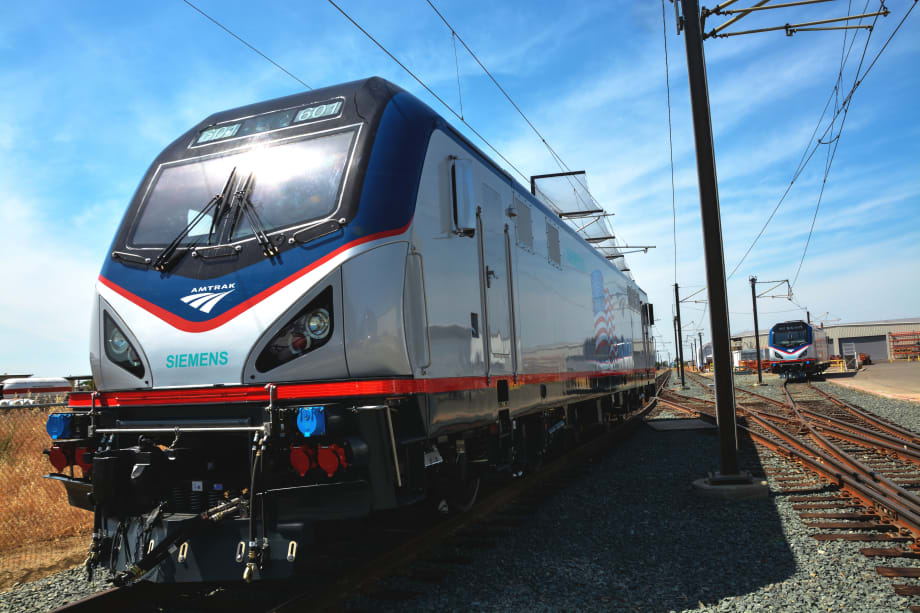
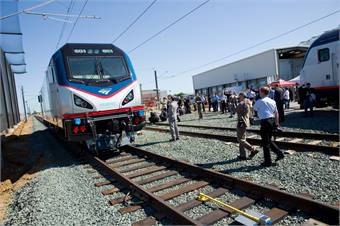
Amtrak's Siemens Sprinter locomotive. Photos courtesy Siemens.
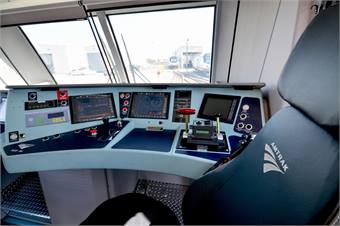
Amtrak's Siemens Sprinter locomotive. Photos courtesy Siemens.
A new era of more reliable and energy efficient Amtrak service for
Northeast intercity rail passengers is coming down the tracks as the first of 70 advanced technology electric locomotives being built by Siemens rolled off the assembly line.
The first units of the $466 million order will be field tested this summer for entry into revenue service in the fall.
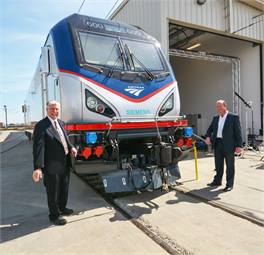
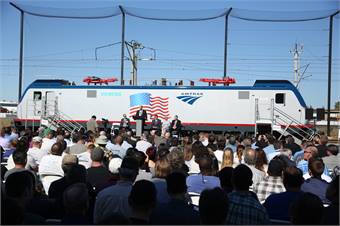
Amtrak President/CEO Michael Boardman and Siemens President Michael Cahill.
“The new Amtrak locomotives will help power the economic future of the Northeast region, provide more reliable and efficient service for passengers and support the rebirth of rail manufacturing in America,” said Amtrak President and CEO Joseph Boardman. “Built on the West Coast for service in the Northeast with suppliers from many states, businesses and workers from across the country are helping to modernize the locomotive fleet of America’s Railroad.”
Using Siemens’ innovative and proven rail technology, the Amtrak Cities Sprinter (ACS- 64) locomotives are being assembled in Siemens’ Sacramento, Calif., rail manufacturing plant powered by renewable energy, with parts built from its plants in Norwood, Ohio, Alpharetta,
Ga., and Richland, Miss., and nearly 70 suppliers, representing more than 60 cities and 23 states.
The new locomotives will operate on Northeast Regional trains at speeds up to 125 mph on the Northeast Corridor (NEC) along the Washington – New York – Boston route and on Keystone Service trains at speeds up to 110 mph on the Keystone Corridor from Philadelphia to Harrisburg, Pa. In addition, all long-distance trains operating on the NEC will be powered by the new locomotives.
“More and more Americans are parking their cars and choosing the comfort and convenience of trains, metros and streetcars as their preferred way of traveling. We’re proud of the innovations we’ve brought to passengers and commuters to expand their transportation options” said Michael Cahill, president of Siemens Rail Systems division in the U.S. “From downtown streetcar systems to regional, passenger rail lines, Siemens’ transportation solutions like the next-generation Amtrak locomotives enhance safety, boost efficiency and performance, and are built in America leveraging Siemens’ U.S. manufacturing hubs and supply chain.”
The new locomotives are designed for easier maintenance, will improve energy efficiency by using a regenerative braking system that will feed energy back into the power grid and will enhance mobility for the people, businesses and economy of the entire Northeast region. They also meet the latest federal rail safety regulations.
"We are committed to connecting people, communities and jobs. This project does all three," said Karen Hedlund, Deputy Federal Railroad Administrator. "Investing in manufacturing these 70 new locomotives are creating and preserving jobs in 60 cities across the country while meeting the growing demand for improved reliability and service along the Northeast and Keystone Corridors."
The first three locomotives will undergo a comprehensive testing program this summer, including two at a U.S. Department of Transportation facility in Pueblo, Colo., and one on the NEC. Once they are commissioned, production of the remaining units will ramp up for monthly delivery through 2016.
The new locomotives are part of a comprehensive Amtrak Fleet Strategy Plan to modernize and expand its equipment. The new units will replace electric locomotives that have between 25 and 35 years of service and average mileage of more than 3.5 million miles traveled with some approaching 4.5 million miles.
More Management

METRO Opens Submissions for 2026 Motorcoach Awards
Nominations are now being accepted for METRO Magazine’s Operator of the Year and Innovative Operator of the Year awards.
Read More →
New York MTA Advances Final Contract for Second Avenue Subway Expansion
Contract Four is the largest in the Second Avenue Subway Phase 2 project and includes construction of station infrastructure, tracks, and signals for the subway expansion, MTA officials said. Work on Contract Four will begin in 2027.
Read More →
Transit Agencies Highlight Safety Gains at National Summit
Leaders from 15 major transit systems shared crime-reduction results and safety initiatives while discussing the role of continued federal support.
Read More →

NITA Names New Leadership, Expands Reduced-Fare Program at First Board Meeting
The new regional transit authority appointed its first board chair and interim executive director while extending reduced fares across CTA, Metra, and Pace for eligible riders.
Read More →
Beyond the Checklist: A Structured Approach to Transit Maintenance
Reliability-Centered Maintenance helps transit agencies move beyond routine checklists to focus limited resources on the assets and failures that have the greatest impact on safety, reliability, and service.
Read More →
APTA 2026 Nominating Committee Selects Leadership Slate, Names Chair and Vice Chair Nominees
Leadership changes will help shape the association’s priorities and its representation of the transportation industry during the 2026–2027 term.
Read More →
DART Launches Major Security, Fare Enforcement Initiative
The 90-day demonstration will deploy coordinated security teams at five light rail stations while testing controlled access and gathering data to guide future investments.
Read More →
Advancing Fare Collection Through Technology and Innovation
Learn about delivering 1300 gates at 91 stations while managing fare evasion. Explore the large scale deployment, solution customization and real-world results that affect the region. Prepare for deployment in your region now.
Read More →
Game Day in Motion: Moving Millions During the 2026 World Cup
Between packed transit stations and team motorcoaches, see how agencies and operators across North America tackled the transportation demands of the 2026 FIFA World Cup.
Read More →
Surface Transportation Extension Averts Shutdown, Leaves Transit Funding Gap
The stopgap keeps federal transportation programs moving, but missing advance funding could complicate the transit and rail projects agencies are planning next.
Read More →