



Following derailment, Metro North to resume full service Wednesday
About 100 workers are on the job, which has been ongoing around the clock since Saturday night when the NTSB completed its initial investigation of the scene and allowed Metro-North to begin removing the two, eight-car trains.

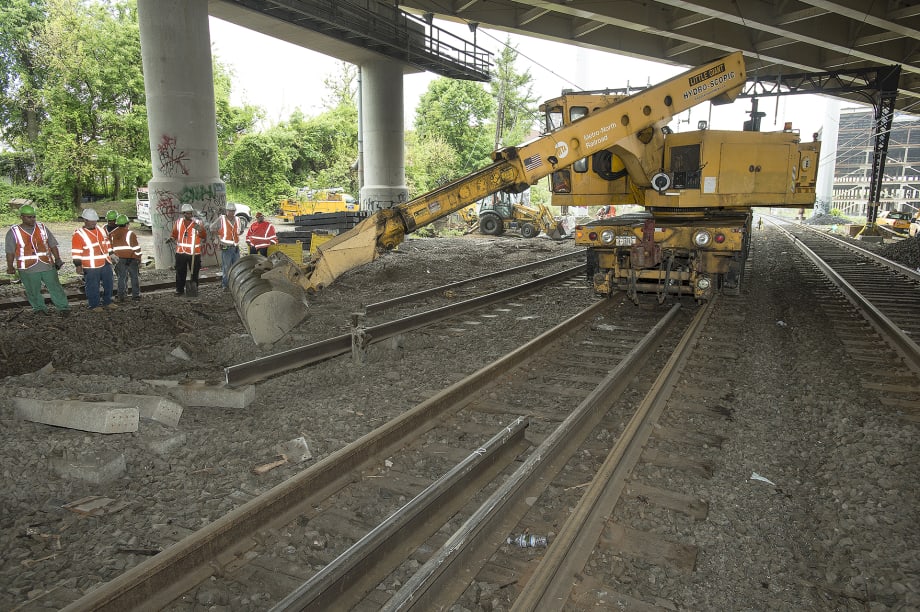
About 100 workers are on the job, which has been ongoing around the clock since Saturday night when the National Transportation Safety Board completed its initial investigation of the scene.
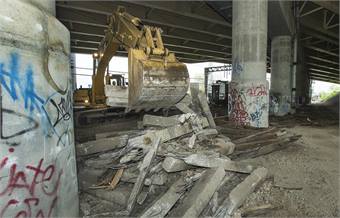
The track itself, including the stone, ties, rail and fasteners, is the first order of business and that job is complete on one of the two sections.
Reconstruction of track infrastructure damaged in a derailment last Friday has progressed to such a degree that Metro-North plans to resume regular train service on the New Haven Line in time for the peak morning service on Wednesday.
At approximately 6:10 p.m. Friday, a Metro-North train (the 4:41 p.m. departure from Grand Central, due to New Haven at 6:32 p.m.) traveling to New Haven with an estimated 300 passengers derailed in the vicinity of the I-95 overpass in Bridgeport, Conn.
A passenger train traveling in the opposite direction carrying an estimated 400 passengers on the adjacent track (the 5:30 p.m. departure from New Haven-State Street, due Grand Central at 7:18 p.m.) then struck the derailed train.
About 100 workers are on the job, which has been ongoing around the clock since Saturday night when the National Transportation Safety Board completed its initial investigation of the scene and allowed Metro-North to begin removing the two, eight-car trains.
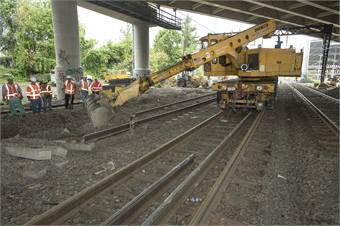
About 100 workers are on the job, which has been ongoing around the clock since Saturday night when the National Transportation Safety Board completed its initial investigation of the scene.
“We are confident that the reconstruction work, inspection and testing will be completed in time for a normal rush hour on Wednesday,” said Metro-North President Howard Permut. “We are grateful for the tireless work of all departments and employees engaged in this huge task.”
The shuttle train operation from New Haven to Bridgeport, with a bus connection to Stamford, where customers can board a train for New York, continued on Tuesday.
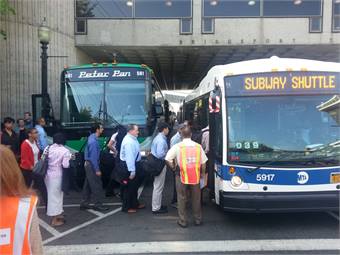
The bus operation went according to plan on Monday with 120 buses on hand and no crowding reported.
The bus operation went according to plan on Monday with 120 buses on hand and no crowding reported.
"The local municipalities offered tremendous support, with signs, special lanes, satellite parking and police assistance and Metro-North is grateful for this very high level of cooperation, which ensured the operation’s success,” said Susan Doering, Metro-North’s VP, customer service and stations.
About 750 people rode the shuttle trains and boarded buses at Bridgeport to Stamford, just 20% of the 4,000 people who ordinarily board trains at New Haven, Milford and Stratford during the morning peak period. However, overall morning peak period ridership on the entire New Haven Line was down just 20%, which means, many people drove to other stations to catch a train. And a 6% increase in ridership was counted on the Harlem Line.
In Bridgeport, work to rebuild two sections of track totaling 2,000 feet continues at a brisk pace. The track itself, including the stone, ties, rail and fasteners, is the first order of business and that job is complete on one of the two sections. Next comes restringing the overhead catenary wire and appropriate connections to the substations.
The signal system is the final component followed by vigorous inspection and a period of operating test trains over the rail. This critical work will continue overnight.
More Rail
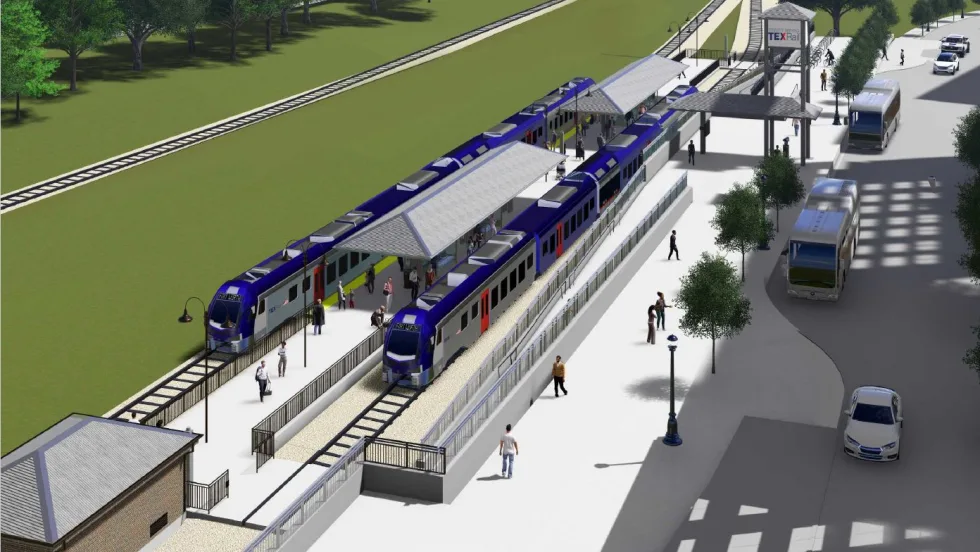
Trinity Metro Breaks Ground on $270M TEXRail Extension
The 2.1-mile extension will connect Fort Worth’s Medical District and Near Southside to downtown, surrounding communities, and Dallas-Fort Worth International Airport.
Read More →
Bringing Austin’s First Light Rail System to Life
Austin Transit Partnership CEO Greg Canally discusses the city's nearly 10-mile light rail project, its collaborative approach to project delivery, the importance of community engagement, and the milestones ahead as construction approaches in 2027.
Read More →
Metra Draft Plan Outlines Costs, Service Improvements for Regional Rail
The Systemwide Network Plan identifies infrastructure needs and potential investments to expand all-day, bidirectional rail service across the Chicago region.
Read More →
Amtrak Completes First Street Tunnel Upgrades, Restores Service
The nine-day construction project included replacing aging track infrastructure and modernizing switch systems near Washington Union Station.
Read More →
FRA Announces $2.3B for Passenger, Freight Rail Projects Nationwide
The CRISI Grant Program funding will support rail infrastructure improvements, safety upgrades, and projects aimed at improving freight and passenger rail service across 45 states and Washington, D.C.
Read More →
Caltrain’s Electrification Drives a New Era of Ridership Growth
The railroad’s shift to electric service has brought more frequent trains, stronger customer satisfaction, and increased ridership, earning it APTA’s Outstanding Public Transportation System award.
Read More →
FTA Advances $164M Broward County Commuter Rail Project
The proposed 10.5-mile commuter rail extension would connect Fort Lauderdale and Aventura, expanding passenger rail options in South Florida.
Read More →
New York MTA Launches Historic $1.9B Signal, Track Modernization Project
Funded in part by congestion pricing revenue, the project will replace nearly century-old signals along the A and C lines in Brooklyn and Queens.
Read More →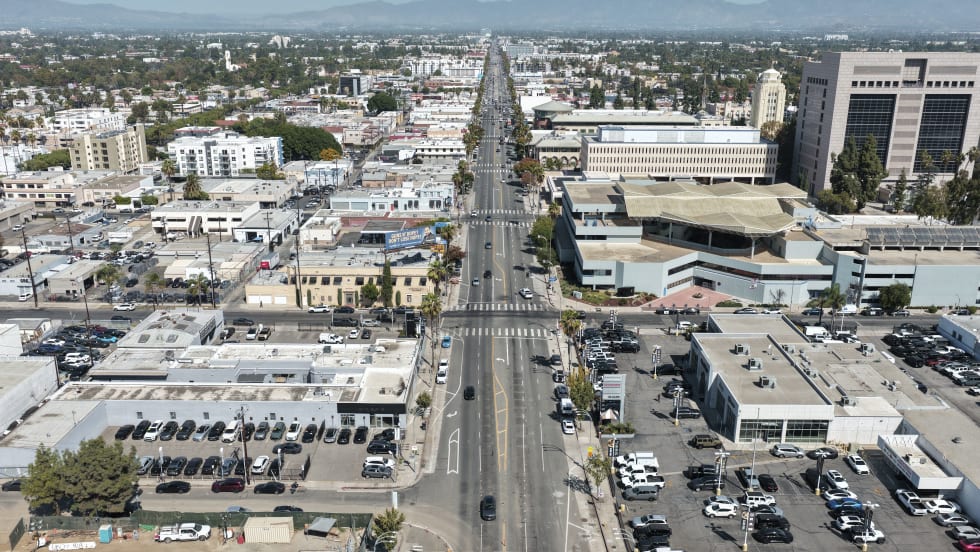
LA Metro Breaks Ground on East San Fernando Valley Light Rail Project
The 6.7-mile line will add 11 stations along Van Nuys Boulevard, expand access to jobs and regional transit connections, and support Metro’s broader efforts to improve mobility as rail ridership grows.
Read More →
CSA Group Releases Climate Resilience Standard for Transit, Passenger Rail
Developed with support from the Standards Council of Canada, CSA D700 guides assessing climate-related risks and planning adaptation measures for transit and passenger rail systems.
Read More →