



BRT a cost-effective catalyst for urban development, study says
Research demonstrates that true BRT systems can leverage as much, or more development, as light rail.

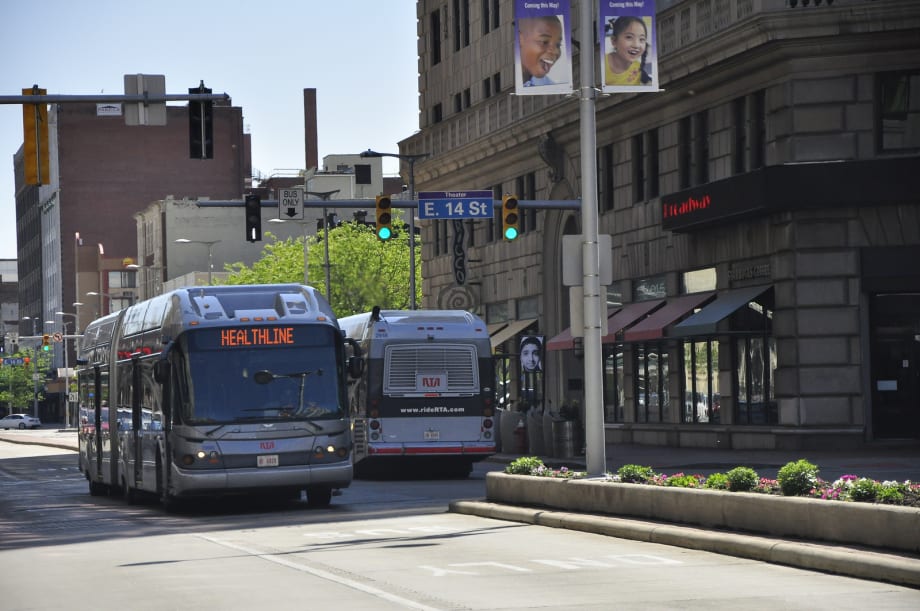
Photo courtesy EMBARQ
Photo courtesy EMBARQ
Bus rapid transit (BRT) systems, led by Cleveland’s HealthLine, provides a cost-effective catalyst for urban development in North America, according to a new report released today by the Institute for Transportation and Development Policy (ITDP).
The research highlights the role that government investments and policies play in developing the areas served by mass transportation systems, and also demonstrates that true BRT systems can leverage as much, or more development, as light rail.
“In the 21st century, we are seeing that mass transit can revitalize cities if governments act wisely — and the type of mass transit providing the best bang for the buck is bus rapid transit,” said Walter Hook, CEO of ITDP. “This is a transportation option that first emerged in Latin America and is now being adopted in the United States and Canada. It can move an urban economy forward quickly and efficiently.”
BRT, which is fairly new to North America, has finally become established enough in the U.S. to show results. This transportation system is characterized by five basic elements shared by world class surface mass transportation systems: exclusive lanes on the street, placement of those lanes away from traffic conflicts, priority at intersections, platform-level boarding and fare payment in stations — as opposed to paying when entering the bus. All of these elements speed up the system by reducing the time that buses do not move.
“In our report, Cleveland’s HealthLine is the showcase for how BRT can revitalize urban areas once in decline,” said Annie Weinstock, ITDP’s director of U.S. programs and co-author of the report. “More and more U.S. municipalities, still strapped by the last recession, are considering the potential of BRT, light rail and other surface mass transit options as a way to anchor new development. The illusion of the car-driven economy has finally reached a dead end.”
Cleveland System Anchors Local Economy
Cleveland’s HealthLine BRT, which launched in 2008, connects the two employment hubs of the city: its downtown area and the University Circle neighborhood. The system’s price tag was $50 million, less than one-fifth of what a light rail line would have cost in the same corridor. Cleveland also spent $150 million on street improvements and other infrastructure in the corridor to attract development around the HealthLine.
Those improvements, along with other types of government support, then helped the initial capital investment leverage $5.8 billion in transit-oriented development (TOD) — $114.54 for every dollar spent on building the HealthLine. The environmental impacts of the HealthLine were also profound; between the diesel-electric hybrid buses and the reductions in car traffic, particulate emissions in the corridor plummeted by 95%.
ITDP’s report, “More Development for Your Transit Dollar: An Analysis of 21 North American Transit Corridors,” evaluates 21 surface mass transit corridors in 13 cities across the U.S. and Canada. The corridors were all rated using The BRT Standard, which assesses how closely the systems conform to international "best practices," and can be used to evaluate light rail transit (LRT) as easily as it can BRT. The report then discusses how each system has served as a catalyst or anchor for urban development.
The findings of the report include:
• Government support is the best predicator of transit-oriented development, regardless of system type. Governments can invest in related infrastructure, change the zoning and other regulations, provide loans or tax abatements and market the area to help support development. But if a government does nothing to support TOD along the transit corridor, there will be no impact.
• Bus rapid transit leverages more transit-oriented development per dollar spent on building transit than light rail transit or streetcars. Cleveland’s HealthLine BRT and Portland’s MAX Blue Line LRT leveraged the most overall TOD of the corridors studied — $5.8 billion and $6.5 billion, respectively. Yet, because the HealthLine cost significantly less to build than the Blue Line, Cleveland leveraged approximately 31 times more TOD per dollar spent on its HealthLine than Portland for its Blue Line.
• The strength of the land market around the transit corridor is the secondary indicator of success. Where governments provide moderate development support, the attractiveness of the land determines the level of TOD investment. Today, downtowns tend to begin as stronger land markets, so routing transit through a city’s downtown leads to better TOD impacts.
• A higher quality transit investment, as scored by The BRT Standard, helps leverage more development in emerging land markets.
Existing Transit Systems Also Generate Development
ITDP’s report also shows how urban planners can employ TOD principles when redeveloping urban areas served by existing transit systems. The TOD success story in Pittsburgh provides the perfect example for this finding. The Martin Luther King, Jr. East Busway, the first BRT in the country, was not conceived as a development initiative. The city built the BRT in 1983 to connect the downtown neighborhood with the communities and suburbs to the east—but did not invest in economic development around the BRT at all.
Twenty years later, though, a public-private initiative looking to revitalize the East Liberty neighborhood focused on the community’s BRT station as a potential economic anchor for new growth. By adjusting the zoning regulations surrounding the station, cleaning up industrial sites and aggressively recruiting economic anchors, the initiative attracted $900 million in new development concentrated around the East Liberty Station.
“Our research found that the most important factor in the success of transit-oriented development is how the mass transit is embraced and promoted — the type of transportation doesn’t matter, so long as it’s good quality,” said Hook. “But in these cash-strapped times, how far an investment stretches sparse government dollars is as critical a factor as finding the lowest possible price tag for the project. Bus rapid transit fits perfectly in this narrow window of opportunity.”
BRT was first developed in Curitiba, Brazil, and later embraced by Latin American cities such as Bogotá, Lima, Rio de Janeiro and Mexico City, as well as other cities around the world, including ones in Australia, China, France, India, Indonesia and South Africa. The largest BRT system in the world is TransMilenio in Bogotá, which has an average daily ridership of nearly two million passengers.
Other North American cities with good-quality BRTs include Eugene, Ore.; Los Angeles; Las Vegas; and Ottawa, Ontario. The bus systems in Boston, and Kansas City, MO, use elements of BRT as well, but have not fully embraced all of the advantages that a comprehensive BRT system provides. Chicago, Boston and San Francisco are among the municipalities currently considering how to implement BRT and use the systems to promote their own growth.
“With revenues still bottoming out from the recent recession, cities today have to stretch their investments as far as possible,” concluded Weinstock. “Cost-effective BRT has now proven itself to be a great catalyst to revitalization. But it doesn’t happen automatically. Cities have to pick the right corridor and then provide considerable support to generate TOD success."
More Bus

New York MTA Plans Largest Bus Fleet Upgrade in More Than a Decade
The agency is seeking manufacturers for 650 new CNG buses to replace aging vehicles, improve reliability, and advance its broader fleet modernization strategy.
Read More →
Building a Flexible Path to Transit Electrification
John Hroncich discusses BAE Systems’ modular and scalable approach, lessons learned from decades of real-world operations, and how agencies can identify electrification strategies that fit their fleets.
Read More →
Bus Tech Talk: Keeping Transit Technicians Ahead of the Technology Curve
LA Metro’s Obed Mejia discusses technician training, evolving maintenance technology, fleet replacement, and strategies for getting the most out of today’s transit fleets.
Read More →
Biz Briefs: RIPTA Unveils New Frontrunners, Clevland RTA Adds New Siemens, and More
In METRO's latest installment, we take a look at recent news from Siemens, Prevost, Dodge, and more partnerships making headlines across the transportation sector.
Read More →
People Movement: Holly Arnold Joins Transdev and More
In this edition, we also cover recent appointments and announcements at Pace, CamTran, MCI, and more, showcasing the individuals helping to shape the future of transportation.
Read More →
The High Cost of Transit Buses: Industry Leaders Look to Procurement Reform
Transit leaders and policymakers examine how standardized bus designs, streamlined procurement, and predictable funding could help agencies stretch budgets and deliver better service.
Read More →
The Business Voice Behind Public Transportation
As chair of APTA’s Business Members Board of Governors, Ray Melleady explains how more than 850 business members are partnering with transit agencies to advance funding, innovation, and industry-wide collaboration.
Read More →
From Surviving to Thriving: Building Stronger Transportation Organizations
Bus Business Consultants founder Brian Dickson shares lessons on leadership, organizational health, and creating options for long-term success in a changing transportation industry.
Read More →
Finding the ‘Happy Medium’: Optimizing Maintenance Without Sacrificing Reliability
The key to maintenance optimization isn’t doing less work—it’s doing the right work at the right time on the right assets.
Read More →
LA Metro, City of West Hollywood, and Partners Advance Smarter Bus Lane Enforcement
The award-winning partnership combines AI-powered detection with human oversight to improve bus reliability, accessibility, and enforcement efficiency.
Read More →