



Cities with rail-to-airport connection boost hotel revenue
New study shows that higher revenue per room translates to a potential $313 million in revenue per year for “rail cities” — cities which have direct rail access to airport terminals.

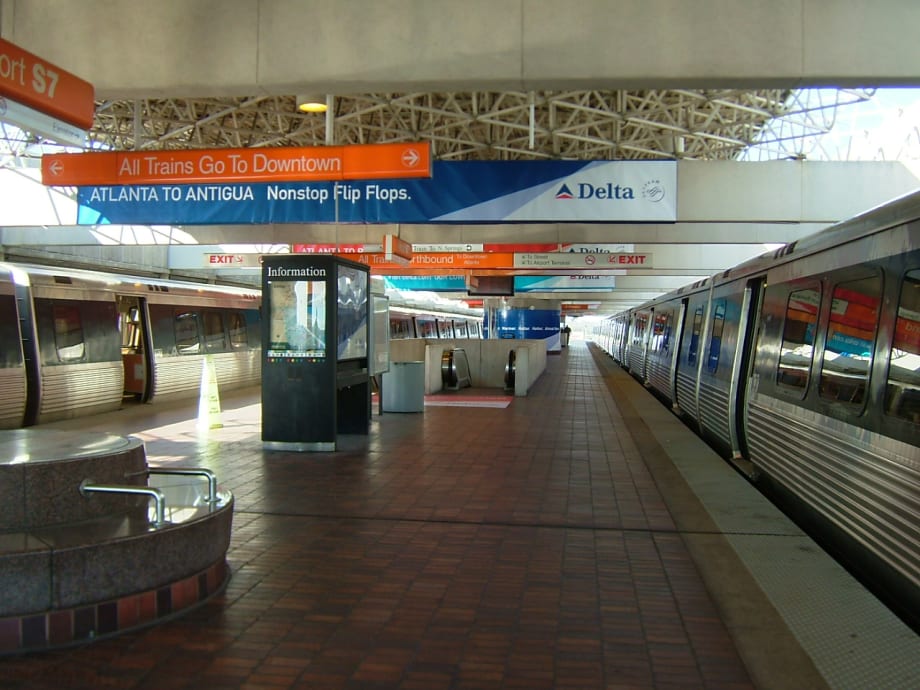
“Rail cities” represented in the report include Atlanta, which has a major multimodal transportation infrastructure option for both residents and travelers.
Photo courtesy DeKalb
“Rail cities” represented in the report include Atlanta, which has a major multimodal transportation infrastructure option for both residents and travelers.
Photo courtesy DeKalb
Hotels in cities with direct rail access from downtown to airport terminals receive nearly 11% more revenue per room than hotels in cities without a rail airport connection, according to a study released by the American Public Transportation Association (APTA) and the U.S. Travel Association.
“Clearly investment in local rail systems not only benefits residents, but drives significant economic growth in the travel and hospitality industries,” said APTA President/CEO Michael Melaniphy. “For our nation’s great cities to be more competitive and command higher hotel room rates, we must seize the opportunity to invest in our local rail systems and interconnect these high-demand airports to our American cities’ world-class amenities.”
The jointly released study, “A New Partnership: Rail Transit and Convention Growth,” shows that higher revenue per room translates to a potential $313 million in revenue per year for “rail cities” — cities which have direct rail access to airport terminals. In the post-recession period, rail cities commanded 16% higher revenue per room than hotels in non-rail cities.
According to the study, hotel properties located within ¼ mile of a rail station performed even better than those outside of that radius. These hotel properties averaged a nearly 50% higher daily room rate and a 12.5% higher occupancy rate.
“Rail cities” represented in the report include Atlanta; Chicago; Washington, D.C.; Minneapolis; Portland, Ore.; and San Francisco — all of which have major multimodal transportation infrastructure options for both residents and travelers. These six “rail cities” were compared to hotel performance in popular convention cities that lacked a direct rail connection to the airport terminal: Las Vegas; New Orleans; Orlando, Fla.; Sacramento, Calif.; and Tampa, Fla.
The difference in performance between hotels in “rail cities” and those without rail public transportation was also apparent with the luxury and upscale hotel properties, which are frequently preferred by business travelers and convention attendees. Luxury hotels can command a 12.4% higher average daily room rate as compared to a non-rail city and also boast a 5.7% higher occupancy rate.
Business meetings and conventions are not limited to American attendees. In fact, international travelers accounted for 14.6% of total business travel spending in 2012, which generated nearly $38 billion, supported 332,000 American jobs and generated $5.7 billion in tax revenue, according to the study. Intermodal infrastructure that provides direct public transit service from airports to cities offers a competitive edge in winning global business meetings, conventions and events, according the study.
“Looking forward, it is essential that America add balance to our overall intercity passenger travel options,” said Melaniphy. “Highway and airports alone will not have the capacity or the dexterity to serve the growing travel markets of the future. Development of higher-performing intercity passenger rail corridors will be critical to America’s future. There already are success stories all over the world. International visitors know how to use these systems. Destinations become stronger. Travel and tourism become still more robust.”
More Management

METRO Opens Submissions for 2026 Motorcoach Awards
Nominations are now being accepted for METRO Magazine’s Operator of the Year and Innovative Operator of the Year awards.
Read More →
New York MTA Advances Final Contract for Second Avenue Subway Expansion
Contract Four is the largest in the Second Avenue Subway Phase 2 project and includes construction of station infrastructure, tracks, and signals for the subway expansion, MTA officials said. Work on Contract Four will begin in 2027.
Read More →
Transit Agencies Highlight Safety Gains at National Summit
Leaders from 15 major transit systems shared crime-reduction results and safety initiatives while discussing the role of continued federal support.
Read More →

NITA Names New Leadership, Expands Reduced-Fare Program at First Board Meeting
The new regional transit authority appointed its first board chair and interim executive director while extending reduced fares across CTA, Metra, and Pace for eligible riders.
Read More →
Beyond the Checklist: A Structured Approach to Transit Maintenance
Reliability-Centered Maintenance helps transit agencies move beyond routine checklists to focus limited resources on the assets and failures that have the greatest impact on safety, reliability, and service.
Read More →
APTA 2026 Nominating Committee Selects Leadership Slate, Names Chair and Vice Chair Nominees
Leadership changes will help shape the association’s priorities and its representation of the transportation industry during the 2026–2027 term.
Read More →
DART Launches Major Security, Fare Enforcement Initiative
The 90-day demonstration will deploy coordinated security teams at five light rail stations while testing controlled access and gathering data to guide future investments.
Read More →
Advancing Fare Collection Through Technology and Innovation
Learn about delivering 1300 gates at 91 stations while managing fare evasion. Explore the large scale deployment, solution customization and real-world results that affect the region. Prepare for deployment in your region now.
Read More →
Game Day in Motion: Moving Millions During the 2026 World Cup
Between packed transit stations and team motorcoaches, see how agencies and operators across North America tackled the transportation demands of the 2026 FIFA World Cup.
Read More →
Surface Transportation Extension Averts Shutdown, Leaves Transit Funding Gap
The stopgap keeps federal transportation programs moving, but missing advance funding could complicate the transit and rail projects agencies are planning next.
Read More →