



BRT improves quality of life in cities, report says
Findings point to mode's capacity to improve quality of life by reducing travel time, improving local air quality, curbing greenhouse gas emissions, and preventing road fatalities and crashes.

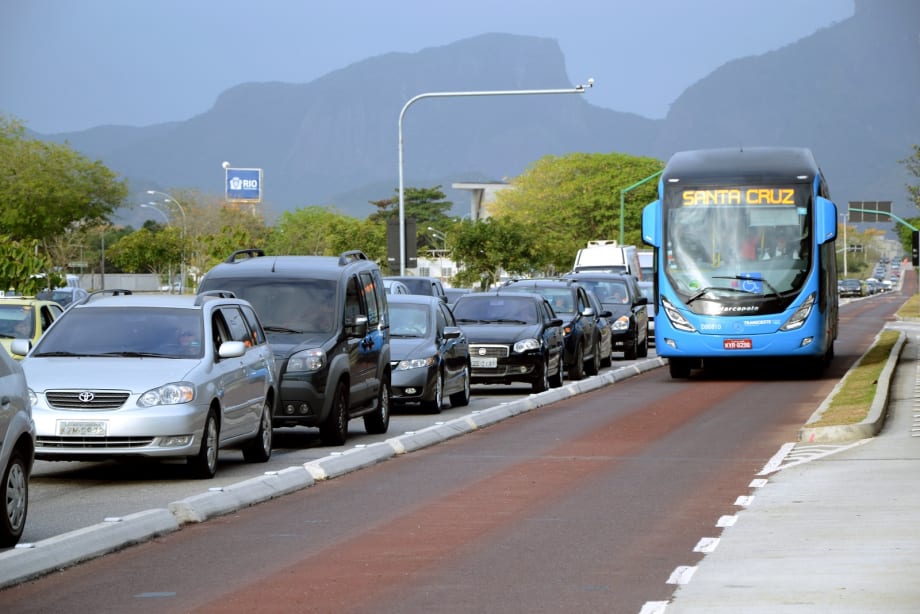
Rio De Janeiro's TransOeste bus rapid transit system pictured.
Photo by Mariana Gil/EMBARQ Brasil
Rio De Janeiro's TransOeste bus rapid transit system pictured.
Photo by Mariana Gil/EMBARQ Brasil
New analysis of four iconic cities shows that commuters can save millions of hours of travel time by shifting to bus rapid transit (BRT) systems (video). The report from EMBARQ, the World Resources Institute program for sustainable urban transport and planning, draws primarily from case studies conducted in Bogotá, Colombia; Mexico City; Johannesburg; South Africa; and Istanbul, Turkey.
Findings from "Social, Environmental and Economic Impacts of Bus Rapid Transit System" point to BRT’s capacity to improve quality of life by reducing travel time, improving local air quality, curbing greenhouse gas (GHG) emissions, and preventing road fatalities and crashes.
BRT is a city-based high-speed bus transit system where new and efficient buses travel on dedicated routes. As of October 2013, more than 29 million passengers ride BRT daily in 163 cities, with an additional 143 BRT systems currently being implemented or expanded. BRT is a growing transport solution around the world, both in developed and developing countries, .
“New research on the broad impacts of bus rapid transit demonstrates the potential for cities to achieve environmentally, socially and financially sustainable urban mobility,” said Holger Dalkmann, Director of EMBARQ. “Results from fast-growing cities that are implementing sustainable mobility around the world strengthen the case for BRT as a response to the challenges of urban transport."
Key report findings show:
In Istanbul, the average passenger on Metrobüs saved 28 workdays per year in reduced travel times.
In Johannesburg, commuters stand to save an estimated 73 million hours by shifting to BRT between 2007-2026. The travel time saved is equivalent to over 9 million 8-hour workdays.
In Mexico City, 2,000 days of lost work due to illness were prevented by reducing local air pollution and emission on the Metrobús Line 3. Additional benefits including prevention of 4 new cases of chronic bronchitis and two deaths per year will save an estimated USD $4.5 million over 20 years.
In Bogotá, the city will save an estimated $288 million in avoided traffic injuries and fatalities between 1998-2017.
Recommendations in the report include steps for policymakers, technical experts and financing bodies to maximize the benefits of BRT projects. Of special note are national and municipal transport policies, physical and operational system design, and effective financing mechanisms.
“Our analysis shows the wide variety of benefits BRT can have on quality of life,” said Dr. Robin King, director, urban development and accessibility, for EMBARQ and co-author of the report. “In addition to saving people thousands of hours on the road, BRT is safer and causes less pollution than business as usual. With the findings and methodology we present, city officials can make better informed choices when shaping the future mobility of their cities.”
BRT has received considerable interest from institutions financing infrastructure and transport projects, including HSBC, which supported this research and the accompanying video.
“With sustainable mobility, cities can become more successful and attractive to business and citizens. BRT offers the means to connect people to economic and social opportunities in a sustainable way for long term growth in cities,” said Graham Smith, director, export finance, at HSBC.
EMBARQ is also releasing a short video — "Bus Rapid Transit: Social, Environmental and Economic Impacts" — focused on the key benefits of BRT outlined in the report. The video features interviews with technical experts, planners, government officials and BRT users.
More Bus

New York MTA Plans Largest Bus Fleet Upgrade in More Than a Decade
The agency is seeking manufacturers for 650 new CNG buses to replace aging vehicles, improve reliability, and advance its broader fleet modernization strategy.
Read More →
Building a Flexible Path to Transit Electrification
John Hroncich discusses BAE Systems’ modular and scalable approach, lessons learned from decades of real-world operations, and how agencies can identify electrification strategies that fit their fleets.
Read More →
Bus Tech Talk: Keeping Transit Technicians Ahead of the Technology Curve
LA Metro’s Obed Mejia discusses technician training, evolving maintenance technology, fleet replacement, and strategies for getting the most out of today’s transit fleets.
Read More →
Biz Briefs: RIPTA Unveils New Frontrunners, Clevland RTA Adds New Siemens, and More
In METRO's latest installment, we take a look at recent news from Siemens, Prevost, Dodge, and more partnerships making headlines across the transportation sector.
Read More →
People Movement: Holly Arnold Joins Transdev and More
In this edition, we also cover recent appointments and announcements at Pace, CamTran, MCI, and more, showcasing the individuals helping to shape the future of transportation.
Read More →
The High Cost of Transit Buses: Industry Leaders Look to Procurement Reform
Transit leaders and policymakers examine how standardized bus designs, streamlined procurement, and predictable funding could help agencies stretch budgets and deliver better service.
Read More →
The Business Voice Behind Public Transportation
As chair of APTA’s Business Members Board of Governors, Ray Melleady explains how more than 850 business members are partnering with transit agencies to advance funding, innovation, and industry-wide collaboration.
Read More →
From Surviving to Thriving: Building Stronger Transportation Organizations
Bus Business Consultants founder Brian Dickson shares lessons on leadership, organizational health, and creating options for long-term success in a changing transportation industry.
Read More →
Finding the ‘Happy Medium’: Optimizing Maintenance Without Sacrificing Reliability
The key to maintenance optimization isn’t doing less work—it’s doing the right work at the right time on the right assets.
Read More →
LA Metro, City of West Hollywood, and Partners Advance Smarter Bus Lane Enforcement
The award-winning partnership combines AI-powered detection with human oversight to improve bus reliability, accessibility, and enforcement efficiency.
Read More →