



Related: WSP | PB to overhaul, upgrade MARTA ventilation systems
No. 7 Subway Extension Brings Rail to N.Y.’s Hudson Yards
The $2.4 billion line lays the groundwork for a projected $20 billion in development for midtown Manhattan’s far west side. Its accompanying station links to 18 subway lines.
by Neil Lucey
February 29, 2016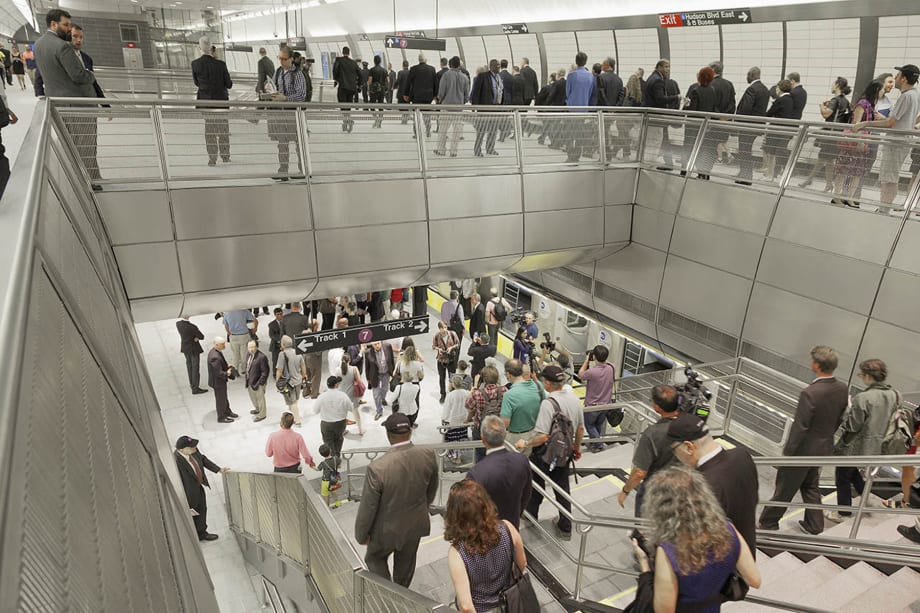
All photos courtesy WSP|Parsons Brinckerhoff
6 min to read
All photos courtesy WSP|Parsons Brinckerhoff
When a new subway station opened in September at New York City’s Hudson Yards — the first in 26 years — it marked the culmination of more than a decade of work by the Metropolitan Transportation Authority (MTA) in planning a new neighborhood and bringing rail transit to midtown Manhattan’s far west side. The new station, at 34th Street and 11th Avenue, serves the city’s No. 7 line subway, which was extended 1.5 miles from its previous terminus at Times Square (8th Avenue at 42nd Street).
The City of New York funded the $2.4 billion extension of the line, with MTA Capital Construction managing the project. The extension was part of a comprehensive redevelopment plan for the far west side, which also included rezoning from low-density manufacturing to higher-density commercial/residential, creating a special zoning district, and establishing the Hudson Yards Development Corp. to spearhead this effort. As the city’s prime consultant, WSP | Parsons Brinckerhoff prepared the environmental impact statement (EIS); led conceptual, preliminary and final design for the subway extension; assisted the MTA in development of overall construction program and contract packaging arrangements; and provided construction support services. As a consultant to contractor, S3II Tunnel Constructors, a joint venture of J.F. Shea Construction Inc., Skanska Construction Inc.,and Shiavone Construction Co. Inc., the firm also served as systems integrator, responsible for ensuring that mechanical-electrical-plumbing (MEP) systems perform as designed.
Station amenities
The extension of the No. 7 subway line runs from the previous terminus at Times Square, west under West 41st Street, and south under 11th Avenue to West 34th Street, although tail tunnels for train storage extend to West 25th Street. The new station links to 18 subway lines, essentially connecting the rest of the city to the Hudson Yards development, Jacob Javits Convention Center, the High Line, the newly opened Hudson Park & Boulevard and the Hudson River waterfront.
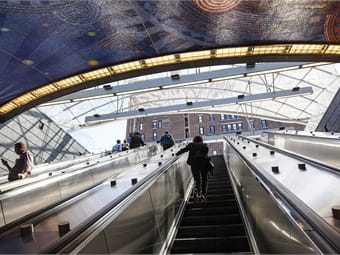
The new Hudson Yards station features the longest column-free platform and the longest escalators inside any station in the New York City system, as well as two inclined elevators between the upper and lower mezzanines.
The station’s amenities include contemporary finishes, such as stainless steel tile wall panels, painted steel ceiling panels, granite floor tile and energy-efficient lighting. It features the longest column-free platform and the longest escalators inside any station in the New York City system; two inclined elevators between the upper and lower mezzanines; an air-tempered platform level to maintain a year-round temperature between 72 to 28 degrees Fahrenheit; 12 intercoms that allow customers to communicate with the station agent or the rail control center in the case of an emergency; and 24 55-inch digital screens on the lower mezzanine to show advertising and service notices from New York City Transit.
Unique Challenges
The 34th Street station, the 469th in the New York subway system, is deep by New York City subway standards — 125 feet underground. As a result, design and construction of the project posed a number of challenges, including:
• Choosing the optimal alignment, along West 41st Street and 11th Avenue, which facilitated construction and served associated development in Hudson Yards.
• Excavation and construction of a tunnel under the Port Authority Bus Terminal.
• Tunneling and construction close to existing structures (in some cases 20 feet), including two Amtrak tunnels and three tubes of the Lincoln Tunnel under which the new tunnel passes.
• Extensive underpinning of the subway station at 8th Avenue and 41st Street and underpinning existing No. 7 tail track tunnel columns.
• Coordinating the design of No. 7 systems building structures with the designs of private development overbuild structures.
The need to avoid the existing tunnels, buildings and other infrastructure required relatively deep tunnels — about 100 feet deep in most places. The tunnels were excavated by two tunnel boring machines (TBMs). As the TBMs dug the tunnels, a cavern for the station was mined through the drill-and-blast method.
All photos courtesy WSP|Parsons Brinckerhoff
Inconspicuous construction
Virtually all construction activity was underground and not visible to the public. Not even riders of the No. 7 line who disembarked at the former terminus of the line at Times Square (42nd Street) were impacted by the work to connect the new tunnel to Times Square station.
Extending the No. 7 subway tunnel from the Times Square station required the construction of a tunnel below the Port Authority Bus Terminal, between 8th and 9th avenues. This work, too, was largely invisible to the public, as it was constructed through “cover-and-cut” tunneling. In this method, the area was first decked over so that the tunnel could be constructed with minimal impact on the bus operations above.
Extension Spurs Development
Finding opportunities to allow for growth is critical to the future of New York City. While the city seeks broad growth throughout the five boroughs, a key to its economic competiveness is to sustain growth in Manhattan through integrated commercial and residential development in the framework of livable and sustainable communities.
A critical success factor to new development in Manhattan is the availability of land. Independent studies by the New York City Department of City Planning and the Group of 35, a committee of city and state leaders in the fields of business, real estate planning, academia, government and labor, indicated that the Hudson Yards area was ideally suited to accommodate needed growth, in that it was a large underutilized area near west midtown containing relatively few residences in locations best-suited to high-density commercial development. These studies also indicated that development of the area for commercial and residential uses would require that the Hudson Yards area be rezoned from its predominantly manufacturing zoning, and that the subway system be extended to allow for the transit-oriented development of the Hudson Yards area.
The Javits Center, located within the Hudson Yards area, is the city’s primary venue for major trade shows, exhibitions and conventions — key contributors to the city and state economies. Studies indicated that the convention center required more prime contiguous exhibition space, nearby hotel space, and meeting rooms to effectively compete for large-size recurring trade shows and conventions.
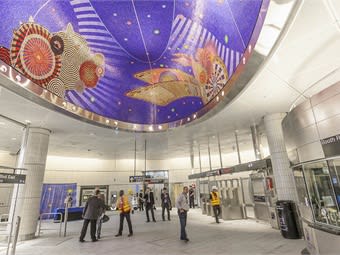
Areas next to the new station (shown) are undergoing significant TOD, including a 51-story office tower.
With these studies as background, the 6,600-page EIS associated with the project considered not only the extension of the subway line, but also the expansion and modernization of the Javits Center and the rezoning of much of the west midtown area of Manhattan for commercial, residential and recreational development, which is projected to total $20 billion. The EIS, completed in 2004 on behalf of the MTA and the city planning commission, has been called the most complex document of its kind in New York history.
Today, the 28-acre site and areas adjacent to the new station are undergoing significant transit-oriented development, including 55 Hudson Yards, a 51-story office tower; 3 Hudson Boulevard, a mixed-use 66-story tower; and 15 Hudson Yards, a 70-story residential high-rise. WSP | Parsons Brinckerhoff’s buildings practice is providing structural and/or MEP engineering for these high-rise projects, and the firm is also designing an extension of a new park and boulevard in the area.
With the opening of the No. 7 subway line extension and 34th Street Hudson Yards station, MTA has created a gateway to midtown Manhattan’s far west side — and New York City’s newest neighborhood.
Neil Lucey is Senior VP/Project Director, No. 7 Line Extension - WSP | Parsons
Brinckerhoff, New York
Subscribe to Our Newsletter
More Rail

New York MTA Advances Final Contract for Second Avenue Subway Expansion
Contract Four is the largest in the Second Avenue Subway Phase 2 project and includes construction of station infrastructure, tracks, and signals for the subway expansion, MTA officials said. Work on Contract Four will begin in 2027.
Read More →
San Diego MTS Breaks Monthly Trolley Ridership Record
Agency officials said July’s ridership indicates MTS’s continued recovery from the pandemic.
Read More →
Report Examines NJ TRANSIT Reliability, Funding Challenges
The Garden State Initiative analysis examines the roles of Amtrak infrastructure, fleet management, and agency operations while recommending a more performance-based approach to improving reliability.
Read More →
Stadler, CapMetro Sign Long-Term Rail Fleet Support Agreement
Beginning in 2027, Stadler will provide on-site technical expertise, spare parts support, training, and obsolescence management to help extend the reliability and longevity of CapMetro’s GTW fleet.
Read More →
Biz Briefs: Alstom Lands Canadian Contract, LYT to Supply California TSP, and More
In METRO's latest installment, we take a look at recent news from Complete Coach Works, Beep, FlixBus, and more partnerships making headlines across the transportation sector.
Read More →
CATS Gold Line Marks 5 Years of Service, 2.8M Passenger Trips
With a six-mile expansion planned, the Charlotte streetcar is positioned to connect more neighborhoods and major transit hubs across the region.
Read More →
Why Simulating Pedestrian Movement Has Become Essential for Modern Rail Stations
Pedestrian microsimulation is helping rail planners identify bottlenecks, test station designs, and prepare complex transit hubs for growing passenger volumes.
Read More →
Amtrak Begins Major Construction at New York’s Sunnyside Yard
The new maintenance facility will support Amtrak’s Airo trainsets while improving maintenance efficiency and turnaround times in New York.
Read More →
Chicago Leaders Unveil Plans for O’Hare Airport Express Train
The privately developed project would offer a 15-minute trip between downtown and O’Hare’s Terminal 2, with trains operating every 15 minutes on a dedicated track. The service would use battery-electric trains and three existing freight rail rights-of-way.
Read More →
OCTA Maps Out 30-Year Strategy to Protect Coastal Rail Corridor
The draft feasibility report identifies strategies to protect the coastal rail line for decades as the agency continues near-term stabilization and sand placement efforts.
Read More →