



Related: Alternative Transit Project Delivery Offers Attractive Options
Design-Build Facilitates Completion of L.A.'s Expo Line Phase 2
The 6.6-mile Expo Line will improve transportation mobility along the corridor, provide an alternative to the heavily-congested I-10 freeway and east-west arterials, and increase the capacity of the transportation system in Los Angeles County.
by Bruce Ross
September 1, 2015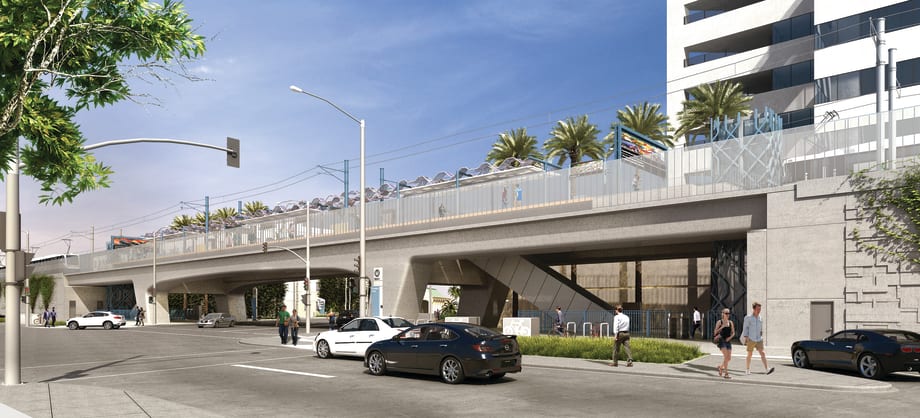
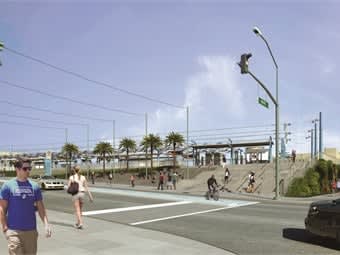
The Exposition/Bundy aerial station will feature a center platform, which will be accessible via stairs and elevator, on a bridge structure over Bundy Dr., just north of Exposition Blvd. Nearby destinations include business centers and the West Los Angeles and Mar Vista neighborhoods. The station’s park-and-ride facility is a surface lot with approximately 250 spaces. Passengers can make connections to Santa Monica Big Blue Bus lines.
6 min to read
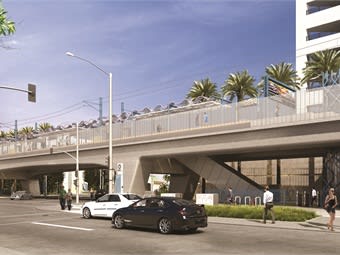
The Exposition/Bundy aerial station will feature a center platform, which will be accessible via stairs and elevator, on a bridge structure over Bundy Dr., just north of Exposition Blvd. Nearby destinations include business centers and the West Los Angeles and Mar Vista neighborhoods. The station’s park-and-ride facility is a surface lot with approximately 250 spaces. Passengers can make connections to Santa Monica Big Blue Bus lines.
What does it take to get Angelenos off the freeway, out of their cars and onto a light rail transit (LRT) line for the 15.2-mile trip between downtown Los Angeles and Santa Monica, L.A.’s beachside neighbor? With the ability to allow riders to make the journey from downtown to the beach in approximately 45 minutes — even during rush hour — the Exposition (Expo) Line may hold the key.
Expo Line Phase 1, an 8.6-mile LRT line with 12 stations between downtown Los Angeles and Culver City, opened in April 2012. Expo Line Phase 2 — the 6.6-mile extension under construction between Culver City and Santa Monica, comprising seven new stations, seven major bridges, and three park-and-ride lots with approximately 570 spaces — is due to open in 2016.
Improve mobility
By 2030, the completed Expo Line is expected to attract a ridership of approximately 64,000 per day. The Expo Line will improve transportation mobility for residents and visitors along the corridor; provide an alternative to the heavily congested I-10 freeway and east-west arterials; increase the capacity of the transportation system in Los Angeles County; and improve access to employment, education and recreation in downtown L.A., Culver City, Santa Monica and other destinations along the corridor.
The state legislature established the Exposition Construction Authority (Expo Authority) to plan, design and construct the Expo Line from downtown to Santa Monica. When Phase 2 is completed, the entire Expo Line will be owned and operated by Los Angeles County Metropolitan Transportation Authority (Metro), the regional transportation planning agency for Los Angeles County.
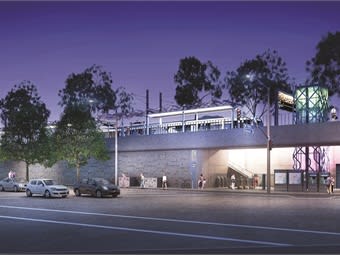
The Palms elevated station will feature a center platform, which will be accessible via stairs and elevators, on the northwest corner of National Blvd. and Palms Blvd. Nearby destinations include the Palms neighborhood, schools, a shopping center and a public park. Passengers can make connections to Santa Monica Big Blue Bus and Culver City Bus lines.
The total project cost of Phase 2, at $1.5 billion, includes costs for design, construction, utility relocation, light rail vehicles and real estate. The Phase 2 funding agreement between Metro and the Expo Authority provided the guidelines by which Metro is funding the project through a half-cent sales tax revenue as well as state and local funds.
Expo Authority awarded a design-build contract to a joint venture of Skanska USA and Rados Construction Inc. for Expo Phase 2. As lead designer for the Skanska-Rados joint venture, Parsons Brinckerhoff provided track design and station design, incorporating bikeway facilities and pedestrian links; design of the track guideway, structures, traction power system, overhead catenary system (OCS) and communication ductwork; design for 24 at-grade and above-grade street crossings; three park-and-ride lots; drainage and road improvements for at-grade crossings; and relocation of utilities.
Streamlined approach
Under the design-build project delivery method, the design-build team works under a single contract with the project owner to provide integrated design and construction services. A streamlined approach with a single point of responsibility, design-build is an alternative to the traditional design-bid-build delivery method in which design and construction services are split between separate entities and contracts.
A proven team approach for efficient construction of highways and buildings, the design-build method is gaining momentum in the transit industry. The Gold Line light rail line from Los Angeles to Pasadena was among the earliest transit design-build projects completed in the U.S. Following this success, Expo Phase 1 and Phase 2 were also built utilizing the design-build method.
“Design-build provides an integrated contracting vehicle for the design and construction of a project,” says Eric Olson, chief project officer, Exposition Construction Authority. “When done successfully, it results in a collaborative effort between the construction contractor, designer and the owner. This facilitates a cost-effective and constructible design that is consistent with the vision of the owner.”
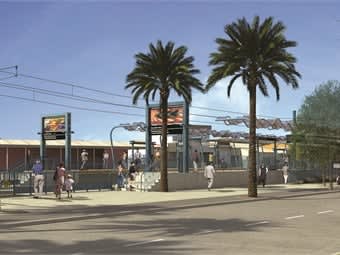
The 26th Street/Bergamot at-grade station will feature two side platforms located adjacent to Bergamot Station, on the southeast corner of Olympic Blvd. and 26th St. Nearby destinations include an arts center, a hospital, an office complex and public parks. Passengers can make connections to a Santa Monica Big Blue Bus line.
As a team approach, design-build takes experience, strong relationships and commitment to a common goal. For Expo Line Phase 2, every discipline lead for design and construction, and a full-time quality assurance manager, were co-located in one project office, meeting weekly, performing interdisciplinary design reviews, constructability reviews, and working from a central document control system and central CADD database to facilitate communication and coordination.
“Most of the design was critical path, so delivering on the design schedule was crucial for the overall success of the project,” says Brett E. Jones, P.E., VP, Parsons Brinckerhoff. “We broke the design into 26 packages that were sequenced according to the approval and construction processes. Authority and Metro were involved early, providing feedback on the trains, operations, and the location and geometry of the turnouts and providing early approval on design deviations. Our design teams completed 90 percent of the design within the first 15 months, which facilitated the construction schedule.”
Collaboration key, resolve challenges
Skanska Project Executive Brian Freund says, “Collaboration between the owner, designer and construction team from the very beginning was a key to success. Decisions made early in the process about proper phasing of project elements could not be made in a vacuum and they had to be handled quickly in order to keep to schedule.”
Discipline leads collaborated in the field to quickly resolve design-build challenges and save project dollars; for example, determining that a mile-long, 10-foot-diameter arched brick storm water pipe 20 feet under Colorado Avenue in Santa Monica would support the LRT load and could be left in place with offset manholes.
The Expo Line was designed as a multimodal transit parkway with parking facilities, bike facilities and transit connections. Stations are generally located at major north/south arterials for increased access and mobility. Station parking is provided at some locations, and all stations feature bike facilities, including bike racks and lockers. Local public transit providers conducted studies to determine how to best serve the new stations.
Landscaping is primarily comprised of native, drought-tolerant plants. The stations feature signature palm and ginko trees, which line the corridor.
Community, stakeholder involvement
Community involvement in station design, native landscaping and public art was an important component of the project. The Expo Authority appointed an urban design committee comprised of members representing communities and stakeholders along the entire Expo alignment to provide input into design, landscaping and art; and a community-stakeholder bikeway advisory committee provided input on the bikeway project built in conjunction with and adjacent to the Phase 2 project.
Metro’s public art program dedicates 0.5% of rail construction project costs to creating original artwork at each station. Of nearly 400 artists who submitted qualifications for consideration for the Expo Phase 2 stations, eight were selected by stakeholders and the community to provide artworks.
Landscaping is primarily comprised of native, drought-tolerant plants. The stations feature signature palm trees and ginkgo trees, which line the corridor, tying into the landscaping on Phase 1.
Community-wide outreach for the project kept the community in the loop with quarterly construction update meetings; presentations to neighborhood councils, homeowner associations, block clubs, business associations and school groups; information tables at community events; and construction notices distributed in affected areas prior to the start of new construction and fieldwork activities.
Construction is slated for substantial completion in late September, when the line will be turned over to Metro for pre-revenue testing. It is anticipated that Expo 2 will be open to the public by early 2016.
The Expo Line is a key component of a regional plan to provide cost-effective, environmentally friendly mass transit options and increase mobility in southern California. By providing an efficient alternative to driving for Angelenos and visitors, the Expo Line also will contribute to reduced levels of air pollutants and greenhouse gases, improving the overall quality of life in this region.
Bruce Ross, founder of New York City-based Bruce Ross Associates Inc., writes frequently about transit.
Subscribe to Our Newsletter
More Rail

New York MTA Advances Final Contract for Second Avenue Subway Expansion
Contract Four is the largest in the Second Avenue Subway Phase 2 project and includes construction of station infrastructure, tracks, and signals for the subway expansion, MTA officials said. Work on Contract Four will begin in 2027.
Read More →
San Diego MTS Breaks Monthly Trolley Ridership Record
Agency officials said July’s ridership indicates MTS’s continued recovery from the pandemic.
Read More →
Report Examines NJ TRANSIT Reliability, Funding Challenges
The Garden State Initiative analysis examines the roles of Amtrak infrastructure, fleet management, and agency operations while recommending a more performance-based approach to improving reliability.
Read More →
Stadler, CapMetro Sign Long-Term Rail Fleet Support Agreement
Beginning in 2027, Stadler will provide on-site technical expertise, spare parts support, training, and obsolescence management to help extend the reliability and longevity of CapMetro’s GTW fleet.
Read More →
Biz Briefs: Alstom Lands Canadian Contract, LYT to Supply California TSP, and More
In METRO's latest installment, we take a look at recent news from Complete Coach Works, Beep, FlixBus, and more partnerships making headlines across the transportation sector.
Read More →
CATS Gold Line Marks 5 Years of Service, 2.8M Passenger Trips
With a six-mile expansion planned, the Charlotte streetcar is positioned to connect more neighborhoods and major transit hubs across the region.
Read More →
Why Simulating Pedestrian Movement Has Become Essential for Modern Rail Stations
Pedestrian microsimulation is helping rail planners identify bottlenecks, test station designs, and prepare complex transit hubs for growing passenger volumes.
Read More →
Amtrak Begins Major Construction at New York’s Sunnyside Yard
The new maintenance facility will support Amtrak’s Airo trainsets while improving maintenance efficiency and turnaround times in New York.
Read More →
Chicago Leaders Unveil Plans for O’Hare Airport Express Train
The privately developed project would offer a 15-minute trip between downtown and O’Hare’s Terminal 2, with trains operating every 15 minutes on a dedicated track. The service would use battery-electric trains and three existing freight rail rights-of-way.
Read More →
OCTA Maps Out 30-Year Strategy to Protect Coastal Rail Corridor
The draft feasibility report identifies strategies to protect the coastal rail line for decades as the agency continues near-term stabilization and sand placement efforts.
Read More →