



Florida’s Brightline to Boost Intercity Train Travel
The first phase of the express passenger rail service, costing more than $1 billion, will connect the region’s main Central Business Districts of Miami, Fort Lauderdale, and West Palm Beach, while Phase 2 will connect Orlando.

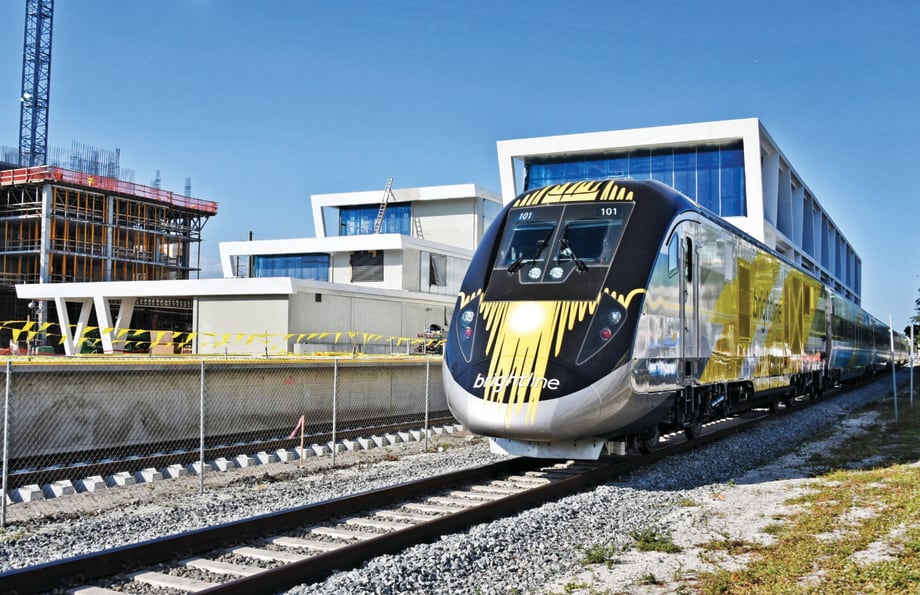
Brightline trains, manufactured by Siemens, feature level boarding and utilize automated retractable platforms that are integrated into the train car door systems.
Brightline trains, manufactured by Siemens, feature level boarding and utilize automated retractable platforms that are integrated into the train car door systems.
Momentum is building for the late summer launch of Brightline — Florida’s express intercity passenger rail service connecting Miami, Fort Lauderdale, and West Palm Beach, with future service to Orlando. It is the only privately owned, operated, and maintained passenger rail system in the U.S. Introductory service will begin between West Palm Beach and Fort Lauderdale in late summer, followed by service to Miami in the fall. The total investment of Phase 1 is more than $1 billion, with an additional $1.5 billion for Phase 2.
METRO Magazine spoke to Brightline’s Chief Marketing Officer Julie Edwards about the dynamic project.
What prompted the development of the Brightline service?
The idea for Brightline came about as we looked at the transportation landscape in the state and observed a couple of important things. Number one, Florida is a large and growing state. The population base is now the third biggest in the country and it’s growing at about 1.5 times the rate of population growth of the rest of the country.
Mobility in the state is limited to personal automobiles. On a road system that was constructed when the population was about one-third of what it is today, and as the economy and population grew over time, one thing that couldn’t keep pace was the transportation infrastructure.
From those realities, came an opportunity for an alternative way to help people move about, particularly to and from places they are moving back and forth in large numbers. In Florida, we’ve seen that approximately 500 million trips per year are taken, predominantly by car,
How was this project influenced by other rail systems?
The Brightline team studied passenger rail systems around the world and came to some pretty important conclusions. Research shows that trains work as the preferred method for people to go back and forth between large population centers that have highly mobile activity between them, like the millions of trips that are made between the four cities that Brightline will serve. When road congestion exists as a significant impediment to driving your car — like it absolutely does in Southeast Florida — that’s a key driver that contributes to the success of profitable rail systems. Also, a key driver is when you can get to the points that you’re connecting to that are approximately 250 to 300 miles apart. You can get there faster by train than if you drive which generally means about a three-hour window. When you look around the world and you find operations that are successful and profitable, they all seem to have those fundamental characteristics. We are able to deliver a service that will reliably get you to your destination in a set period of time — 30 minutes from Miami to Fort Lauderdale — something that cannot be done if you take the chance on the highway because of the unpredictability of traffic.
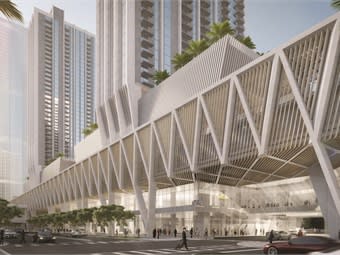
MiamiCentral, which encompasses nearly three million square feet, will include retail, offices, residences, the Brightline train service, and ample parking, while serving as a connector between Brightline’s passengers and Miami’s existing public transport systems.
What are the benefits of being privately funded?
We have been able to do this in just about five years. The main impetus has been that we are a private company that is privately funding this project — we have not asked for supplemental investment from the public sector. The first phase of the project totals about $1 billion in private investment. Secondly, leveraging the existing rail corridor has been a benefit for us. We have invested heavily in upgrading the existing infrastructure, but to have the rail corridor in place already was a significant advantage.
How will the service impact transportation in the region?
The rail service is spurring additional conversations about expanding existing transit systems, like Tri-Rail. Brightline worked closely with the South Florida Regional Transportation Authority, the operator of Tri-Rail, and the local agencies in Miami-Dade County to make the Tri-Rail Coastal Link connection a reality.
Today, Tri-Rail terminates at the Miami International Airport’s Intermodal Center. In early 2018, the commuter rail system will extend to downtown Miami and into MiamiCentral. This is critical for the region as Tri-Rail has 17 stations on its route, connecting communities along the west of I-95 and through the tri-county area. New transit connections mean additional employment and entertainment opportunities for the millions who live, work and play in our region.
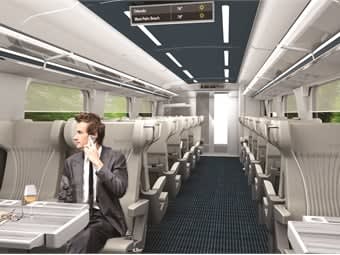
On each trainset, there is one Select (pictured) and three Smart coaches, riders can reserve specific seats when booking tickets through Brightline’s mobile application, website, or station kiosks.
How has the project spurred economic development?
Brightline is spurring a significant amount of development around each of its station locations in South Florida and is also developing mixed-use developments around each of its stations. MiamiCentral is about three million square feet, including 800 rental units, Class A office space, and about 200,000 square feet of retail and food and beverage.
The company owns several acres of land in downtown Fort Lauderdale and is planning adjacent transit oriented development. Developers in Fort Lauderdale have announced plans for new residential buildings and hotels within close proximity to Brightline’s station.
In West Palm Beach, Brightline is developing a 290-unit apartment building just west of its station, and across the street, Alliance Residential Co. is developing a multi-story apartment project. These are just some examples of development occurring around the stations.
Discuss the significance of the selected corridors?
Brightline is the legacy company of Henry Flagler, who extended the Florida East Coast Railway from Jacksonville to Key West. The Florida East Coast Railway has been in continuous operation for more than 120 years, and it was only used for freight over the past several decades. Brightline will utilize the Florida East Coast Railway corridor for the Phase 1 segment and Phase 2.
The Phase 2 segment will utilize the Florida East Coast Railway to Cocoa, and 40 miles of new rail will be constructed along the SR 528 corridor to the Greater Orlando International Airport, which is where the Orlando station will be located. The rail company is leveraging an existing asset and double-tracking the corridor, upgrading the grade crossings, installing new signal systems and Positive Train Control.
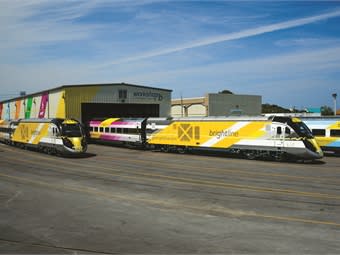
Workshop b is Brightline’s new 12-acre railroad operations facility in West Palm Beach that serves to repair, maintain, clean, and store Brightline’s trains. There are four tracks within the facility, two of which are covered by an 800-foot-long canopy.
Discuss any collaboration with other transit agencies.
Brightline is connecting to existing and future transit systems. The downtown Miami station, MiamiCentral, will be a mobility hub, including connections to Metrorail, Metromover, county bus system, trolleys, rideshare, and bikeshare, as well as rental car options. In Fort Lauderdale, the station provides easy access to Broward County’s transit system, the Sun Trolley system, and the future Wave streetcar. In West Palm Beach, the Brightline station connects to the trolley system and is about a half a mile east of the Tri-Rail and Amtrak stations.
Any partnerships for first-mile/last-mile connections?
A variety of transportation offerings are available to get riders to the stations and their final destinations through ride sharing/taxi options, rental cars, and shuttle services.
Talk about the train features.
Onboard train features include giant windows for a great view from every seat, powerful and free Wi-Fi with convenient power outlets. There are two comfortable train coach experiences in Select and Smart. Select car guests can also take advantage of added benefits including extra-wide premium leather seats, complimentary food and beverages, and access to Brightline’s Premium Guest Lounge.
The train sets, being manufactured in California by Siemens USA, are 100% Buy America-compliant. They are powered by two locomotives and are equipped with a 16-cylinder, 4,000hp Cummins EPA Tier-IV-compliant diesel-electric engine.
Level boarding is a unique feature on these trains. As part of the automated door system, Brightline utilizes a ‘gap filler’ that bridges the gap and height change between the train and the platform. Other features include 32-inch-wide interior aisles to provide ample space for wheelchairs and strollers. Energy-efficient LED lighting is featured throughout the trainsets.
More Rail

New York MTA Advances Final Contract for Second Avenue Subway Expansion
Contract Four is the largest in the Second Avenue Subway Phase 2 project and includes construction of station infrastructure, tracks, and signals for the subway expansion, MTA officials said. Work on Contract Four will begin in 2027.
Read More →
San Diego MTS Breaks Monthly Trolley Ridership Record
Agency officials said July’s ridership indicates MTS’s continued recovery from the pandemic.
Read More →
Report Examines NJ TRANSIT Reliability, Funding Challenges
The Garden State Initiative analysis examines the roles of Amtrak infrastructure, fleet management, and agency operations while recommending a more performance-based approach to improving reliability.
Read More →
Stadler, CapMetro Sign Long-Term Rail Fleet Support Agreement
Beginning in 2027, Stadler will provide on-site technical expertise, spare parts support, training, and obsolescence management to help extend the reliability and longevity of CapMetro’s GTW fleet.
Read More →
Biz Briefs: Alstom Lands Canadian Contract, LYT to Supply California TSP, and More
In METRO's latest installment, we take a look at recent news from Complete Coach Works, Beep, FlixBus, and more partnerships making headlines across the transportation sector.
Read More →
CATS Gold Line Marks 5 Years of Service, 2.8M Passenger Trips
With a six-mile expansion planned, the Charlotte streetcar is positioned to connect more neighborhoods and major transit hubs across the region.
Read More →
Why Simulating Pedestrian Movement Has Become Essential for Modern Rail Stations
Pedestrian microsimulation is helping rail planners identify bottlenecks, test station designs, and prepare complex transit hubs for growing passenger volumes.
Read More →
Amtrak Begins Major Construction at New York’s Sunnyside Yard
The new maintenance facility will support Amtrak’s Airo trainsets while improving maintenance efficiency and turnaround times in New York.
Read More →
Chicago Leaders Unveil Plans for O’Hare Airport Express Train
The privately developed project would offer a 15-minute trip between downtown and O’Hare’s Terminal 2, with trains operating every 15 minutes on a dedicated track. The service would use battery-electric trains and three existing freight rail rights-of-way.
Read More →
OCTA Maps Out 30-Year Strategy to Protect Coastal Rail Corridor
The draft feasibility report identifies strategies to protect the coastal rail line for decades as the agency continues near-term stabilization and sand placement efforts.
Read More →