




RELATED: MTS bus service gets $2M boost
San Diego MTS increases uniformed presence with new staffing plan
The new plan increases the number of MTS Code Compliance Inspectors from 34 to 64 employees.
September 26, 2017
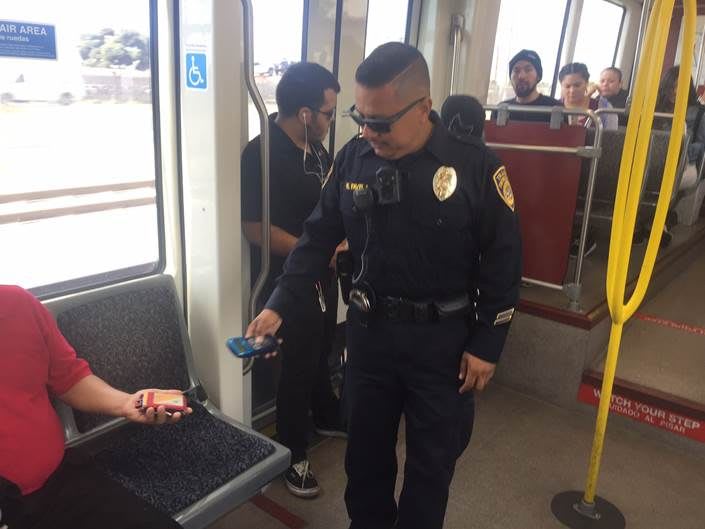
Code Compliance Inspector, Ricardo Favela, checks a passenger’s transit fare during a routine inspection onboard an MTS Trolley.
San Diego MTS
2 min to read
Code Compliance Inspector, Ricardo Favela, checks a passenger’s transit fare during a routine inspection onboard an MTS Trolley.
San Diego MTS
The San Diego Metropolitan Transit System launched a new Security Staffing Plan aimed at making the system safer by restructuring the composition of MTS’ security personnel and making changes to their deployment schedule. The plan was fully implemented this month.
“Passenger safety is a top priority for MTS,” said Paul Jablonski, MTS CEO. “The new security staffing plan will add a greater uniform presence on our system. This is another strategic step MTS has taken to boost system-wide security.”
The new plan increases the number of MTS Code Compliance Inspectors (CCI) from 34 to 64 employees. The additional CCIs will enable MTS to implement a beat system, where each beat will consist of three to five trolley stations patrolled by a “train team” made up of a security officer paired with a CCI. This new deployment strategy nearly triples the presence of CCIs at any given time. In a related move, the number of contracted security officers will be reduced to make room for the additional CCIs. MTS has approximately 200 CCIs and contracted security officers patrolling the system.
The train teams will allow MTS to increase uniform presence during the Day Watch, maintain the same uniform presence during the Night Watch, and give the system more access to greater enforcement capabilities. The beat system will allow security teams to patrol the same beat for an extended period of time to improve familiarity, and develop a better sense of the characteristics and customers at a limited number of stations.
This new security strategy builds upon the formation of the Joint Agency Task Force in 2015. This four-person team of police officers from different law enforcement agencies assists in patrolling the MTS system and provides support during special events, while helping bolster officer experience and powers of arrest.
Other efforts to boost system security MTS has made include:
Enhanced video systems on all Trolleys and most transit stations.
Body cameras for code enforcement officers.
A canine unit to patrol trains and respond to reports of suspicious packages and bomb threats.
“Eagle Team” — a special unit to patrol late night trains on the Orange Line and UC San Diego Blue Line.
Joint security training exercises with partner transit and law enforcement agencies.
More Security and Safety

RTD Launches NextRide App to Consolidate Trip Planning, Fares, Security Reporting
The app expands on RTD’s existing NextRide web application and allows customers to view real-time vehicle locations and service alerts, purchase and store digital fares, and access customer support.
Read More →
TAPTCO Updates OSHA Compliance Training for Transit Maintenance Operations
The revamped program addresses 26 OSHA standards for maintenance facilities, with TAPTCO pointing to training, documentation, and everyday shop hazards as continuing challenges for transit operations.
Read More →
Sponsored•August 18, 2026
How VaporVision Adds Value to Transit Door Systems
Wabtec engineers explain how the system improves doorway detection, strengthens diagnostics and gives transit agencies and OEMs greater operating flexibility.
Read More →

FRA Announces $5.3B in Rail Investments, Including $2B for Amtrak
Funding will support grade-crossing improvements, infrastructure upgrades, and new Amtrak equipment in 23 states.
Read More →
Chicago, Maryland Expand Non-Law-Enforcement Safety, Rider Support
The CTA and MTA are launching new programs aimed at de-escalation, crisis response, rider assistance, and greater transparency.
Read More →
LA Metro, City of West Hollywood, and Partners Advance Smarter Bus Lane Enforcement
The award-winning partnership combines AI-powered detection with human oversight to improve bus reliability, accessibility, and enforcement efficiency.
Read More →
LA Metro Reports 57% Decline in Homelessness on Transit System Since 2024
The agency's latest homelessness count offers new data on how care-based services and cross-sector partnerships can complement traditional transit security strategies.
Read More →
FTA Launches 'Transit Moves America' Dashboard to Highlight Agency Safety and Performance
The online dashboard transforms National Transit Database information into a public-facing resource that allows users to compare transit agencies on key operational and safety metrics.
Read More →
LA Metro Marks Banner Year, Sets Ambitious Goals for New Fiscal Year
Incoming LA Metro Board Chair and Los Angeles Mayor Karen Bass joined outgoing Board Chair Fernando Dutra and LA Metro CEO Stephanie Wiggins to review accomplishments from fiscal year 2026, which included the opening of new rail extensions, advancement of major transit projects, expanded safety programs, and new rider amenities.
Read More →
Building the Next Generation of Transit Technology
In this edition of METROspectives, Luminator CEO Magnus Friberg discusses the company's transformation, the growing role of AI and software, and what's next for transit technology.
Read More →