



Calif. Agencies Raise Drought Awareness, Employ Water-Saving Measures
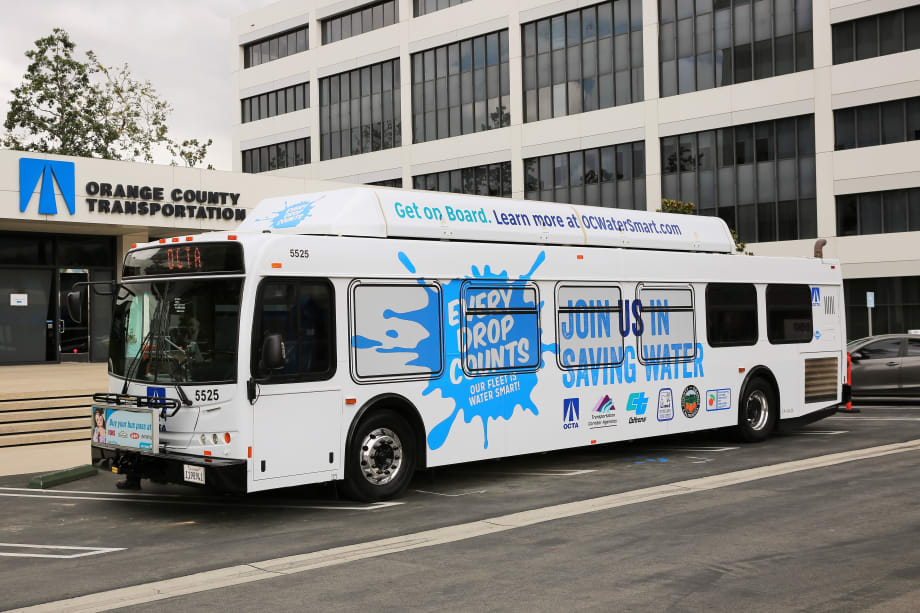
OCTA launched the “Every Drop Counts, Join Us in Saving Water” campaign and trans-formed two of its buses into moving water-conservation billboards.
OCTA
OCTA
The Orange County Transportation Authority (OCTA) recently partnered with city, water and state agencies to launch a water conservation campaign to promote awareness of the drought that has been plaguing California for the past four years.
Earlier this year in April, Gov. Jerry Brown ordered California’s first-ever mandatory water restriction. Per the restriction, cities and towns would have to cut water usage by 25%, according to the Los Angeles Times.
The restriction is unprecedented in the state, but it is also needed. The year prior, Gov. Brown asked for a 20% reduction in water use and most cities failed to meet that number, according to the Los Angeles Times. Since the drought began, temperatures in the state have reached record-breaking highs and reservoir levels have dropped to all-time lows.
In an effort to do its part, OCTA launched the “Every Drop Counts, Join Us in Saving Water” campaign and transformed two of its buses into moving water-conservation billboards. The buses are wrapped in white vinyl with blue water drops prominently displaying “Every Drop Counts” and “Join Us in Saving Water” in large, bold letters.
“One of the key things for us on this particular campaign was to raise awareness, if you live in the Central Valley or in the Bay Delta area, you’re probably more acutely aware of the drought than most of Southern California has been, and one of the things we wanted to do is continue to raise awareness that this is not going away, that it’s important,” said Darrell Johnson, OCTA CEO.
Along with its water-conservation campaign, the transportation agency has also made water usage cuts throughout its fleet and offices, which has resulted in a 20% reduction in water usage. At its offices, OCTA has installed drought-tolerant landscaping, as well as low-flow appliances.
While these recent measures have made OCTA’s offices more sustainable, its biggest reduction in water usage comes from washing their buses less often.
OCTA has gone from washing its 556 fixed-route and 248 ACCESS buses every day to washing them two times a week, using an improved reclaimed water system that saves about 30 gallons per bus. This 20% reduction accounts for about seven million gallons worth of water, or about 10 Olympic-sized pools.
However, water conservation is a state-wide issue and OCTA isn’t the only transportation agency trying to be as efficient with California’s limited supply of water.
From 2010 to 2014, Caltrans (the California Department of Transportation) reduced its statewide water usage by 32%, said Jason Probst, Caltrans spokesman, much of which is owed to the installation of 1,250 new smart irrigation controllers.
The controllers automatically adjust water patterns with the weather conditions and soil moisture. In the event of a break in the system, the controllers will shut off and send an alert to managers, guaranteeing minimal water waste.
The controllers have been installed on 64% of Caltrans’ irrigation system and are part of a $47 million investment to upgrade statewide irrigation systems, with an additional $28 million in emergency funding coming to install more controllers statewide, Probst said.
Compared to 1992, Caltrans now uses 50% less water used to irrigate to water about 33% more landscaping. This reduction in water is significant considering that 75% of the water Caltrans uses goes to watering highway vegetation throughout California.
In terms of getting the word out to people about the drought and conserving water, Caltrans uses its 700 roadside message signs, social media, advertising and its website to send reminders to people about what they should be doing during this drought.
And similar to OCTA, Caltrans has significantly cut the amount of times its state vehicles are washed. In a memo to all Caltrans employees, Director Malcom Dougherty urged employees to not wash their state vehicles unless it would otherwise present a potential health and safety issue to the driver.
More Technology

From Hardware to Digital Partner: Luminator Charts Its Next Chapter
CEO Magnus Friberg discusses Luminator’s shift toward becoming a digital partner, the growing importance of software and interoperability, and how AI can help agencies improve operations and passenger experience.
Read More →
Beyond the Checklist: A Structured Approach to Transit Maintenance
Reliability-Centered Maintenance helps transit agencies move beyond routine checklists to focus limited resources on the assets and failures that have the greatest impact on safety, reliability, and service.
Read More →
NJ TRANSIT Advances Bus Technology Upgrades Across Statewide Fleet
More than 1,500 buses now feature upgraded technology designed to improve arrival predictions and provide free Wi-Fi, with deployment expected to reach nearly 2,000 buses by the end of 2026.
Read More →

Building a Flexible Path to Transit Electrification
John Hroncich discusses BAE Systems’ modular and scalable approach, lessons learned from decades of real-world operations, and how agencies can identify electrification strategies that fit their fleets.
Read More →
Biz Briefs: Alstom Lands Canadian Contract, LYT to Supply California TSP, and More
In METRO's latest installment, we take a look at recent news from Complete Coach Works, Beep, FlixBus, and more partnerships making headlines across the transportation sector.
Read More →
From Legacy Silos to Conversational Intelligence
What if transit leaders could ask any operational question and get a trusted answer in seconds? Conversational AI is transforming how agencies use their data.
Read More →
USDOT Announces Rail Vehicle Replacement Grants, Chattanooga AV Shuttle Funding
More than $191 million in federal funding will help three transit agencies replace aging rail vehicles and support a new autonomous shuttle service in Chattanooga.
Read More →
Bus Tech Talk: Keeping Transit Technicians Ahead of the Technology Curve
LA Metro’s Obed Mejia discusses technician training, evolving maintenance technology, fleet replacement, and strategies for getting the most out of today’s transit fleets.
Read More →
Biz Briefs: RIPTA Unveils New Frontrunners, Clevland RTA Adds New Siemens, and More
In METRO's latest installment, we take a look at recent news from Siemens, Prevost, Dodge, and more partnerships making headlines across the transportation sector.
Read More →
Why Simulating Pedestrian Movement Has Become Essential for Modern Rail Stations
Pedestrian microsimulation is helping rail planners identify bottlenecks, test station designs, and prepare complex transit hubs for growing passenger volumes.
Read More →