



Bombardier wireless electric bus charging to power Berlin fleet
The PRIMOVE system charges the Berlin buses' batteries at 200 kW in the very few minutes of dwell time spent at the end stations. This allows the e-buses to serve the nearly four-mile-long bus line back and forth - without additional stops or battery changing for an entire day.

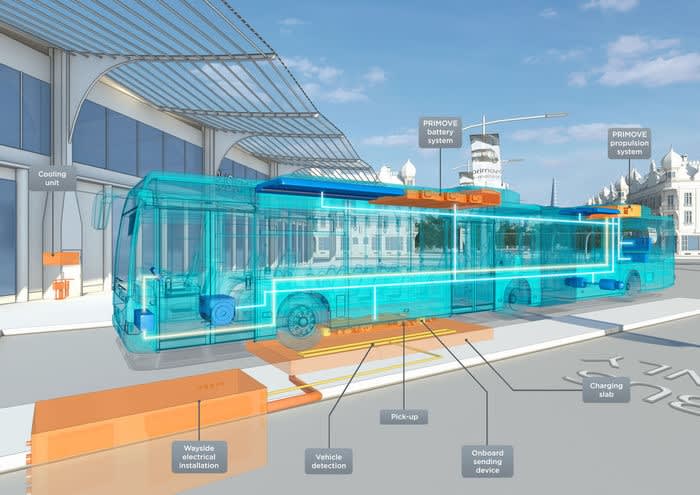
PRIMOVE 12 m e -bus for Berlin – showing the components of PRIMOVE charging and battery syste.
PRIMOVE 12 m e -bus for Berlin – showing the components of PRIMOVE charging and battery syste.
Berlin will be the first capital city to turn a complete bus line into an eco-friendly route using e-buses with the wireless PRIMOVE charging system and the compact PRIMOVE battery system. Starting in summer 2015, passengers on the city centre bus line 204 will be able to enjoy a quiet and zero-emission ride through Berlin. The German Federal Ministry of Transport and Digital Infrastructure (BMVI) is supporting the project in the context of the "International Showcase Programme for E-mobility Berlin Brandenburg".
RELATED:German bus system to test Bombardier electric charging tech
On the occasion of the installation of the inductive charging pad at Berlin's first charging station the project partners Berliner Verkehrsbetriebe (BVG; Berlin public transport authority), Technical University (TU) Berlin and Bombardier Transportation invited representatives from the BMVI, the City of Berlin and media to inform them about the technical details of the wireless charging technology, the current project status and the further project milestones. At the event, guests had the rare opportunity to inspect the charging pad, which will be invisibly embedded under the ground in just a few days. The precast charging pad weighs seven tons, is 16 feet long, 6.5 feet wide and 10 inches thick.
Bombardier's innovative PRIMOVE system charges the Berlin buses' batteries at 200 kW in the very few minutes of dwell time spent at the end stations. This allows the e-buses to serve the nearly four-mile-long bus line back and forth - without additional stops or battery changing for an entire day. As with an electric toothbrush, charging works without a cable connection. As soon as the e-bus is positioned over the underground charging pad, the pick-up coil mounted on the underside of the vehicle lowers. The inductive energy transfer begins, generating an electromagnetic field. This poses no danger to drivers, passengers or pedestrians - or even to people with pacemakers. With the optimization of the transfer frequencies and advanced shielding, the charging system falls well below the very strict European limit values for electromagnetic emissions.
Starting in April 2015, additional PRIMOVE charging stations will be installed at the route's second end stop as well as at BVG's bus depot where the four e-buses will be based. The e-buses will be built this spring by the Polish manufacturer Solaris. The twelve meter long vehicles are nearly identical to the Urbino 12 electric bus equipped with PRIMOVE charging and batteries, which has been in successful passenger operations in Braunschweig, Germany, since March 2014. The delivery of the first e-bus to the Bombardier site in Mannheim, Germany, for final coordination of the technical components is planned for May 2015. Following this, the vehicles will be delivered to Berlin for approval and commissioning. In summer 2015, passenger operations on route 204 will commence.
Berlin's new fleet of e-buses will save around 260 tons of CO2 per year. In order to achieve the same affect, around 250 private cars in Berlin, on the basis of normal driving behaviour, would have to be switched to electric mode.
More Technology

From Hardware to Digital Partner: Luminator Charts Its Next Chapter
CEO Magnus Friberg discusses Luminator’s shift toward becoming a digital partner, the growing importance of software and interoperability, and how AI can help agencies improve operations and passenger experience.
Read More →
Beyond the Checklist: A Structured Approach to Transit Maintenance
Reliability-Centered Maintenance helps transit agencies move beyond routine checklists to focus limited resources on the assets and failures that have the greatest impact on safety, reliability, and service.
Read More →
NJ TRANSIT Advances Bus Technology Upgrades Across Statewide Fleet
More than 1,500 buses now feature upgraded technology designed to improve arrival predictions and provide free Wi-Fi, with deployment expected to reach nearly 2,000 buses by the end of 2026.
Read More →

Building a Flexible Path to Transit Electrification
John Hroncich discusses BAE Systems’ modular and scalable approach, lessons learned from decades of real-world operations, and how agencies can identify electrification strategies that fit their fleets.
Read More →
Biz Briefs: Alstom Lands Canadian Contract, LYT to Supply California TSP, and More
In METRO's latest installment, we take a look at recent news from Complete Coach Works, Beep, FlixBus, and more partnerships making headlines across the transportation sector.
Read More →
From Legacy Silos to Conversational Intelligence
What if transit leaders could ask any operational question and get a trusted answer in seconds? Conversational AI is transforming how agencies use their data.
Read More →
USDOT Announces Rail Vehicle Replacement Grants, Chattanooga AV Shuttle Funding
More than $191 million in federal funding will help three transit agencies replace aging rail vehicles and support a new autonomous shuttle service in Chattanooga.
Read More →
Bus Tech Talk: Keeping Transit Technicians Ahead of the Technology Curve
LA Metro’s Obed Mejia discusses technician training, evolving maintenance technology, fleet replacement, and strategies for getting the most out of today’s transit fleets.
Read More →
Biz Briefs: RIPTA Unveils New Frontrunners, Clevland RTA Adds New Siemens, and More
In METRO's latest installment, we take a look at recent news from Siemens, Prevost, Dodge, and more partnerships making headlines across the transportation sector.
Read More →
Why Simulating Pedestrian Movement Has Become Essential for Modern Rail Stations
Pedestrian microsimulation is helping rail planners identify bottlenecks, test station designs, and prepare complex transit hubs for growing passenger volumes.
Read More →