



Key considerations for electric bus fleet infrastructure
Air pollution in major cities from Los Angeles to New York, caused in part by fossil fuel-burning vehicles, is a growing issue of concern that many transit agencies and municipalities simply cannot ignore.

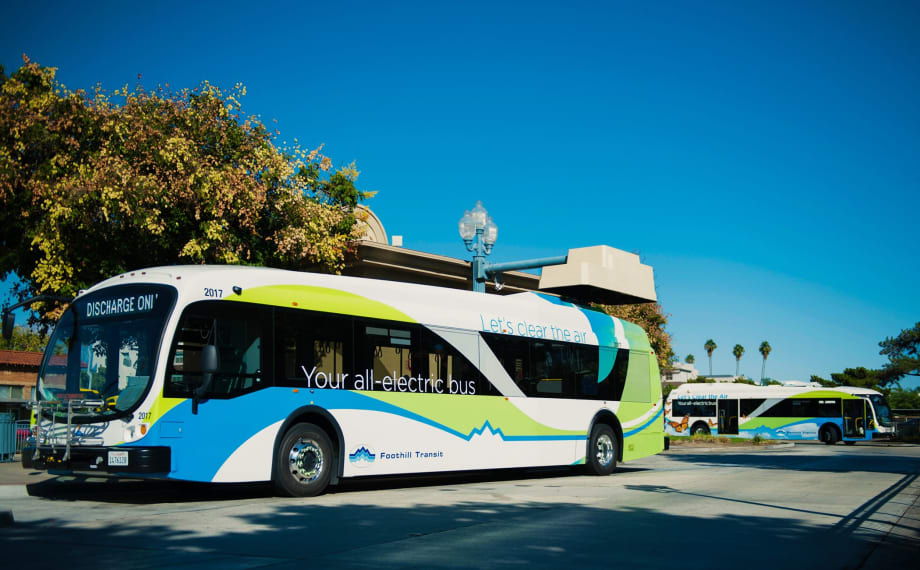
From 2010 to 2016, Foothill Transit’s 15 electric buses eliminated 2,616 tons of greenhouse gases.
RNL
From 2010 to 2016, Foothill Transit’s 15 electric buses eliminated 2,616 tons of greenhouse gases.
RNL
By Patrick M. McKelvey, AIA, PQP
Across the country, transit agencies face a growing need to adopt more sustainable operations and maintenance practices, including the use of environmentally friendly products and transportation methods. Air pollution in major cities from Los Angeles to New York, caused in part by fossil fuel-burning vehicles, is a growing issue of concern that many transit agencies and municipalities simply cannot ignore. In fact, according to the Federal Transit Administration, transportation accounts for 29% of greenhouse gas emissions in the U.S. One approach transit agencies can take to address their impact: battery-electric buses.
Electric buses are quickly becoming the vehicle of choice for transit agencies looking to reduce their carbon footprint. Some major transit agencies are already putting stakes in the ground to go completely electric. Both the Los Angeles County Metropolitan Transportation Authority (LA Metro) and West Covina, Calif.-based Foothill Transit have committed to using 100% zero-emission electric bus fleets by 2030. LA Metro currently operates 2,200 buses; Foothill operates over 300. The impact could be significant. From 2010 to 2016, Foothill’s 15 electric buses eliminated 2,616 tons of greenhouse gases and helped the agency save 200,405 gallons of natural gas. Other agencies, such as Madison Metro in Wisconsin, have opted to slowly replace their existing fleet over time through annual replacement programs.
Electric buses are designed to operate with more efficiency and at a lower cost than buses that use diesel or compressed natural gas (CNG), a lower-emission alternative that many agencies have started using over the past decade. Liquified natural gas briefly was in favor in the previous decade, but didn’t gain the market share of CNG. While there are many arguments in favor of electric buses, including reducing air pollutants, such as carbon monoxide, nitrogen dioxide, particulate matter, and other volatile organic compounds, the decision to use them isn’t quite as simple as a yes or no.
Transit agencies must first identify and create the infrastructure needed to maintain and operate this new kind of vehicle. Agencies that made the transition from diesel to CNG bus fleets might cringe at the thought of going through another change, but fortunately, incorporating electric is not quite as difficult. It simply requires different considerations.
Operation, charging electric buses
When bus fleets in major metro areas made the transition from diesel to CNG, the infrastructure upgrades were significant. Agencies had to create new fueling stations, meet new exhaust, ventilation and monitoring standards, and educate crews on maintaining the vehicles.
In switching to electric buses, crews will still need to be educated on maintenance and operations (including charging protocol), but there is no need to change fuel stations or update exhaust systems because a zero-emissions bus fleet simply does not require it. Electric charging stations can be easily located inside new or existing vehicle storage areas.
However, the operating limitations of electric buses do require consideration. Diesel and natural gas-powered buses can run up to 400 miles on one tank of gas. While it may not be the best option for the environment, these buses can make continuous routes without refueling breaks.
The current technology in electric buses does not provide that same flexibility. While manufacturers and models vary, today’s electric buses can typically run up to 120 miles on one charge — and only 35 miles on certain models. With that in mind, it’s important to consider the location of the transit agency’s operations and maintenance facility in relation to routes.
If electric buses need to operate outside their range, transit agencies will need to consider charging vehicles en route, either by developing charging stations along longer routes or by using on-bus charging systems. Manufacturers such as Proterra offer a 10-minute full-charge technology that can be used for buses in transit. These can be “in-line” charges, or an ideal location would be in transit centers. Typically, bus schedules call for a “layover” at the transit center, providing a perfect opportunity to charge the buses while they wait. Another option is to limit the use of electric buses to shorter routes with close proximity to the facility. However, as electric bus technology continues to advance, the need for multiple charges throughout the day will most likely dissipate.
Electric buses can also be charged overnight, which comes with its own set of advantages. Since buses are already stored overnight in facilities, there is minimal infrastructure needed to support electric buses. Besides creating charging stations, the overnight storage will not look very different from today’s set-ups.
Relationship with Utility Companies
One of the biggest changes to the infrastructure of a transit facility using electric buses is ensuring the correct amount of power is available. Electric buses require more electric energy to operate than their diesel counterparts — energy that would need to come from the region’s electrical grid or generated on-site. Utility companies, then, are one of the most important relationships for any transit agency because they are the gatekeepers of that power.
Recognizing the future role of electric vehicles, many utility companies are already figuring out ways to support city-wide and state-wide energy goals. Some states, like Wisconsin, have efficiency programs in place that provide rebates to cities for designing highly efficient operating facilities. By partnering with these companies, a transit agency can begin to assess the level of electricity needed to charge 15, 150, or 1,500 electric buses, and when the best time to do that is, depending on what the grid can handle.
As electric bus technology advances, transit agencies will have increasingly viable options for improving the sustainability of their operations. Looking at the whole picture, from bus technology to infrastructure needs, is one important step in ensuring this move is done as effectively and efficiently as possible.
Patrick M. McKelvey, AIA, PQP is a senior principal at RNL (www.rnldesign.com), now part of Stantec.
More Technology

From Hardware to Digital Partner: Luminator Charts Its Next Chapter
CEO Magnus Friberg discusses Luminator’s shift toward becoming a digital partner, the growing importance of software and interoperability, and how AI can help agencies improve operations and passenger experience.
Read More →
Beyond the Checklist: A Structured Approach to Transit Maintenance
Reliability-Centered Maintenance helps transit agencies move beyond routine checklists to focus limited resources on the assets and failures that have the greatest impact on safety, reliability, and service.
Read More →
NJ TRANSIT Advances Bus Technology Upgrades Across Statewide Fleet
More than 1,500 buses now feature upgraded technology designed to improve arrival predictions and provide free Wi-Fi, with deployment expected to reach nearly 2,000 buses by the end of 2026.
Read More →

Building a Flexible Path to Transit Electrification
John Hroncich discusses BAE Systems’ modular and scalable approach, lessons learned from decades of real-world operations, and how agencies can identify electrification strategies that fit their fleets.
Read More →
Biz Briefs: Alstom Lands Canadian Contract, LYT to Supply California TSP, and More
In METRO's latest installment, we take a look at recent news from Complete Coach Works, Beep, FlixBus, and more partnerships making headlines across the transportation sector.
Read More →
From Legacy Silos to Conversational Intelligence
What if transit leaders could ask any operational question and get a trusted answer in seconds? Conversational AI is transforming how agencies use their data.
Read More →
USDOT Announces Rail Vehicle Replacement Grants, Chattanooga AV Shuttle Funding
More than $191 million in federal funding will help three transit agencies replace aging rail vehicles and support a new autonomous shuttle service in Chattanooga.
Read More →
Bus Tech Talk: Keeping Transit Technicians Ahead of the Technology Curve
LA Metro’s Obed Mejia discusses technician training, evolving maintenance technology, fleet replacement, and strategies for getting the most out of today’s transit fleets.
Read More →
Biz Briefs: RIPTA Unveils New Frontrunners, Clevland RTA Adds New Siemens, and More
In METRO's latest installment, we take a look at recent news from Siemens, Prevost, Dodge, and more partnerships making headlines across the transportation sector.
Read More →
Why Simulating Pedestrian Movement Has Become Essential for Modern Rail Stations
Pedestrian microsimulation is helping rail planners identify bottlenecks, test station designs, and prepare complex transit hubs for growing passenger volumes.
Read More →