




RELATED: The 'Genius' Idea for Improving Rail Signaling Accuracy
NY MTA, business leaders launch tech lab to bolster modernization
Focus areas include technology and process innovation in infrastructure, data, operations, customer service, and revenue generation.
October 9, 2018
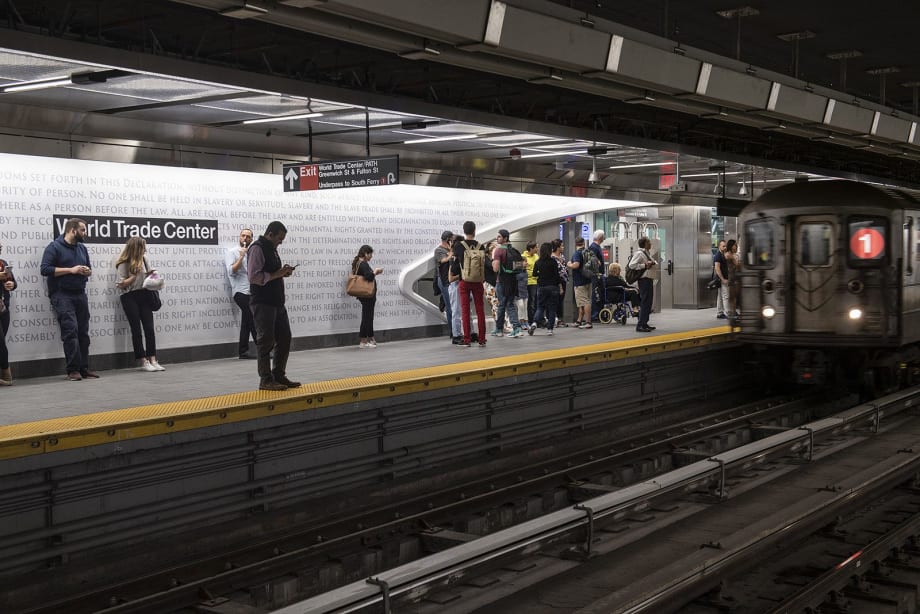
World Trade Center Cortlandt Station. Photo: NY MTA
3 min to read
World Trade Center Cortlandt Station. Photo: NY MTA
The Metropolitan Transportation Authority's executive leadership team and the city’s business community, represented by the Partnership for New York City, announced the launch of the nation’s first Transit Tech Lab. The lab’s purpose is to identify and test promising new technology and other products that will accelerate modernization of New York’s public transportation network and contribute to improved services and a better customer experience.
Tech entrepreneurs who are developing products that could be useful to the MTA’s modernization plans find it difficult to navigate large public agencies. The Transit Tech Lab is one example of how the MTA is changing its internal processes to be more open to innovation. The lab will provide a faster and less expensive way for the MTA to review new products and carry out pilot projects with the best transit innovators from around the world.
The idea for the lab came from a working group that the Partnership for New York City and the MTA established earlier this year, the Transit Innovation Partnership (TIP). This is a privately funded, nonprofit initiative that was developed in response to Gov. Andrew M. Cuomo’s challenge to the business community to help address the needs of the regional transit system. It is led by Rachel Haot, executive director and the former chief digital officer for both New York City and New York State, and an advisory board of civic and business leaders, chaired by Alan Fishman, chairman of Ladder Capital Finance.
The first lab projects will be to identify technologies that can move buses faster and reduce the impact of subway delays. Submissions are being requested from teams that have products that are ready for beta testing with the MTA. Companies can learn more about the opportunity and how to apply before the Nov. 30 deadline at transitinnovation.org.
For the subway challenge, the Transit Tech Lab seeks technologies to better predict how long a subway delay will last and how it will affect trains and lines across the system, information that will be communicated to customers. Potential technologies to solve this challenge include analyzing historical subway data to find patterns that can be used to predict future disruptions, exploring tools for immediately communicating with customers, and using entirely new data sources such as social media that may provide fresh insights into subway incident impacts.
The bus challenge seeks technologies to help public buses move faster and more efficiently. The challenge welcomes a range of potential technologies, including sensors, cameras, and software that can help identify obstructions and patterns, improve coordination of routes and transfers, alert enforcement agencies about vehicles located in bus lanes, and adjust bus activity to changing customer demand.
After companies apply, MTA specialists and private sector experts will review Lab proposals. Evaluators from the business community include:
Reilly Brennan, general partner, Trucks Venture Capital
Shana Fisher, managing director, Third Kind Venture Capital
Maria Gotsch, president/CEO, Partnership Fund for New York City
Nick Grossman, GM, Union Square Ventures
Dylan Hixon, principal, Arden Road Investments
Brian Keil, managing director, NYS Innovation VC Fund, Empire State Development Corp.
Linda Kirkpatrick, executive VP, U.S. Market Development, Mastercard
Kevin Ryan, chairman/founder, Zola, Workframe, Nomad Health, Mongo DB
The most promising companies will be selected to participate in an eight-week accelerator program starting in February where they will be able to refine their products to more directly meet the needs of public transit. At the end of the program, the MTA will select successful companies for a 12-month pilot with the transit system. The pilot is unpaid, but offers companies a unique opportunity to demonstrate their technology in the nation’s largest transit system and positively contribute to the future of New York City
More Technology

From Hardware to Digital Partner: Luminator Charts Its Next Chapter
CEO Magnus Friberg discusses Luminator’s shift toward becoming a digital partner, the growing importance of software and interoperability, and how AI can help agencies improve operations and passenger experience.
Read More →
Beyond the Checklist: A Structured Approach to Transit Maintenance
Reliability-Centered Maintenance helps transit agencies move beyond routine checklists to focus limited resources on the assets and failures that have the greatest impact on safety, reliability, and service.
Read More →
NJ TRANSIT Advances Bus Technology Upgrades Across Statewide Fleet
More than 1,500 buses now feature upgraded technology designed to improve arrival predictions and provide free Wi-Fi, with deployment expected to reach nearly 2,000 buses by the end of 2026.
Read More →

Building a Flexible Path to Transit Electrification
John Hroncich discusses BAE Systems’ modular and scalable approach, lessons learned from decades of real-world operations, and how agencies can identify electrification strategies that fit their fleets.
Read More →
Biz Briefs: Alstom Lands Canadian Contract, LYT to Supply California TSP, and More
In METRO's latest installment, we take a look at recent news from Complete Coach Works, Beep, FlixBus, and more partnerships making headlines across the transportation sector.
Read More →
Sponsored•September 8, 2026
From Legacy Silos to Conversational Intelligence
What if transit leaders could ask any operational question and get a trusted answer in seconds? Conversational AI is transforming how agencies use their data.
Read More →
USDOT Announces Rail Vehicle Replacement Grants, Chattanooga AV Shuttle Funding
More than $191 million in federal funding will help three transit agencies replace aging rail vehicles and support a new autonomous shuttle service in Chattanooga.
Read More →
Bus Tech Talk: Keeping Transit Technicians Ahead of the Technology Curve
LA Metro’s Obed Mejia discusses technician training, evolving maintenance technology, fleet replacement, and strategies for getting the most out of today’s transit fleets.
Read More →
Biz Briefs: RIPTA Unveils New Frontrunners, Clevland RTA Adds New Siemens, and More
In METRO's latest installment, we take a look at recent news from Siemens, Prevost, Dodge, and more partnerships making headlines across the transportation sector.
Read More →
Why Simulating Pedestrian Movement Has Become Essential for Modern Rail Stations
Pedestrian microsimulation is helping rail planners identify bottlenecks, test station designs, and prepare complex transit hubs for growing passenger volumes.
Read More →