



‘Rapid’ Growth Showcases APTA Chair’s Skills
Peter Varga’s theme for his year as chair is “America’s Future is Riding on Public Transportation.” This is reflected in his success at accommodating increasing ridership and improving job access as CEO at Michigan’s The Rapid and his work with APTA on a reauthorization plan.

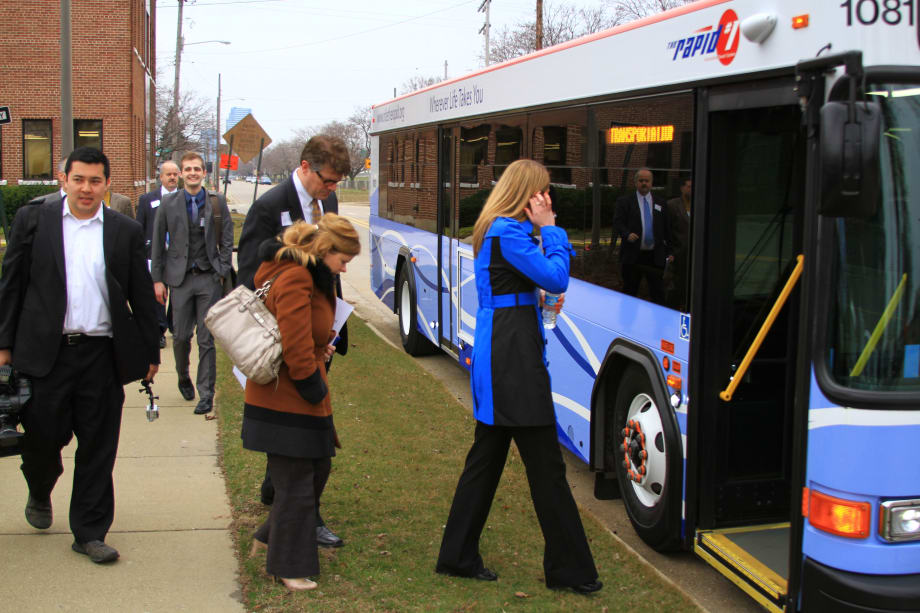
As his leadership at Grand Rapids, Mich.’s The Rapid (Interurban Transit Partnership) shows, Peter Varga, CEO, and chair of the American Public Transportation Association (APTA), is passionate about enhancing public transportation, particularly for future generations, by creating more access to jobs and education. To make that happen at his agency, he has spearheaded the call for more local funding, seeing four property tax referendums pass successfully. He brings that skill to APTA, working to get members on board with a comprehensive reauthorization plan.
Beginnings
Like the most recent former APTA chair, Flora Castillo, Varga also originally hails from outside the U.S. He was born in Ethiopia, the son of Hungarian exiles. His family moved to the U.S. when he was 13.
Varga started his transportation career driving a cab in New York while he was in college. After moving to California, he drove buses and eventually became a safety and training coordinator for Santa Cruz (Calif.) Metropolitan Transit District. He also worked at Muskegon (Mich.) Area Transit System as executive director of its bus systems before coming aboard The Rapid in 1994.
APTA plans
Varga’s theme for his year as chair, “America’s Future is Riding on Public Transportation,” reflects his emphasis on millennials as crucial public transportation customers.
“Transit is also increasing in popularity among seniors and baby boomers, but the millennials are a demographic we need to pay attention to,” he says.
People in that age group see transit as more viable than cars, which they view as a last resort, he says. Since these riders “want to be in a high-tech world,” as he puts it, transit systems need to be on Google Transit, and offer Wi-Fi on buses as well as bus tracking, he says.
A longtime member of APTA — since 1991 — Varga was invited to chair the association’s Small Operations Committee after taking over as CEO of The Rapid in 2000. Soon after, he became chair of the Executive Committee.
Known for his strong focus on legislation, APTA members encouraged Varga to run for chair this year, with no one running against him, which was a vote of confidence, he says.
“Peter has a keen and intuitive knowledge of the federal program, and more importantly, understands how to set the stage for successful legislation,” Jeff Nelson, GM of St. Louis-based MetroLINK, says. “Peter’s talent and skills will shape our legislative accomplishments in the years to come.”
What has driven Varga most in his work for APTA is the need he sees for members to coalesce behind a proposal for comprehensive reauthorization.
“Whether we will be successful with Congress or not, a plan will be there,” he says.
Under Varga’s leadership, The Rapid won APTA’s Outstanding Public Transit System award twice, first in 2004 and again in 2013, for expanding to accommodate a significant ridership spike as its 281-square-mile service area grows, and leading efforts in sustainability.
[PAGEBREAK]

Known for his strong focus on legislation, APTA members encouraged Varga to run for chair this year. He plans to focus on meeting the transportation needs of millennials and a comprehensive reauthorization plan.
Expanding The Rapid
Varga’s achievements at The Rapid over the past 19 years include approval of four property tax referendums; the agency’s upcoming bus rapid transit (BRT) line; its 20-year Transit Master Plan; two LEED buildings to date; and the start of Grand Valley State University (GVSU) bus service.
The Rapid’s ridership has nearly tripled from 2000 to 2012, jumping from 4.5 million to 11.9 million. To accommodate this growth, the agency has expanded its system, with help from the four successful referendums that increased the property millage and funded about one-third of its operations since 2000. One-third of funding also comes from state support, the gas tax and auto-related revenue, respectively.
One of The Rapid’s goals has been to expand job accessibility. The agency was able to grow from offering no evening or Sunday service and very little Saturday service to adding more frequent service on six routes on weekends and during commute hours and extending evening service until 1 a.m. to provide access to second- and third-shift jobs. This late-night service has shown the greatest ridership spike, Varga says.
The agency’s focus on work-related trips paid off when it was cited in 2011 as No. 11 out of 50 transit systems for providing access to employment in a Brookings Institution Study, “Missed Opportunity: Transit and Jobs in Metropolitan America.”
“That makes us proud to know we help the community with job access,” Varga says.
As the agency has grown, it is taking on staff members who can handle the extra responsibility. One challenge has been getting its employees to become more customer focused.
“We have a responsibility to the growing number of customers because they prefer us as a transportation mode,” Varga says. “It has been challenging because people want different services, but we nurtured that.”
The first phase of the agency’s Transit Master Plan, approved by The Rapid’s board in 2010, will create the Silver Line, the first BRT line in the state.
Set to open in August, 2014, the Silver Line will connect riders with major employers, including St. Mary’s Medical campus, the Michigan State University College of Human Medicine, and the Cook-DeVos School of Nursing. The agency procured 10 hybrid-electric Gillig buses for the service, adding to the five it currently has in fixed-route service. It also hired 19 drivers for the service and was planning to hire more at press time.
[PAGEBREAK]
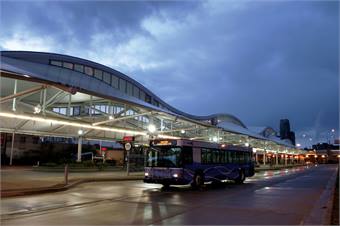
The Rapid has extended evening service until 1 a.m. to provide access to second- and third-shift jobs The agency was cited in 2011 as No. 11 out of 50 transit systems for providing access to employment in a Brookings Institution study.
University relationships
The Rapid has also broadened service throughout multiple counties by building relationships with universities such as GVSU, one of the most prominent in the area, with approximately 20,000 students in attendance.
The transit system connects two of the university’s campuses; those trips make up about three million of the agency’s total trips per year. GVSU emphasizes the availability of public transportation in its recruitment, Varga says.
The Rapid recently renewed contracts with universities including Calvin College, Grand Rapids Community College, Ferris State University and Aquinas College, for shuttles to downtown Grand Rapids and on-campus service.
Sustainable facilities
With nearly one-fifth of all LEED-certified buildings in the U.S. located in the Western Michigan region, Varga says, The Rapid had no trouble gaining support for its LEED building projects. In fact, the agency’s board of directors has several LEED champions, particularly Mayor George Heartwell of Grand Rapids.
The Rapid Central Station, which opened in 2004, became the first LEED-certified public transit building in the nation in 2006. The agency revitalized a brownfield location for the station; installed a canopied roof over the bus platform to reflect solar light and shade passengers; added a “green” roof over the main building for an added layer of insulation and used recycled materials for the building.
The Rapid’s $31 million renovated Rapid Operations Center, which opened in 2012, earned a LEED-Gold rating in January 2013 for features such as a bus wash water reclamation system that saves nine million gallons of water annually, a 40,000-square-foot "green" roof, increased natural light and radiant floor heating in the bus garage.
RELATED: "Grand Rapids resurrects downtown streetcar plans"
More Bus

New York MTA Plans Largest Bus Fleet Upgrade in More Than a Decade
The agency is seeking manufacturers for 650 new CNG buses to replace aging vehicles, improve reliability, and advance its broader fleet modernization strategy.
Read More →
Building a Flexible Path to Transit Electrification
John Hroncich discusses BAE Systems’ modular and scalable approach, lessons learned from decades of real-world operations, and how agencies can identify electrification strategies that fit their fleets.
Read More →
Bus Tech Talk: Keeping Transit Technicians Ahead of the Technology Curve
LA Metro’s Obed Mejia discusses technician training, evolving maintenance technology, fleet replacement, and strategies for getting the most out of today’s transit fleets.
Read More →
Biz Briefs: RIPTA Unveils New Frontrunners, Clevland RTA Adds New Siemens, and More
In METRO's latest installment, we take a look at recent news from Siemens, Prevost, Dodge, and more partnerships making headlines across the transportation sector.
Read More →
People Movement: Holly Arnold Joins Transdev and More
In this edition, we also cover recent appointments and announcements at Pace, CamTran, MCI, and more, showcasing the individuals helping to shape the future of transportation.
Read More →
The High Cost of Transit Buses: Industry Leaders Look to Procurement Reform
Transit leaders and policymakers examine how standardized bus designs, streamlined procurement, and predictable funding could help agencies stretch budgets and deliver better service.
Read More →
The Business Voice Behind Public Transportation
As chair of APTA’s Business Members Board of Governors, Ray Melleady explains how more than 850 business members are partnering with transit agencies to advance funding, innovation, and industry-wide collaboration.
Read More →
From Surviving to Thriving: Building Stronger Transportation Organizations
Bus Business Consultants founder Brian Dickson shares lessons on leadership, organizational health, and creating options for long-term success in a changing transportation industry.
Read More →
Finding the ‘Happy Medium’: Optimizing Maintenance Without Sacrificing Reliability
The key to maintenance optimization isn’t doing less work—it’s doing the right work at the right time on the right assets.
Read More →
LA Metro, City of West Hollywood, and Partners Advance Smarter Bus Lane Enforcement
The award-winning partnership combines AI-powered detection with human oversight to improve bus reliability, accessibility, and enforcement efficiency.
Read More →