




RELATED: Accessibility to jobs by transit in top U.S. cities ranked
NYC Public Transit Ranks No. 1 in North America for Sustainability: Study
Overall, North American cities rank low compared to equivalent European or Asian cities due to the car-centric culture that exists today.
October 30, 2017
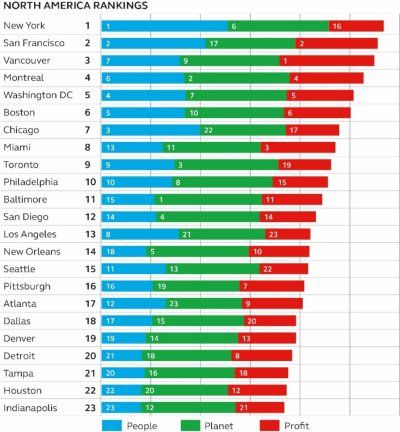
Sitting in 23rd place globally, NYC is the most sustainable city for transportation in U.S. and Canada.
Image: Arcadis
4 min to read
New York City ranks No. 1 among 23 North American cities for overall sustainability of its urban transportation systems, according to a new study.
Sitting in 23rd place globally, NYC is the most sustainable city for transportation in U.S. and Canada, buoyed by an efficient, expansive and heavily used metro system operating around the clock, according to the first Arcadis Sustainable Cities Mobility Index.
This index, an indicative ranking of sustainable urban transportation practices across 100 of the world’s leading cities, looks at more than 20 elements of mobility that are essential to a city’s competitive advantage, economic vitality and overall sustainability. The study was conducted for Arcadis by the London-based Centre for Economics and Business Research (Cebr).
Exploring the three pillars of sustainability — People (social), Planet (environmental) and Profit (economic) — the study measures financial investments and infrastructure improvements to urban transportation systems, including:
Access to multiple transit modes.
Active commuting.
Bicycle infrastructure.
Commuting travel time.
Affordability of public transit.
Digital mapping and payment capabilities.
Air and emissions pollution.
Internet connectivity.
North America: Car Dependency & Reduced Public Iinvestment Hampering Sustainability
Overall, North American cities rank low compared to equivalent European or Asian cities due to the car-centric culture that exists today. Many U.S. cities lack an extensive transit network due to years of reduced public investment.
To improve future mobility, bold actions need to happen soon. North American cities will have to overcome the negative public perception of public transit and alternative modes of transportation by incentivizing usage and working with companies and developers to encourage ridership.
Using technology, such as apps, smartcards and other communication systems, is also critical to the adoption of public transit by streamlining the user experience and making commutes convenient. Further, cities should work collaboratively with counties, state departments of transportation, transit agencies, businesses, and investors to implement sustainable mobility solutions.
“A city is most sustainable when it is most attractive for people to live, work and invest,” said Arcadis President of Infrastructure Wassim Selman. “While some North American cities enjoy well-funded and comprehensive transit systems, most rely heavily on private vehicles and lack developed public transit options. We need to be bold in implementing non-traditional approaches and leveraging technology to meet the mobility needs of our communities today and into the future.”
North American Transit Sustainability Study Highlights
North American cities are generally challenged in Planet factors such as measurements of greenhouse gas emissions – especially in Houston, Pittsburgh, Chicago and Atlanta. With exception of New York City, North America is car-dominated with a strikingly low percentage of trips taken by public transit and a small share of commuters cycling or walking to work.
For instance, Atlanta, Tampa and Dallas can boost their rankings by further encouraging bicycle use and expanding bike lanes compared to other international cities. Meanwhile, the most car-dependent U.S. cities include Indianapolis, New Orleans, Dallas and Houston, which have a low percentage of public transit journeys made per capita and sit in the bottom 10 globally in this category.
The number of traffic fatalities across North America trends higher than its global counterparts, with only Toronto making it into the index’s 20 safest cities. Meanwhile, Miami, Tampa, New Orleans, Houston, Dallas and Indianapolis rank in the bottom 20 for high volumes of road fatalities, which are indicative of an ineffective roadway network.
Los Angeles ranks lowest in North America for congestion and delays, but the city is addressing this challenge by investing in metro rail projects.
For People factors, Boston, Denver and Detroit all rank near the bottom in providing internet connectivity on public transportation. However, U.S. and Canadian cities are increasingly offering transit apps to improve the public transit user experience.
On the bright side, North American cities generally score better compared with most global cities for offering incentives to stimulate adoption of electric vehicles and making public transit generally affordable.
On Profit factors, Chicago and New York lead the world when it comes to offering citizens a 24/7 metro service. New York City also has one of the highest shares of trips taken by public transit, and San Francisco ranked first for having the most bus and metro stops per square kilometer in the U.S., an important factor in delivering a more sustainable mobility system across a metro area.
Notable Cities Worldwide
The cities most balanced among 23 indicators include Hong Kong (ranking first globally), followed by Zurich and Paris.
European cities dominate the top of the rankings, making up 14 of the leading 20.
In Asia, Hong Kong leads the index, and Seoul and Singapore sit alongside their European counterparts to make up the global top 10.
African cities in the index all sit in the bottom 50.
More Management

METRO Opens Submissions for 2026 Motorcoach Awards
Nominations are now being accepted for METRO Magazine’s Operator of the Year and Innovative Operator of the Year awards.
Read More →
New York MTA Advances Final Contract for Second Avenue Subway Expansion
Contract Four is the largest in the Second Avenue Subway Phase 2 project and includes construction of station infrastructure, tracks, and signals for the subway expansion, MTA officials said. Work on Contract Four will begin in 2027.
Read More →
Transit Agencies Highlight Safety Gains at National Summit
Leaders from 15 major transit systems shared crime-reduction results and safety initiatives while discussing the role of continued federal support.
Read More →

NITA Names New Leadership, Expands Reduced-Fare Program at First Board Meeting
The new regional transit authority appointed its first board chair and interim executive director while extending reduced fares across CTA, Metra, and Pace for eligible riders.
Read More →
Beyond the Checklist: A Structured Approach to Transit Maintenance
Reliability-Centered Maintenance helps transit agencies move beyond routine checklists to focus limited resources on the assets and failures that have the greatest impact on safety, reliability, and service.
Read More →
APTA 2026 Nominating Committee Selects Leadership Slate, Names Chair and Vice Chair Nominees
Leadership changes will help shape the association’s priorities and its representation of the transportation industry during the 2026–2027 term.
Read More →
DART Launches Major Security, Fare Enforcement Initiative
The 90-day demonstration will deploy coordinated security teams at five light rail stations while testing controlled access and gathering data to guide future investments.
Read More →
Sponsored•September 9, 2026
Advancing Fare Collection Through Technology and Innovation
Learn about delivering 1300 gates at 91 stations while managing fare evasion. Explore the large scale deployment, solution customization and real-world results that affect the region. Prepare for deployment in your region now.
Read More →
Game Day in Motion: Moving Millions During the 2026 World Cup
Between packed transit stations and team motorcoaches, see how agencies and operators across North America tackled the transportation demands of the 2026 FIFA World Cup.
Read More →
Surface Transportation Extension Averts Shutdown, Leaves Transit Funding Gap
The stopgap keeps federal transportation programs moving, but missing advance funding could complicate the transit and rail projects agencies are planning next.
Read More →