



Transit systems work to preserve trees along rail lines
Transit systems planning rail lines, such as Honolulu Authority for Rapid Transportation and California’s Sonoma-Marin Area Rail Transit, are working with their communities to preserve trees in the paths of proposed routes.


SMART is reviewing options to save a rare green and white Chimera Coast Redwood tree located within a planned railroad right-of-way.

Transit systems planning rail lines, such as Honolulu Authority for Rapid Transportation (HART) and California’s Sonoma-Marin Area Rail Transit (SMART), are working with their communities to preserve trees in the paths of proposed routes.
HART received high marks from The Outdoor Circle, a nonprofit environmental group, for measures it is taking to preserve up to 900 trees that will need to be removed to make way for a 20-mile rail line.
Marti Townsend, The Outdoor Circle’s executive director, told KITV4 that HART has done “an excellent job” ensuring that the trees they transplant survive.
In the first phase of the project, 300 trees have been removed and 250 of those have been transplanted elsewhere with a 90% survival rate, according to a report filed last month with the Honolulu City Council.
Additionally, some trees determined to be too valuable to lose have resulted in HART moving rail columns by a few feet to accommodate them.
“Some of the trees initially slated for removal or relocation were able to remain in place by making slight changes to the rail design and tree pruning,” Jeanne Mariani-Belding HART’s director, communications, said.
HART’s planning team meets regularly with The Outdoor Circle’s local chapter to go over the proper and safe relocation of trees. The working relationship includes group discussions and on-site visits, Mariani-Belding added.
HART’s Environmental Impact Statement identified which trees would be affected by the rail alignment. From there, the transit system’s project arborist evaluated the health, size and species of each tree to determine the best course, including which trees could be successfully transplanted, Mariani-Belding explained. The arborist also prepared a regularly updated plan that provides the status of each tree.
“The environment is a special part of Hawaii’s beauty, and we take special care to do all that we can to protect it,” she added.

Meanwhile, in March, SMART suspended the removal of a rare, green and white Chimera Coast Redwood tree located within a planned railroad right-of-way as it explores other options.
The community’s interest in the tree prompted the move, Matt Stevens, community and media relations, SMART, said.
An arborist hired by SMART conducted a study and identified the tree as a Chimera Redwood Tree, which has some chromosomes without chlorophyll, making it partially albino, Stevens explained.
The study also determined the tree is not naturally-occurring; it was raised in a nursery. The redwood was planted in the right-of-way of the historic 1850’s-era Northwestern Pacific Railroad approximately 45 years ago by a private individual, likely as a landscape ornamental, according to SMART.
Reviewing an option to meet the safety clearances through extensive pruning, the study concluded that in addition to requiring removal of all branches and foliage on the east side of the tree, the tree’s health would be undermined by the track construction and it could not survive in its present location. It would also become prone to wind throw, within falling distance of both the track and adjacent private property, creating a public safety hazard.
SMART will consult with additional independent experts to verify the report’s conclusions and continue to look at options to save the tree.
One of the options is to move the tree to another location. The City of Cotati has volunteered to accept the tree if moving it is the most viable option, Stevens said.
SMART is still making good progress on the project, he added.
“Our contractors are working in other areas while we evaluate our options. While it has slowed down construction in that area, it has not slowed down project construction in general,” said Stevens.
More Rail
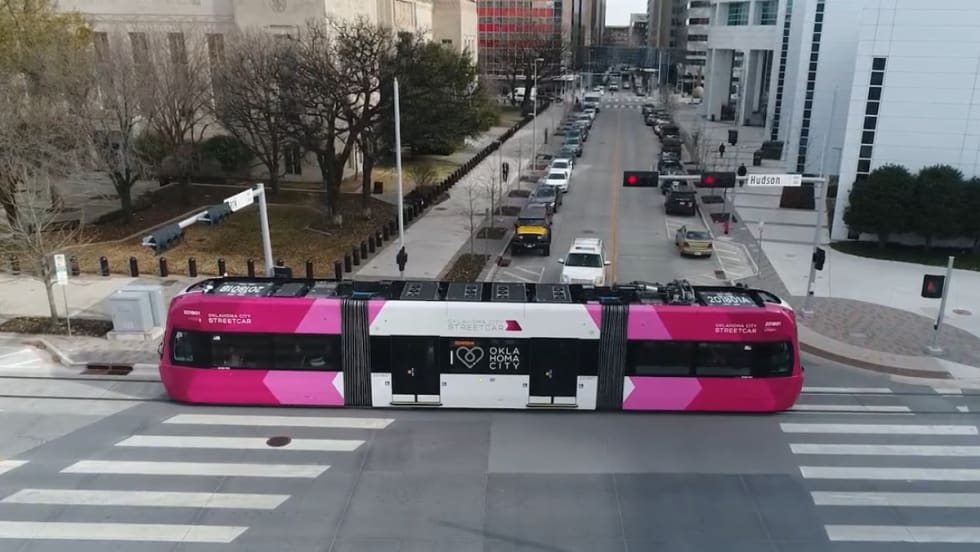
OKC Streetcar Makes Zero-Fare Service Permanent
Ridership increased an average of 71% compared with the same period a year earlier during the fare-free pilot.
Read More →
DART Customer Satisfaction Reaches Six-Year High
Overall satisfaction rose to 74.9%, while the agency’s Net Promoter Score reached a record 33.7.
Read More →
How DART's GoPass Is Redefining Regional Mobility
Serving 14 transit agencies, GoPass simplifies multimodal travel by allowing riders to plan, pay for, and manage an entire trip through one app.
Read More →
Amtrak Board Advances Plan to Restructure Organization, Seeks Public Input
The proposal, developed by Amtrak management and approved by the board for further consideration, is intended to modernize the organization's structure while improving accountability, operational efficiency, and customer service.
Read More →
Biz Briefs: STV teams with Amtrak, Motorcoach Operators Boost Fleet and Land Contracts, and More
From manufacturers and suppliers to transit agencies and motorcoach operators, these updates offer a snapshot of the projects, partnerships and business moves driving the industry forward.
Read More →
Metra Celebrates 100 Years of Electric Rail, Looks to the Future
The event was also a celebration of recent reforms to public transportation in the Chicago area, changes that could be as transformative in the future as the major civic achievement a century ago, said officials.
Read More →
LA Metro Marks Banner Year, Sets Ambitious Goals for New Fiscal Year
Incoming LA Metro Board Chair and Los Angeles Mayor Karen Bass joined outgoing Board Chair Fernando Dutra and LA Metro CEO Stephanie Wiggins to review accomplishments from fiscal year 2026, which included the opening of new rail extensions, advancement of major transit projects, expanded safety programs, and new rider amenities.
Read More →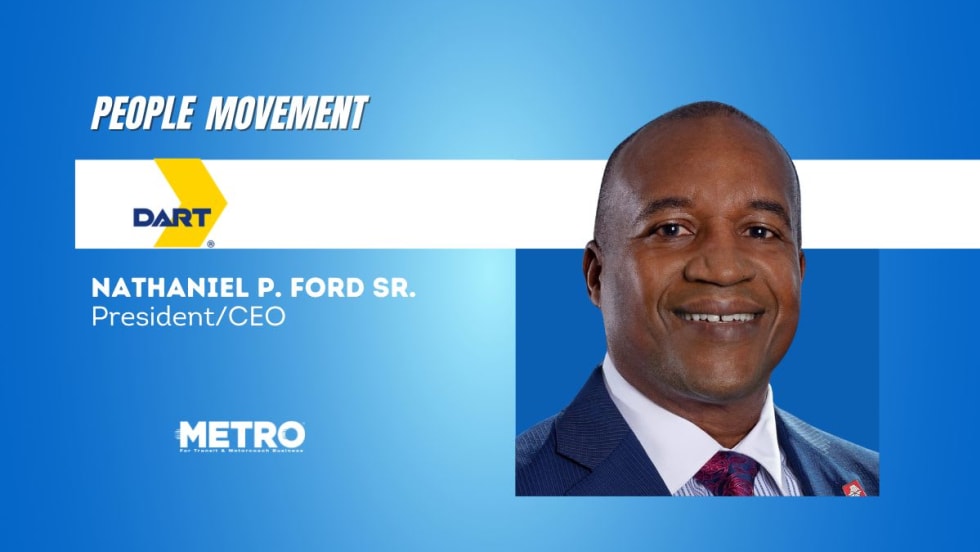
DART Taps Nathaniel P. Ford Sr. as Next President/CEO
Since 2012, Ford has served as the CEO of the Jacksonville Transportation Authority
Read More →
California High-Speed Rail Authority Signs MOU to Advance High Desert Corridor
The agreement deepens collaboration between the California High-Speed Rail Authority and the High Desert Corridor Joint Powers Agency, supporting design integration, cost savings, and faster delivery of a key Southern California rail link.
Read More →
Building the Next Generation of Transit Technology
In this edition of METROspectives, Luminator CEO Magnus Friberg discusses the company's transformation, the growing role of AI and software, and what's next for transit technology.
Read More →