



Women In Transportation Profile: Sandy Modell
Title: General Manager Organization: Alexandria Transit Company City: Alexandria, Va.
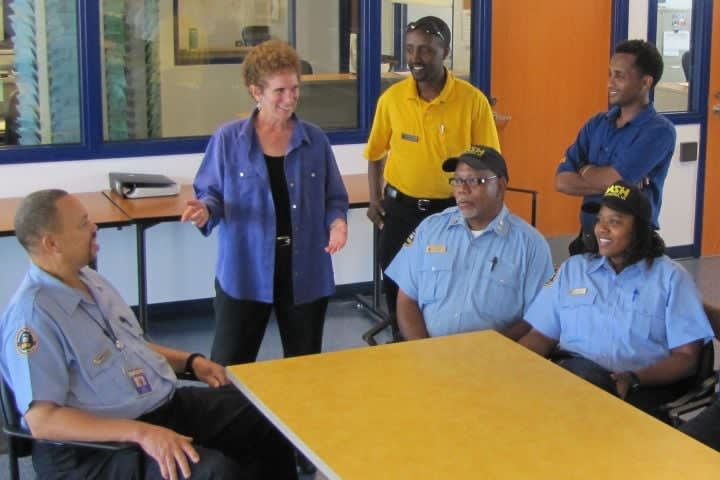
Among her greatest accomplishments at DASH, Modell counts the cultivation of a supportive work environment, which made Alexandria's DASH system one of METRO Magazine's Top 10 Transit Systems to Work For in 2008. Modell calls the way DASH treats its customers and employees the "DASH Difference."
Among her greatest accomplishments at DASH, Modell counts the cultivation of a supportive work environment, which made Alexandria's DASH system one of METRO Magazine's Top 10 Transit Systems to Work For in 2008. Modell calls the way DASH treats its customers and employees the "DASH Difference."
While an undergraduate at James Madison University, Sandy Modell stumbled across a "help wanted" ad for bus drivers. At the time, Modell was planning to pursue a career in teaching or a recreational field, but a year of driving buses, transit, paratransit and taxis part-time in Harrisonburg, Va., changed her mind.
"I loved what I was doing so much," Modell says. "I just really enjoyed driving. I enjoyed working with people and the customers so much that I decided when I graduated, I would stay on with the agency."
Stay on she did. Following college, Modell worked her way up in the City of Harrisonburg Transportation Department, eventually becoming the department's first transit administrator. In 1984, she was offered a job by the City of Alexandria to help facilitate the creation of a new DASH system, since — at the time — the city had no transit operations experts on staff. In her new position, Modell worked on planning, marketing, fares and transfer policies with other local bus systems. Today, she is the Alexandria Transit Co.'s (DASH) GM.
When Modell first started, Alexandria's DASH system consisted of only 19 buses and 40 employees; ridership was hovering around 923,000 annually. Today, the system serves four million riders a year, and has a total of 63 buses and 140 employees.
"When I came here it was called 'the fledgling bus system.' They didn't know if it was going to make it or not because the system didn't have full support of the community or top officials," she explains. As overseer of such a new transit system, she faced a major hurdle in that the area was already served by a regional bus system, the Washington Metropolitan Area Transit Authority. "Basically, we had to prove ourselves. We had to prove to the community and to the city that we were worthy of the support and of being here," she says.
Today, DASH is recognized by the community in recent city surveys as one of Alexandria's top five services. Modell attributes this to DASH's high standards in maintenance and customer service, to which she has made some significant contributions.
"When I first came to DASH, wheelchair lifts hadn't really gotten under way yet," Modell says. "But, we decided early on — prior to the passage of the Americans with Disabilities Act — that our goal was to make DASH 100 percent wheelchair accessible, and I took on the project. We implemented the program with new buses. All our new buses had wheelchair lifts even though it was not required at that time."
Among her greatest accomplishments at DASH, Modell counts the cultivation of a supportive work environment, which made Alexandria's DASH system one of METRO Magazine's Top 10 Transit Systems to Work For in 2008. Modell calls the way DASH treats its customers and employees the "DASH Difference."
Modell is also responsible for the construction of Alexandria's new DASH maintenance, operations and administration building, — the $35 million William B. Hurd Transit Facility — which opened this year. According to Modell, the DASH staff was suffering from overcrowding in the old facility but, from the time she first had an idea for a new building to the time the facility was opened, 15 years had passed.
"Projects like these do not happen overnight. You have to build consensus, you have to be a strong negotiator, and you have to have perseverance and determination to make something like this happen," Modell says.
Modell's perseverance has paid off. Because of the new facility, the transit system is now poised for growth and expansion. She is now working to replace the system's oldest buses with hybrids, and she hopes that soon DASH will have a system-wide, real-time bus information system. She is focused on DASH's long-term plans to help meet Alexandria's transit needs.
More Bus

New York MTA Plans Largest Bus Fleet Upgrade in More Than a Decade
The agency is seeking manufacturers for 650 new CNG buses to replace aging vehicles, improve reliability, and advance its broader fleet modernization strategy.
Read More →
Building a Flexible Path to Transit Electrification
John Hroncich discusses BAE Systems’ modular and scalable approach, lessons learned from decades of real-world operations, and how agencies can identify electrification strategies that fit their fleets.
Read More →
Bus Tech Talk: Keeping Transit Technicians Ahead of the Technology Curve
LA Metro’s Obed Mejia discusses technician training, evolving maintenance technology, fleet replacement, and strategies for getting the most out of today’s transit fleets.
Read More →
Biz Briefs: RIPTA Unveils New Frontrunners, Clevland RTA Adds New Siemens, and More
In METRO's latest installment, we take a look at recent news from Siemens, Prevost, Dodge, and more partnerships making headlines across the transportation sector.
Read More →
People Movement: Holly Arnold Joins Transdev and More
In this edition, we also cover recent appointments and announcements at Pace, CamTran, MCI, and more, showcasing the individuals helping to shape the future of transportation.
Read More →
The High Cost of Transit Buses: Industry Leaders Look to Procurement Reform
Transit leaders and policymakers examine how standardized bus designs, streamlined procurement, and predictable funding could help agencies stretch budgets and deliver better service.
Read More →
The Business Voice Behind Public Transportation
As chair of APTA’s Business Members Board of Governors, Ray Melleady explains how more than 850 business members are partnering with transit agencies to advance funding, innovation, and industry-wide collaboration.
Read More →
From Surviving to Thriving: Building Stronger Transportation Organizations
Bus Business Consultants founder Brian Dickson shares lessons on leadership, organizational health, and creating options for long-term success in a changing transportation industry.
Read More →
Finding the ‘Happy Medium’: Optimizing Maintenance Without Sacrificing Reliability
The key to maintenance optimization isn’t doing less work—it’s doing the right work at the right time on the right assets.
Read More →
LA Metro, City of West Hollywood, and Partners Advance Smarter Bus Lane Enforcement
The award-winning partnership combines AI-powered detection with human oversight to improve bus reliability, accessibility, and enforcement efficiency.
Read More →