



San Diego graffiti program tags offenders
The privately-owned Web-based Graffiti Tracker program uses a database that tracks, measures and links graffiti incidents throughout the region.
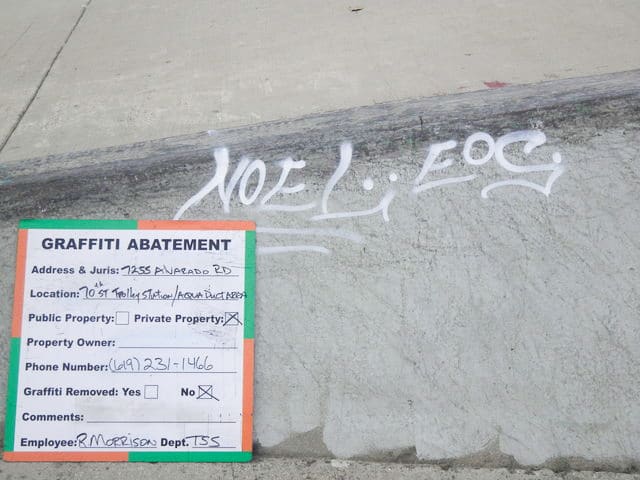
Graffiti Tracker enables agencies, such as San Diego MTS, to use a database that tracks, measures and links graffiti incidents throughout the region (each green or orange stripe above is two feet long). The information is then shared by law enforcement to prosecute vandals.
Graffiti Tracker enables agencies, such as San Diego MTS, to use a database that tracks, measures and links graffiti incidents throughout the region (each green or orange stripe above is two feet long). The information is then shared by law enforcement to prosecute vandals.
A new program being used by San Diego Metropolitan Transit System (MTS) to fight graffiti is beginning to pay dividends for the agency.
The privately-owned Web-based Graffiti Tracker program uses a database that tracks, measures and links graffiti incidents throughout the region. That information is shared by law enforcement to prosecute vandals for numerous graffiti incidents, resulting in stiffer penalties and large restitutions.
The program is currently being used not only by MTS, but also other area agencies including the City and County of San Diego, the North County Transit District and the Port of San Diego.
"The big advantage is if one of the communities that we serve were to catch somebody committing graffiti, arrest them, and take a picture and then feed it into the computer system, there is the likelihood that they can get hits from the same person who committed graffiti on our line as well, because it's all fed into the same database," explained Bill Burke, chief of police for MTS.
Graffiti Tracker is now helping MTS, which operates trolley and bus service in the San Diego region with more than 80 bus routes and 53 miles of light rail, recoup some its financial losses caused by graffiti.
The agency's first big case occurred in September, when the Superior Court of California ordered a juvenile to pay the MTS $14,710 in restitution for damage caused by graffiti on its property. The juvenile ordered to pay restitution used spray paint, permanent markers and etching tools to place graffiti in at least 20 different locations on MTS property.
Meanwhile in March, MTS undercover security operations arrested five juveniles over a two-week span, who were responsible for 277 individual tags covering 3,580 square feet and damage estimated at more than $25,000, according to information culled and stored in Graffiti Tracker's database.
"It's taken time to really develop a database and start catching these people that are out there, and as they see more and more that this is occurring, they are going to know we are taking this very seriously," said Burke. "We're not looking at it as 'if we catch somebody.' We know it will happen; we will catch these people and we're not going to back off. We are going to prosecute them and look for restitution, because that's the only way to make them understand that it's not acceptable behavior."
Burke added that the cost for MTS to deal with graffiti totals approximately $1 million a year.
"When graffiti occurs you have to cover it up, and you have to do it rather quickly because other gangs want to put their graffiti on top of that graffiti," he said. "If you don't cover it up right away, then it really gets out of hand."
The MTS joined the program a little more than a year ago at the urging of San Diego County Supervisor Greg Cox, following a successful pilot by city and county sheriff's offices and other area agencies.
The initial investment for four cameras and signs, which measure and detail information relating to the graffiti, cost MTS approximately $13,000, according to Burke. The agency also pays $5,000 to Graffiti Tracker for its annual subscription.
Additionally, the MTS uses an undercover security team and has recently supplemented its in-station closed-circuit television system with on-board cameras on its buses and trolleys to help fight graffiti vandals. It is the uniqueness of the Graffiti Tracker program, however, that is really making its mark, explained Burke.
"Prior to [using the program], we had pictures of graffiti that we took, but it really didn't mean anything unless you remembered you had it in a file somewhere, which is hard to do and not very effective," he said. "Graffiti isn't just an issue on our system, it's a community issue, as well. All of these agencies are working together to accomplish this and that's where the real success of this program lies."
More Bus

New York MTA Plans Largest Bus Fleet Upgrade in More Than a Decade
The agency is seeking manufacturers for 650 new CNG buses to replace aging vehicles, improve reliability, and advance its broader fleet modernization strategy.
Read More →
Building a Flexible Path to Transit Electrification
John Hroncich discusses BAE Systems’ modular and scalable approach, lessons learned from decades of real-world operations, and how agencies can identify electrification strategies that fit their fleets.
Read More →
Bus Tech Talk: Keeping Transit Technicians Ahead of the Technology Curve
LA Metro’s Obed Mejia discusses technician training, evolving maintenance technology, fleet replacement, and strategies for getting the most out of today’s transit fleets.
Read More →
Biz Briefs: RIPTA Unveils New Frontrunners, Clevland RTA Adds New Siemens, and More
In METRO's latest installment, we take a look at recent news from Siemens, Prevost, Dodge, and more partnerships making headlines across the transportation sector.
Read More →
People Movement: Holly Arnold Joins Transdev and More
In this edition, we also cover recent appointments and announcements at Pace, CamTran, MCI, and more, showcasing the individuals helping to shape the future of transportation.
Read More →
The High Cost of Transit Buses: Industry Leaders Look to Procurement Reform
Transit leaders and policymakers examine how standardized bus designs, streamlined procurement, and predictable funding could help agencies stretch budgets and deliver better service.
Read More →
The Business Voice Behind Public Transportation
As chair of APTA’s Business Members Board of Governors, Ray Melleady explains how more than 850 business members are partnering with transit agencies to advance funding, innovation, and industry-wide collaboration.
Read More →
From Surviving to Thriving: Building Stronger Transportation Organizations
Bus Business Consultants founder Brian Dickson shares lessons on leadership, organizational health, and creating options for long-term success in a changing transportation industry.
Read More →
Finding the ‘Happy Medium’: Optimizing Maintenance Without Sacrificing Reliability
The key to maintenance optimization isn’t doing less work—it’s doing the right work at the right time on the right assets.
Read More →
LA Metro, City of West Hollywood, and Partners Advance Smarter Bus Lane Enforcement
The award-winning partnership combines AI-powered detection with human oversight to improve bus reliability, accessibility, and enforcement efficiency.
Read More →