



Chicago Gets Jump On BRT
Chicago Transit Authority opened the city’s first BRT line and the first of four planned routes, the Jeffery Jump, in November of last year.

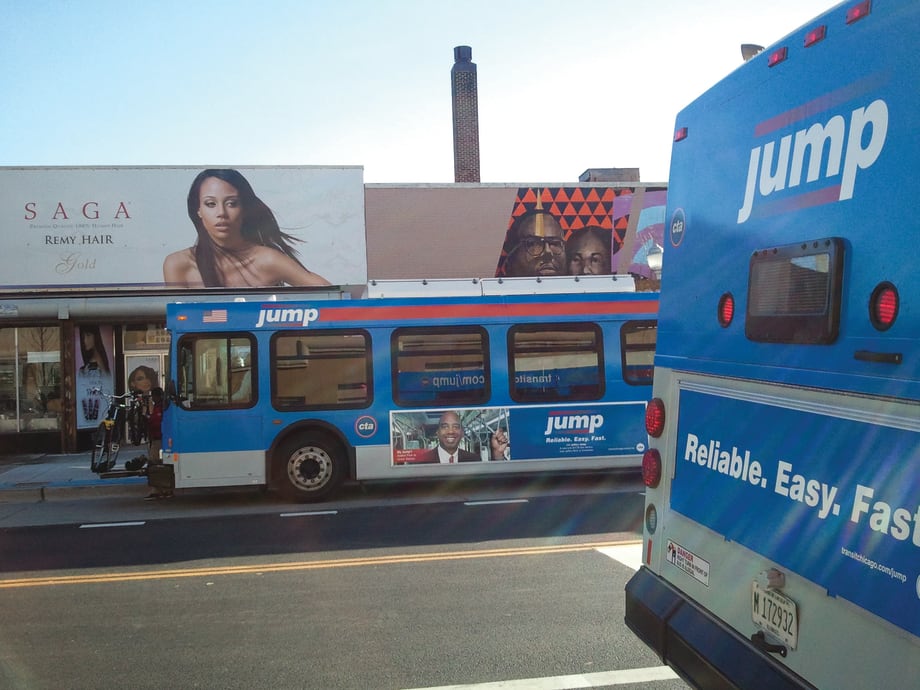
Chicago’s Jeffrey Jump, which is its first BRT route, opened in November. BRT was part of Mayor Rahm Emmanuel’s transition plan for his first 100 days in office.
Chicago’s Jeffrey Jump, which is its first BRT route, opened in November. BRT was part of Mayor Rahm Emmanuel’s transition plan for his first 100 days in office.
Chicago Transit Authority (CTA) opened the city’s first BRT line and the first of four planned routes, the Jeffery Jump, in November of last year.
Following the Jump are the Central Loop, or East-West Corridor, expected to launch in 2014, and the Ashland and Western Corridors project, which are each currently in the development phase.
Meanwhile, CTA and Chicago Department of Transportation (CDOT) are conducting a study to see where BRT improvements would be most valuable on the 20-mile Chicago Lakefront Corridor.
The projects are equal partnerships between CTA and CDOT, with CDOT managing the street, and CTA running the service.
The project received strong agency and political support. Chicago Mayor Rahm Emmanuel put BRT in his transition plan, which mapped out different goals for his first 100 days in office. In addition, there was approval from all the city’s districts.
The route features 25 hybrid-electric, articulated low-floor vehicles. One station, the highest boarding location for the route, serves as a retail hub and transit center with a commuter rail station, and features a shelter with real-time information, benches and landscaping.
Joe Iacobucci, manager, strategic planning and policy, CTA, and Lambrini Lukidis, media representative, CTA, spoke with us to share more details about the project.
Why BRT?: “CTA had record ridership numbers two years in a row. People are flocking toward public transportation for a number of reasons,” Lukidis says. “This is one of the best ways we can accommodate [them]. It’s a benefit for our customers and a way to integrate everyone who shares the roadway.”
“CTA currently has 1.7 million bus boardings a day,” Iacobucci adds. “We also know that customers are voting with their feet and flocking to faster, more reliable service. Congestion has gotten worse in Chicago over the last 30 years. BRT is the way to redesign the streets to make sure we can fulfill those desires for our customers better.”
What it has taken to get it to this point: The planning phase ranged from 2010 to 2012. The total project cost was $11 million, Iacobucci says.
The agency received funding from a Bus and Bus Facility Livability Initiative grant in 2009, allowing it to implement the route.
Public feedback: “We’ve gotten so many anecdotal responses from people who used the service and enjoy it,” Lukidis says. “We’ve gotten a lot of feedback on the look and feel of the service and people really like the brand the ‘Jeffery Jump’: You’re jumping ahead of traffic, getting a jump-start on your day, getting downtown. That was part of what got people to understand the service and the brand has resonated with them.”
Adds Iacobucci:“We received official comments from customers who don’t even ride the corridor but have seen the route and know about the project, asking when their ‘jump bus’ is going to come on their corridor, which is really satisfying.”
The project also received significant civic support. Local partners include Active Transportation Alliance, an alternative transportation advocacy group, the Metropolitan Planning Council, a non-profit organization that advocates for transportation, housing and economic development initiatives, and the Chicago Architecture Foundation which focuses on the design impact of BRT on the streets. In addition, CTA engaged the Chicago Department of Housing and Economic Development as a project partner.
Challenge to overcome: BRT, Iacobucci points out, is new to Chicago. “Now that we have our first line up and running, every additional line will be a little easier. But going out and explaining BRT was a hurdle to get over, since we didn’t have it in the region,” he says. “We did our best to point [to] examples in Cleveland and New York, and internationally.”
More Bus

People Movement: Dan Dipert Coaches Adds Third-Generation Leader, Keolis Names New Valley Metro VP/GM, and More
In this edition, we also cover recent appointments and announcements at the Wabtec, SilverRide, HNTB, and more, showcasing the individuals helping to shape the future of transportation.
Read More →
New York MTA Plans Largest Bus Fleet Upgrade in More Than a Decade
The agency is seeking manufacturers for 650 new CNG buses to replace aging vehicles, improve reliability, and advance its broader fleet modernization strategy.
Read More →
Building a Flexible Path to Transit Electrification
John Hroncich discusses BAE Systems’ modular and scalable approach, lessons learned from decades of real-world operations, and how agencies can identify electrification strategies that fit their fleets.
Read More →
Bus Tech Talk: Keeping Transit Technicians Ahead of the Technology Curve
LA Metro’s Obed Mejia discusses technician training, evolving maintenance technology, fleet replacement, and strategies for getting the most out of today’s transit fleets.
Read More →
Biz Briefs: RIPTA Unveils New Frontrunners, Clevland RTA Adds New Siemens, and More
In METRO's latest installment, we take a look at recent news from Siemens, Prevost, Dodge, and more partnerships making headlines across the transportation sector.
Read More →
People Movement: Holly Arnold Joins Transdev and More
In this edition, we also cover recent appointments and announcements at Pace, CamTran, MCI, and more, showcasing the individuals helping to shape the future of transportation.
Read More →
The High Cost of Transit Buses: Industry Leaders Look to Procurement Reform
Transit leaders and policymakers examine how standardized bus designs, streamlined procurement, and predictable funding could help agencies stretch budgets and deliver better service.
Read More →
The Business Voice Behind Public Transportation
As chair of APTA’s Business Members Board of Governors, Ray Melleady explains how more than 850 business members are partnering with transit agencies to advance funding, innovation, and industry-wide collaboration.
Read More →
From Surviving to Thriving: Building Stronger Transportation Organizations
Bus Business Consultants founder Brian Dickson shares lessons on leadership, organizational health, and creating options for long-term success in a changing transportation industry.
Read More →
Finding the ‘Happy Medium’: Optimizing Maintenance Without Sacrificing Reliability
The key to maintenance optimization isn’t doing less work—it’s doing the right work at the right time on the right assets.
Read More →