



2013 Women In Transportation: Kristen Joyner
Like many other transit professionals, Kristen Joyner fell into public transportation while looking to change careers. Born in El Dorado, Ark., and growing up in a family of teachers, she taught piano and music classes and majored in voice and piano at Arkansas Tech University. Her goal was a career in music therapy.

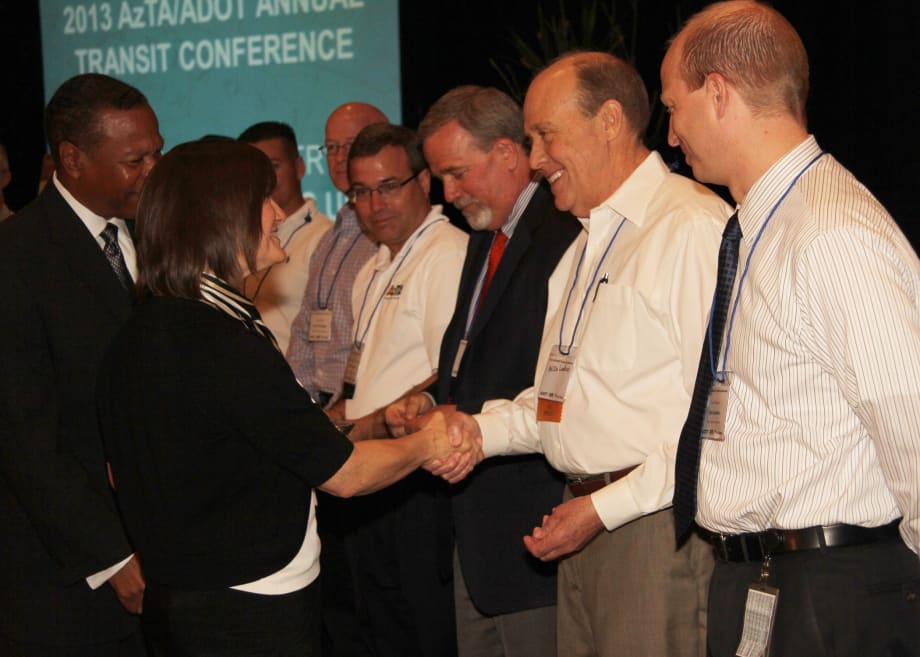
Joyner thanks veteran Michael Ladino, general counsel at Phoenix-based Valley Metro., for his service. She spearheaded Operation Veterans in Public Transportation.
Joyner thanks veteran Michael Ladino, general counsel at Phoenix-based Valley Metro., for his service. She spearheaded Operation Veterans in Public Transportation.
Kristen Joyner
Executive Director, South West Transit Association,
Fort Worth, Texas
Like many other transit professionals, Kristen Joyner fell into public transportation while looking to change careers. Born in El Dorado, Ark., and growing up in a family of teachers, she taught piano and music classes and majored in voice and piano at Arkansas Tech University. Her goal was a career in music therapy.
However, because she would have had to go to Kansas to pursue it and her parents insisted she stay in-state for school, she stayed put. Soon after, she met her husband, a professional musician.
After a stint in sales and marketing at a radio station, Joyner began her first transportation job at Central Arkansas Transit Authority in Little Rock, Ark. She was assistant to the executive director at the time, Keith Jones. Applying her marketing savvy, she crafted an initiative that brought in extra revenue by getting restaurants and hotels along a popular new bus and light rail line to advertise on the transit system’s website.
After five years, Joyner and her husband moved to Nashville, Tenn. She worked with Fred Pryor Seminars, conducting leadership development classes for nonprofit boards and organizations across the U.S.
In 2007, Jones, president of the board at the time, brought her back into transit to be South West Transit Association’s (SWTA) new executive director. The position was the perfect fit for Joyner’s experience with marketing, training and developing boards, and radio.
Joyner advocates in Washington, D.C. for issues that affect SWTA’s eight-state region and oversees its leadership training and certification program for upper-level managers and new supervisors.
What she enjoys most about her work is bringing people together, whether that’s by connecting members living in different states who are dealing with the same challenges, introducing veterans to transportation careers or making association meetings more accessible for members with special needs.
Joyner recently spearheaded Operation Veterans in Public Transportation, a project the association developed to acknowledge and support veterans in transportation.
“Veterans gave service to our country,” Joyner says. “Now, they are serving their communities in public transportation.”
At each SWTA annual meeting, Joyner invites veterans onstage, presenting each one with a pin, shaking their hands and thanking them for serving their country and community by being a part of public transportation.
SWTA also recruits veterans and their spouses at job fairs in its region and offers a training program that connects veterans with transit jobs that correlate with their military duties.
Joyner led SWTA’s effort to publish an accessible media guideline book after finding that the transportation industry could do more to make meetings and related materials accessible to all members.
“A hotel that I was going to have a meeting at in Kansas City said it had an elevator that would take people to the ballroom,” Joyner explains. “I found out before the meeting took place that the elevator had been broken for a year. We made them build a ramp into the ballroom so that any [attendee] could go in there.”
Being the only full-time person on staff to serve a large geographic area can be a challenge, but Joyner commits to visiting each state in her region. She also admits to frustration with the stereotypes people have about public transportation and its customers, as well as the lack of national investment in public transportation.
However, having a hopeful outlook has helped her overcome such obstacles.
“I look at every problem as, ‘how can we solve this? I know if we work together, there’s a solution,’ she says. “That drives everything I do.”
“I love my job and being a part of an industry that makes a difference in peoples’ lives every day by giving them freedom and choices that they wouldn’t normally have,” Joyner adds.
Outside the office, Joyner is an active musician, singing in jingles written by her husband and at church. She also wrote a children’s musical.
More Bus

New York MTA Plans Largest Bus Fleet Upgrade in More Than a Decade
The agency is seeking manufacturers for 650 new CNG buses to replace aging vehicles, improve reliability, and advance its broader fleet modernization strategy.
Read More →
Building a Flexible Path to Transit Electrification
John Hroncich discusses BAE Systems’ modular and scalable approach, lessons learned from decades of real-world operations, and how agencies can identify electrification strategies that fit their fleets.
Read More →
Bus Tech Talk: Keeping Transit Technicians Ahead of the Technology Curve
LA Metro’s Obed Mejia discusses technician training, evolving maintenance technology, fleet replacement, and strategies for getting the most out of today’s transit fleets.
Read More →
Biz Briefs: RIPTA Unveils New Frontrunners, Clevland RTA Adds New Siemens, and More
In METRO's latest installment, we take a look at recent news from Siemens, Prevost, Dodge, and more partnerships making headlines across the transportation sector.
Read More →
People Movement: Holly Arnold Joins Transdev and More
In this edition, we also cover recent appointments and announcements at Pace, CamTran, MCI, and more, showcasing the individuals helping to shape the future of transportation.
Read More →
The High Cost of Transit Buses: Industry Leaders Look to Procurement Reform
Transit leaders and policymakers examine how standardized bus designs, streamlined procurement, and predictable funding could help agencies stretch budgets and deliver better service.
Read More →
The Business Voice Behind Public Transportation
As chair of APTA’s Business Members Board of Governors, Ray Melleady explains how more than 850 business members are partnering with transit agencies to advance funding, innovation, and industry-wide collaboration.
Read More →
From Surviving to Thriving: Building Stronger Transportation Organizations
Bus Business Consultants founder Brian Dickson shares lessons on leadership, organizational health, and creating options for long-term success in a changing transportation industry.
Read More →
Finding the ‘Happy Medium’: Optimizing Maintenance Without Sacrificing Reliability
The key to maintenance optimization isn’t doing less work—it’s doing the right work at the right time on the right assets.
Read More →
LA Metro, City of West Hollywood, and Partners Advance Smarter Bus Lane Enforcement
The award-winning partnership combines AI-powered detection with human oversight to improve bus reliability, accessibility, and enforcement efficiency.
Read More →