



Light Rail Projects Make Inroads in U.S., Beyond
We visit a sampling of projects, from Maryland MTA’s Purple Line, which was approved to be delivered via public-private partnership, to Perth, Australia, where a 14-mile network is being planned.
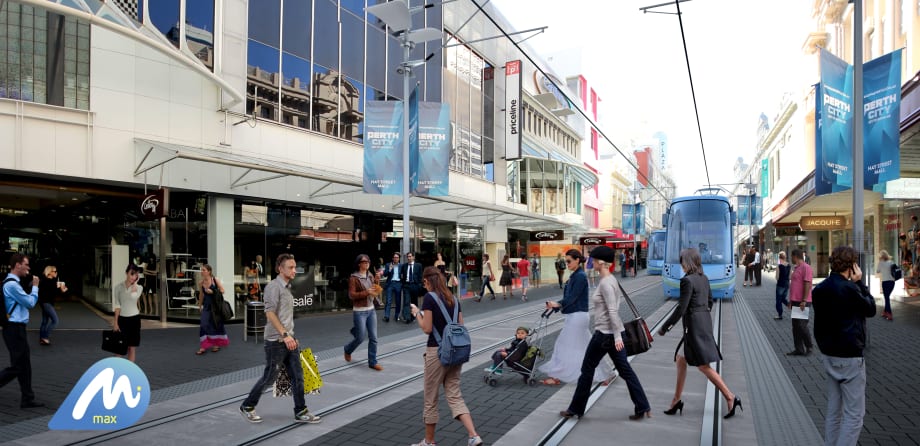
A rendering of Perth,
Australia’s MAX light rail line.
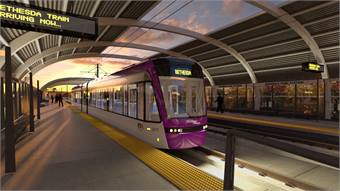
The Maryland Transit Administration’s Purple Line is a proposed 16-mile light rail transit line from New Carrollton in Prince George’s County to Bethesda in Montgomery County.
Light rail projects in the U.S. and across the globe are making headway in streamlining the public transportation landscape. We visit a sampling of projects in the planning, development and construction, as well as operational phases to gauge their progress.
Baltimore, Maryland
The 16-mile Purple Line will provide direct connections to Metrorail, MARC, Amtrak and local bus routes.
The Maryland Transit Administration’s (MTA) Purple Line is a proposed 16-mile light rail transit line from New Carrollton in Prince George’s County to Bethesda in Montgomery County. It will run mainly in dedicated or exclusive lanes, with 21 planned stations. The $2.2 billion project will provide direct connections to the Washington Metropolitan Area Transit Authority’s Metrorail Orange Line, Green Line and two branches of the Red Line, as well as MARC commuter rail’s Brunswick, Camden and Penn Lines; Amtrak and local bus routes.
Currently, it is difficult and time-consuming to get from many parts of the corridor to Metrorail. The Purple Line would provide a high-quality, faster and more dependable east-west transit link that does not exist today.
It would provide a direct link to the state's primary university and largest employer in Prince George's County, the University of Maryland.
The number of people and jobs in the area is growing and more people are traveling east to west and vice versa. The existing roads are highly congested, and commuting times continue to increase. The existing east-west bus services are unreliable and slow.
The project is expected to improve east-west mobility and reduce travel times for thousands of area residents. This fall, Gov. Martin O’Malley and members of the Board of Public Works (BPW) approved the MTA’s plan to deliver the Purple Line through a public-private partnership (P3). Board members also approved the MTA’s proposed competitive solicitation method for selecting a private concessionaire to design, build, finance, operate and maintain the east-west light rail line.
The BPW’s approval of a P3 delivery method for this project means that a single private partner will be responsible for designing, constructing, operating and maintaining the project, as well as providing up to $900 million in private financing. Per the passage of the Transportation Infrastructure Investment Act of 2013, Gov. O’Malley added $711 million in state funds for design and construction of the Purple Line to MTA’s six-year capital budget (FY 2014 –FY 2019).
With the vote by BPW members to approve the competitive solicitation process for selecting a private partner, MTA is slated to issue a Request for Qualifications and select the short list of qualified proposers by the end of 2013 and announce a preferred partner by fall 2014.
Construction on the Purple Line could begin in 2015, if funding is available. It would likely take three years to five years to complete construction.
[PAGEBREAK]

Ottawa, Ontario’s Confederation Line light rail system will feature a 1.5-mile downtown tunnel and 13 stations.
Ottawa, Ontario
Ottawa, Ontario’s Confederation Line light rail system will feature a 1.5-mile downtown tunnel and 13 stations.
In early October, officials gathered to mark the commencement of tunnel construction for Ottawa, Ontario’s Confederation Line Light Rail Transit system — touted as the “largest infrastructure project in the city’s history.” The eight-mile starter line, which features a 1.5-mile downtown tunnel and 13 stations, will alleviate congestion through the downtown core.
The Confederation Line is a $2.1 billion project that is jointly funded by the Government of Canada, the Province of Ontario and the City of Ottawa. The project is the first stage in Ottawa’s future rail network. The electric light rail system replaces existing diesel-powered buses, providing rapid transit between Blair Station in the east and Tunney’s Pasture in the west.
In late February, Alstom finalized a contract to provide 34 light rail vehicles and 30 years of maintenance services to the Rideau Transit Group consortium that was selected to design, build, finance and maintain the Confederation Line. Alstom’s portion of the contract is worth approximately $520 million.
Alstom will launch a new light rail vehicle (LRV) for the Ottawa system — the Citadis Spirit. Designed as a high-capacity LRV, the vehicle will be able to operate in extreme winter conditions and reach maximum speeds of up to 65 mph, reducing travel time between suburban areas and the city center.[PAGEBREAK]
A rendering of Perth,
Australia’s MAX light rail line.
Perth, Australia
A public-private partnership model is being considered to fund Perth’s MAX rail network.
In the international light rail arena, Perth, Australia is planning a 13.7-mile light rail network called Metro Area Express (MAX).
The proposed route runs from the suburb of Mirrabooka on the north end through the central business district of Perth before branching out to a medical center in the west and a transfer station to the east. This key corridor is not currently served by any high-capacity public transportation.
One particular section of the route along the corridor, Alexander Drive, one of cities busiest public transit bus corridors, has reached capacity and is unable to meet current and future demand.
Funding for the light rail project is expected to come from a combination of state, federal and private sector sources. Additionally, a P3 model is being considered. The state and federal governments have invested a combined $16 million for the initial planning phase.
The Department of Transport (DoT) of Western Australia has selected a joint venture of Parsons Brinckerhoff and AECOM to form an integrated services team for the next phase of the MAX network. The joint venture is working with the DoT to develop a business case for the $1.7 billion project.
David Thomas, MAX project director for DoT, says the project will introduce a new era of public transportation to Perth.
“MAX will support the city’s transformation by providing a frequent, high-capacity service in the inner-north and central west and eastern suburbs of Perth,” Thomas says.
Essentially, a modern electric light rail system, the new MAX network, will be quiet and efficient. It will be built along existing street corridors and largely separated from general traffic. Stations will be built on raised platforms featuring shelters and security cameras. Although the type of vehicles to be used has not been determined, they will be air conditioned, and ticketing for the system will be integrated with the region’s existing smart card system.
The project is seen by the city as a catalyst for change and is being coordinated with land-use planning, with the intention of stimulating revitalization and new developments along the proposed alignment, according to project officials.
MAX is a priority project for the state government, with construction scheduled to commence in 2016. The first stages of the network are due to be operational by the end of 2019.
RELATED: "Light Rail Line Links Salt Lake City with Airport."
More Management

METRO Opens Submissions for 2026 Motorcoach Awards
Nominations are now being accepted for METRO Magazine’s Operator of the Year and Innovative Operator of the Year awards.
Read More →
New York MTA Advances Final Contract for Second Avenue Subway Expansion
Contract Four is the largest in the Second Avenue Subway Phase 2 project and includes construction of station infrastructure, tracks, and signals for the subway expansion, MTA officials said. Work on Contract Four will begin in 2027.
Read More →
Transit Agencies Highlight Safety Gains at National Summit
Leaders from 15 major transit systems shared crime-reduction results and safety initiatives while discussing the role of continued federal support.
Read More →

NITA Names New Leadership, Expands Reduced-Fare Program at First Board Meeting
The new regional transit authority appointed its first board chair and interim executive director while extending reduced fares across CTA, Metra, and Pace for eligible riders.
Read More →
Beyond the Checklist: A Structured Approach to Transit Maintenance
Reliability-Centered Maintenance helps transit agencies move beyond routine checklists to focus limited resources on the assets and failures that have the greatest impact on safety, reliability, and service.
Read More →
APTA 2026 Nominating Committee Selects Leadership Slate, Names Chair and Vice Chair Nominees
Leadership changes will help shape the association’s priorities and its representation of the transportation industry during the 2026–2027 term.
Read More →
DART Launches Major Security, Fare Enforcement Initiative
The 90-day demonstration will deploy coordinated security teams at five light rail stations while testing controlled access and gathering data to guide future investments.
Read More →
Advancing Fare Collection Through Technology and Innovation
Learn about delivering 1300 gates at 91 stations while managing fare evasion. Explore the large scale deployment, solution customization and real-world results that affect the region. Prepare for deployment in your region now.
Read More →
Game Day in Motion: Moving Millions During the 2026 World Cup
Between packed transit stations and team motorcoaches, see how agencies and operators across North America tackled the transportation demands of the 2026 FIFA World Cup.
Read More →
Surface Transportation Extension Averts Shutdown, Leaves Transit Funding Gap
The stopgap keeps federal transportation programs moving, but missing advance funding could complicate the transit and rail projects agencies are planning next.
Read More →