



UT Profile: Georgia Southern U. adds ElDorados to meet growth
The service began in 2005 with five buses running one route and has grown to three routes, serving more than two million rides per year to students. The service has now expanded to 12 buses, running two routes Monday through Friday.

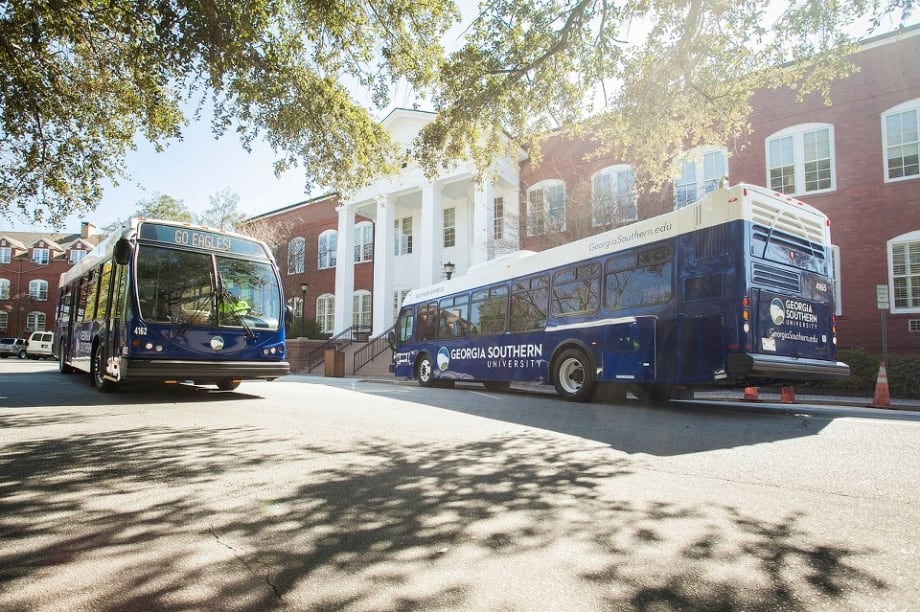

In February, Statesboro, Ga.-based Georgia Southern University began a new era in transporting students around campus with the unveiling of a new fleet of ElDoradoNational EZ Rider Low-Floor buses for its Southern Express shuttle service.
The service began in 2005 with five buses running one route and has grown to three routes, serving more than two million rides per year to students. The service has since expanded to 12 buses running two routes Monday through Friday.
“As with any growing university, parking spaces on campus are at a premium, and we found ourselves unable to keep up with the growing demands for parking spaces,” said Kristi Bryant, director, parking & transportation, for Georgia Southern about the reasons behind launching the service. “From the first day of transit service, it has been well received by our university community.”
Since each new bus will be equipped with GPS, students will soon be able to use their smartphones and a mobile app to track a bus instead of spending valuable time waiting at a bus stop. There are safety improvements, too. The buses have low-floors and a handicap ramp instead of a lift. There are also more handrails on the buses and a larger front window where drivers can have better views of the roads.
The new Southern Express buses also run on biodiesel, completing the system’s transition from compressed natural gas. The university anticipates opening a new facility that will house a biodiesel fueling station in the short-term future.
The buses are owned and operated by First Transit under contract with Georgia Southern.
“Georgia Southern and First Transit have had a wonderful business relationship since the day they arrived,” said Bryant. “The staff is very courteous and strives for excellence. The drivers that are employed are highly trained, well qualified drivers that are the best in the region. If any routes are changed and/or modified, we are always consulted. If we, as a university, ask for a route change, they are ready, willing and capable of handling our request.”
The transit program is funded by a mandatory student Transportation Fee of $55/semester. No ID is needed and anyone can ride. Additionally, faculty and staff members can opt out of paying to park on campus by parking at the university’s stadium and riding the transit system.
Since the inception of the Southern Express, the university has grown from around 17,000 students in 2006 to 20,500 today. The university is expecting to grow to 25,000 students by 2020, according to Bryant, who is expecting the shuttle service to expand as well.
"The future of transportation on campus is exciting. We hope to offer more routes on campus as well as offer a weekend shuttle to the shopping district, off campus,” she said. “Long term, I would like to see our student transportation system integrate with a city transit service — the City of Statesboro does not have any type of public transportation, currently — offering our students a broad variety of destinations.”
Georgia Southern University, a Carnegie Doctoral/Research University founded in 1906, offers more than 120 degree programs serving more than 20,500 students. Through eight colleges, the university offers bachelor’s, master’s and doctoral degree programs built on more than a century of academic achievement.
RELATED ARTICLE: Check out, "UT Profile: Student-run Unitrans keeps sustainability in mind."
More Technology

From Hardware to Digital Partner: Luminator Charts Its Next Chapter
CEO Magnus Friberg discusses Luminator’s shift toward becoming a digital partner, the growing importance of software and interoperability, and how AI can help agencies improve operations and passenger experience.
Read More →
Beyond the Checklist: A Structured Approach to Transit Maintenance
Reliability-Centered Maintenance helps transit agencies move beyond routine checklists to focus limited resources on the assets and failures that have the greatest impact on safety, reliability, and service.
Read More →
NJ TRANSIT Advances Bus Technology Upgrades Across Statewide Fleet
More than 1,500 buses now feature upgraded technology designed to improve arrival predictions and provide free Wi-Fi, with deployment expected to reach nearly 2,000 buses by the end of 2026.
Read More →

Building a Flexible Path to Transit Electrification
John Hroncich discusses BAE Systems’ modular and scalable approach, lessons learned from decades of real-world operations, and how agencies can identify electrification strategies that fit their fleets.
Read More →
Biz Briefs: Alstom Lands Canadian Contract, LYT to Supply California TSP, and More
In METRO's latest installment, we take a look at recent news from Complete Coach Works, Beep, FlixBus, and more partnerships making headlines across the transportation sector.
Read More →
From Legacy Silos to Conversational Intelligence
What if transit leaders could ask any operational question and get a trusted answer in seconds? Conversational AI is transforming how agencies use their data.
Read More →
USDOT Announces Rail Vehicle Replacement Grants, Chattanooga AV Shuttle Funding
More than $191 million in federal funding will help three transit agencies replace aging rail vehicles and support a new autonomous shuttle service in Chattanooga.
Read More →
Bus Tech Talk: Keeping Transit Technicians Ahead of the Technology Curve
LA Metro’s Obed Mejia discusses technician training, evolving maintenance technology, fleet replacement, and strategies for getting the most out of today’s transit fleets.
Read More →
Biz Briefs: RIPTA Unveils New Frontrunners, Clevland RTA Adds New Siemens, and More
In METRO's latest installment, we take a look at recent news from Siemens, Prevost, Dodge, and more partnerships making headlines across the transportation sector.
Read More →
Why Simulating Pedestrian Movement Has Become Essential for Modern Rail Stations
Pedestrian microsimulation is helping rail planners identify bottlenecks, test station designs, and prepare complex transit hubs for growing passenger volumes.
Read More →