



Wireless charging electric bus debuts in South Korea
Technology enables electric vehicles to transfer electricity wirelessly from the road surface while moving. Power comes from the electrical cables buried under the surface of the road, creating magnetic fields.

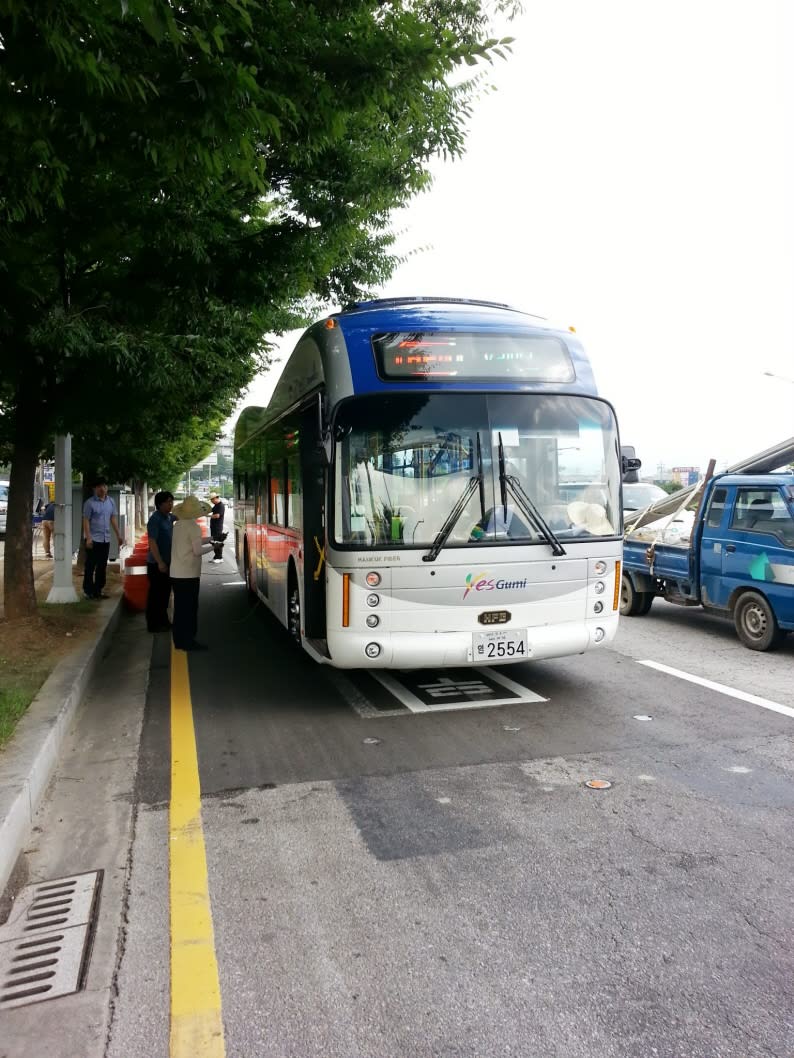
A wireless electric bus, capable of being charged while stationary or driving, made its debut in South Korean city of Gumi this week.
The Online Electric Vehicle (OLEV), developed by the Korea Advanced Institute of Science and Technology (KAIST), removes the need to stop at a charging station.
RELATED: "German bus system to test Bombardier electric charging tech."
Two OLEV buses will run an inner city route between Gumi Train Station and In-dong district, for a total of 24 km roundtrip. The bus will receive 20 kHz and 100 kW (136 hp) electricity at an 85% maximum power transmission efficiency rate while maintaining a 17cm air gap between the underbody of the vehicle and the road surface.
OLEV receives power wirelessly through the application of the “Shaped Magnetic Field in Resonance (SMFIR)” technology. This is a new technology introduced by KAIST that enables electric vehicles to transfer electricity wirelessly from the road surface while moving. Power comes from the electrical cables buried under the surface of the road, creating magnetic fields. There is a receiving device installed on the underbody of the OLEV that converts these fields into electricity. The length of power strips installed under the road is generally 5% to15% of the entire road, requiring only a few sections of the road to be rebuilt with the xembedded cables.
The OLEV battery is one-third of the size of the battery from a regular electric car. The vehicle complies with the international electromagnetic fields (EMF) standards of 62.5 mG, within the margin of safety level necessary for human health. The road has a smart function as well, to distinguish OLEV buses from regular cars — the segment technology is employed to control the power supply by switching on the power strip when OLEV buses pass along, but switching it off for other vehicles, thereby preventing EMF exposure and standby power consumption. As of today, the SMFIR technology supplies 60 kHz and 180 kW of power remotely to transport vehicles at a stable, constant rate.
After the successful operation of the two OLEV buses by the end of this year, Gumi City plans to provide ten more such buses by 2015.
RELATED: "Proterra to Power South Carolina Fleet."
More Bus

New York MTA Plans Largest Bus Fleet Upgrade in More Than a Decade
The agency is seeking manufacturers for 650 new CNG buses to replace aging vehicles, improve reliability, and advance its broader fleet modernization strategy.
Read More →
Building a Flexible Path to Transit Electrification
John Hroncich discusses BAE Systems’ modular and scalable approach, lessons learned from decades of real-world operations, and how agencies can identify electrification strategies that fit their fleets.
Read More →
Bus Tech Talk: Keeping Transit Technicians Ahead of the Technology Curve
LA Metro’s Obed Mejia discusses technician training, evolving maintenance technology, fleet replacement, and strategies for getting the most out of today’s transit fleets.
Read More →
Biz Briefs: RIPTA Unveils New Frontrunners, Clevland RTA Adds New Siemens, and More
In METRO's latest installment, we take a look at recent news from Siemens, Prevost, Dodge, and more partnerships making headlines across the transportation sector.
Read More →
People Movement: Holly Arnold Joins Transdev and More
In this edition, we also cover recent appointments and announcements at Pace, CamTran, MCI, and more, showcasing the individuals helping to shape the future of transportation.
Read More →
The High Cost of Transit Buses: Industry Leaders Look to Procurement Reform
Transit leaders and policymakers examine how standardized bus designs, streamlined procurement, and predictable funding could help agencies stretch budgets and deliver better service.
Read More →
The Business Voice Behind Public Transportation
As chair of APTA’s Business Members Board of Governors, Ray Melleady explains how more than 850 business members are partnering with transit agencies to advance funding, innovation, and industry-wide collaboration.
Read More →
From Surviving to Thriving: Building Stronger Transportation Organizations
Bus Business Consultants founder Brian Dickson shares lessons on leadership, organizational health, and creating options for long-term success in a changing transportation industry.
Read More →
Finding the ‘Happy Medium’: Optimizing Maintenance Without Sacrificing Reliability
The key to maintenance optimization isn’t doing less work—it’s doing the right work at the right time on the right assets.
Read More →
LA Metro, City of West Hollywood, and Partners Advance Smarter Bus Lane Enforcement
The award-winning partnership combines AI-powered detection with human oversight to improve bus reliability, accessibility, and enforcement efficiency.
Read More →