



How to Prepare Passenger Rail Service for Special Events
Crowd control, ticketing and providing timely service can become challenging in the midst of large events. Establishing a command center, deploying volunteers and conducting outreach through the media can help.
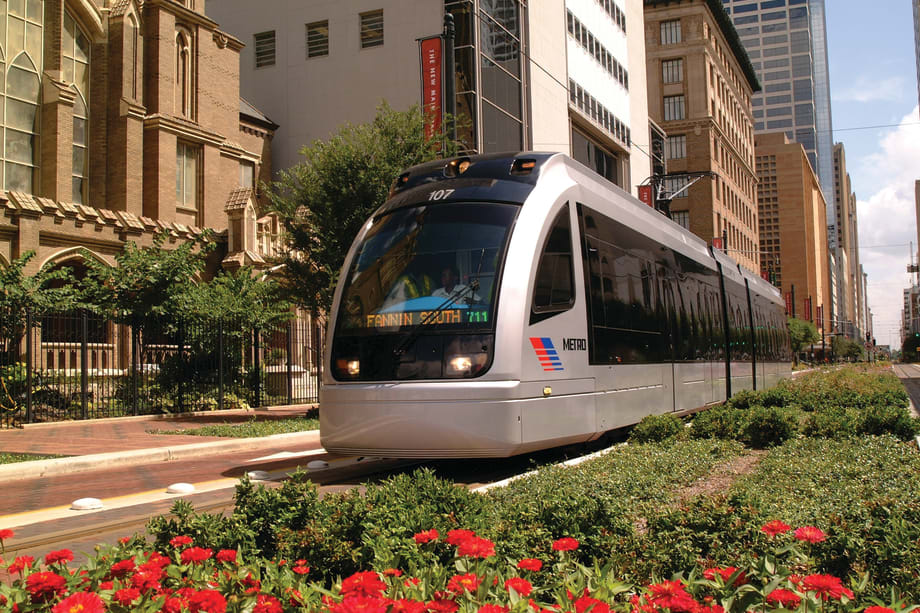
When Dallas Area Rapid Transit (DART) opened a new light rail line to Fair Park — the location of Texas’ annual state fair — and the Cotton Bowl in anticipation of the 2009 “Red River Rivalry” football game, officials planned for a 50% rail ridership increase. Instead, 132,000 people boarded the system during the playoff between Oklahoma State and the University of Texas — a 150% increase.
What resulted were passenger queues stretching over 300 yards, long train delays and overcrowding. It took five hours to clear the crowds, and the traffic signaling system in downtown Dallas crashed after becoming overloaded by the trains operating at street level.
“It didn’t take long after the state fair was over that year for our Executive Director Gary Thomas to give us his charge: ‘Fix it for next year.’ That’s all he said; that’s all he had to say,” says Larry Gaul, assistant VP, rail operations, for DART.
Preparing rail service for special events can be a daunting task. Experts from four transit operators who shared their stories during this year’s American Public Transportation Association (APTA) rail conference in Dallas spoke with METRO Magazine about lessons learned during high-stress events in their areas of service.
Keep track of lessons learned
The first thing DART officials did following the new Green Line kafuffle was to develop a list of lessons learned, according to Gaul.
“We put everything we could think of on pieces of paper,” he says. “This was done by a large group that was assigned by DART and had reps from all across the agency. From that list, we developed a set of objectives for 2010.”
DART altered its service to reduce congestion, implemented a direct shuttle service from the commuter rail station to the fairgrounds, established an emergency communication center and ran multiple simulations prior to the big game in 2010. While minor adjustments have been made in the years since, the agency now has a strong plan to provide reliable service during the event.
Similarly, officials from Denver’s Regional Transportation District (RTD) keep a record of lessons learned in a book in the system’s control center, so that key stakeholders can review what went wrong and what went right following each special event.
RTD’s C and E light rail lines run past the Sports Authority Field at Mile High, home to the Denver Broncos. RTD will be adding a third line next April.
The operator’s light rail system also serves the Pepsi Center and Coors Field.
Find a point person
Austin Jenkins, assistant GM, rail operations for RTD, says that when there’s a big game, he appoints a central manager to coordinate service.
“One of my three senior managers or one of their delegates will be responsible for the actual onsite coordinator of the train movements,” Jenkins explains. “We have about two hours where we are taking passengers into the game. A couple of hours prior to this service, we add 14 extra four-car trains.”
Having a central figure to oversee service and make difficult decisions is vital, explains Gary Howard, director, rail transit, for the Metropolitan Transit Authority of Harris County (Metro) in Houston.
“One of the big things as far as how to really get organized is to designate somebody who is going to come up with the plan as opposed to establishing a committee,” Howard says.
Each year, Metro light rail serves attendees of the Houston Livestock Show and Rodeo, which is billed as the largest rodeo in the world.
Currently, one of Metro’s chief controllers writes the operation plans for major events, such as the rodeo and football games at Reliant Stadium.
“I find that working with the control center is best — if they’re going to have to control the train movement through the area, they have the knowledge of what it is going to take, as far as getting the train in and out of the area,” says Howard. “They are also good references as far as building that relationship with the field units and so forth.”[PAGEBREAK]
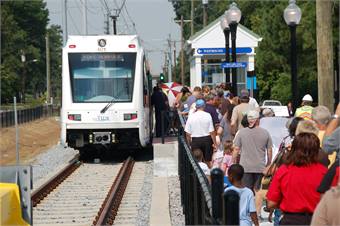
Hampton Roads Transit riders wait to board the Tide at MacArthur Square Station in Norfolk, Va. To help properly accommodate crowds during the Grand Illumination Parade, the agency recently began offering advanced online ticketing.
Partner with outside agencies
While it is important to have a point person, it is equally important to coordinate with outside agencies such as police, fire and the management of the venue where special events are being held.
Jenkins says RTD works closely with the management from the large venues in its service area to coordinate security, as well as with the Department of Homeland Security and the Secret Service during the recent presidential debate. RTD Chief of Police John Tarbert stays involved with security agencies at a national level, including the FBI.
“Cooperation and coordination with those other agencies is really critical,” Jenkins says. “We all do it a lot, but [Tarbert] is responsible for, primarily, the security.”
Similarly, during Norfolk’s annual Grand Illumination Parade, Hampton Roads Transit (HRT) coordinates with the Transportation Security Administration (TSA) to provide security, with officers sometimes riding along as a show of force, according to HRT Public Affairs Officer Tom Holden.
“We don’t want the transit services to be the story,” Holden explains. “We want the parade to be the story. And so if we do our job correctly, everyone goes to the parade and has a blast…and we take everybody home — that’s our goal, to make sure our services are transparent in that way, so that people are happy.”
Make ticketing easy
Because the Grand Illumination Parade has been the source of HRT’s highest light rail ridership numbers, it is important for officials to properly accommodate crowds. One element of this is ticketing.
“We’ve got a number of people who are going to be coming in to our system who aren’t normally there, so they really put a load on our capacity to distribute tickets,” Holden says.
To deal with this, the operator has taken to promoting advanced online ticket sales.
“We have a website that allows you to buy a ticket online, and then, load it into your phone so you can present it that way to a fair enforcement officer, or you could print it out on a piece of paper,” he adds.
Ticketing has also been a challenge for Metro during special events.
Ticketing is fairly simple for passengers who are in the process of going to an event, says Metro’s Howard, but “the problem comes when they leave the event; how do you ticket all of these people and do it efficiently enough?”
“We have picked our key locations where the larger groups of people are going to be coming in and will set up and sell wristbands for round trip tickets,” Howard explains. “Basically, when people come back out onto the platform, we can see that they are already ticketed.”
In addition, during the Houston Livestock Show and Rodeo, Metro partners with rodeo management to sell rail tickets inside the event.
RTD, on the other hand, receives a 100% return on the fares for football games by partnering with Reliant Stadium.
“They actually pay for the ridership to the game, so we don’t need to worry about trying to recover that money at the farebox,” Howard explains. “Rather, it’s calculated off of our automatic passenger counters.”
Utilize volunteers
Prior to the opening of its light rail system in the summer of 2011, HRT experienced mostly transit-dependent usage. The light rail brought a bevy of new riders who were inexperienced.
“In the beginning, we brought in some local community volunteers who knew about the system and stationed them at the stations with the highest ridership,” explains Karen Waterman, HRT’s former transit development officer and current planning and project development manager for Seattle’s Sound Transit. “They wore reds shirts to indicate who they were and helped people use the ticket vending machines.”
The operator also uses volunteers to help during the Grand Illumination Parade and other special events when more out-of-towners are expected to use public transit.
During large football games, DART also uses staff volunteers at busy stations.
“We had a small number of staff volunteers that were at key stations to help with customer information on the new service and some crowd control issues,” says Gaul. “And then, we had special shuttle bus service from various light rail stations in the outlying areas, with staff volunteers encouraging people to ride the shuttle buses, and that freed up more room on the rail system.”[PAGEBREAK]
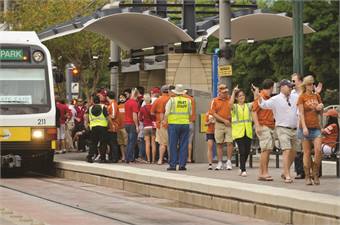
Dallas Area Rapid Transit created a list of lessons learned based on a previous experience with long train delays and overcrowding at a popular annual event. The agency altered its service to reduce congestion and added a direct shuttle service from a rail station near the event location.
Outreach is vital
The fastest way to inform the public about special event rail service is through the media. Jenkins points out that RTD uses radio advertising and social media to alert its users to special light rail service.
In addition, “We have good coordination with the stadiums themselves and work with our public information people,” he says. “They will do signage inside the stadium on the big screens and they will also do them downtown.”
Meanwhile, Houston Metro raises awareness through light rail wraps.
“We partner with Reliant Stadium and they actually wrap one of our LRVs in a Texans football style,” Howard says. “We will have … one of the key players for the Texans on the side of the train and so forth.”
Be flexible
No matter how much planning you do, however, operators must be prepared for something to go wrong.
Having an emergency communications center manned by key personnel will allow operators to take control of a situation quickly if it gets out of hand.
“When we know we have something coming, we will set up our emergency center,” says Jenkins. “We have a game plan. And, this allows us to marshal forces, move resources where we need to, make sure communication is clear with the public and that we’re not speaking with two voices, so the information that we’re putting out is consistent and true.”
DART has also opted to establish an emergency command center during large events to deal with problems.
“[Our] emergency command center is based on ICS, — or the integrated command structure principals — which is a new concept within emergency command and coordination,” explains Gaul.
For HRT, the most important part of planning for special events is to plan ahead for as much as possible.
“We have to think about all the amenities that we could think of, so we achieve our goal — which is to get people from where they are to where they want to go as quickly and seamlessly as possible,” Holden says.
More Rail

New York MTA Advances Final Contract for Second Avenue Subway Expansion
Contract Four is the largest in the Second Avenue Subway Phase 2 project and includes construction of station infrastructure, tracks, and signals for the subway expansion, MTA officials said. Work on Contract Four will begin in 2027.
Read More →
San Diego MTS Breaks Monthly Trolley Ridership Record
Agency officials said July’s ridership indicates MTS’s continued recovery from the pandemic.
Read More →
Report Examines NJ TRANSIT Reliability, Funding Challenges
The Garden State Initiative analysis examines the roles of Amtrak infrastructure, fleet management, and agency operations while recommending a more performance-based approach to improving reliability.
Read More →
Stadler, CapMetro Sign Long-Term Rail Fleet Support Agreement
Beginning in 2027, Stadler will provide on-site technical expertise, spare parts support, training, and obsolescence management to help extend the reliability and longevity of CapMetro’s GTW fleet.
Read More →
Biz Briefs: Alstom Lands Canadian Contract, LYT to Supply California TSP, and More
In METRO's latest installment, we take a look at recent news from Complete Coach Works, Beep, FlixBus, and more partnerships making headlines across the transportation sector.
Read More →
CATS Gold Line Marks 5 Years of Service, 2.8M Passenger Trips
With a six-mile expansion planned, the Charlotte streetcar is positioned to connect more neighborhoods and major transit hubs across the region.
Read More →
Why Simulating Pedestrian Movement Has Become Essential for Modern Rail Stations
Pedestrian microsimulation is helping rail planners identify bottlenecks, test station designs, and prepare complex transit hubs for growing passenger volumes.
Read More →
Amtrak Begins Major Construction at New York’s Sunnyside Yard
The new maintenance facility will support Amtrak’s Airo trainsets while improving maintenance efficiency and turnaround times in New York.
Read More →
Chicago Leaders Unveil Plans for O’Hare Airport Express Train
The privately developed project would offer a 15-minute trip between downtown and O’Hare’s Terminal 2, with trains operating every 15 minutes on a dedicated track. The service would use battery-electric trains and three existing freight rail rights-of-way.
Read More →
OCTA Maps Out 30-Year Strategy to Protect Coastal Rail Corridor
The draft feasibility report identifies strategies to protect the coastal rail line for decades as the agency continues near-term stabilization and sand placement efforts.
Read More →