




RELATED: Sound Transit light rail to run on 100% clean energy
Sound Transit breaks ground on new light rail ops., maintenance facility
The design-build team of Hensel Phelps Construction Co., Stantec, and partners will deliver the new $218 million OMF East.
May 14, 2018
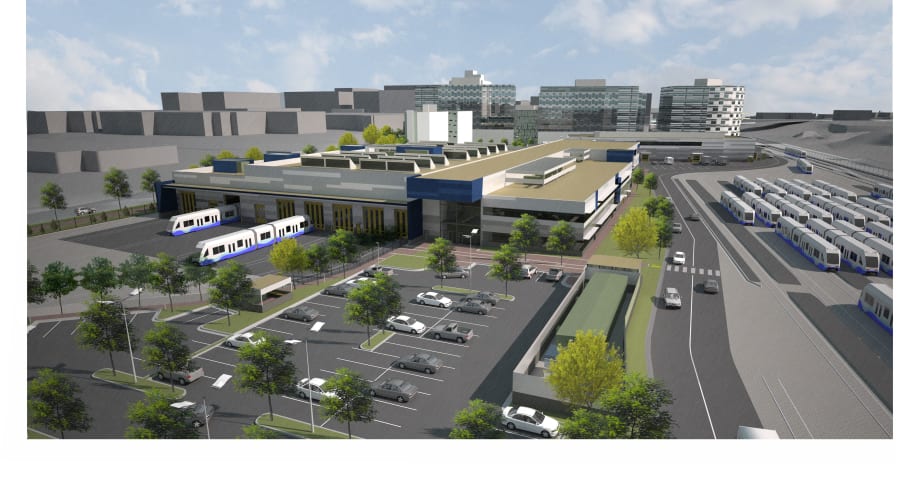
A rendering of Sound Transit's new Operations and Maintenance Facility via VIA Architecture.
2 min to read
A rendering of Sound Transit's new Operations and Maintenance Facility via VIA Architecture.
Seattle’s Sound Transit broke ground on its new Operations and Maintenance Facility (OMF) East, which will service and house light rail vehicles for the growing fleet in the Puget Sound area. Beginning in 2019, and continuing through 2023, Sound Transit’s light rail vehicle fleet will expand from its current 62 vehicles to 214. The new OMF East will service extensions to Northgate, Lynnwood, Federal Way, and Redmond.
The design-build team of Hensel Phelps Construction Co., Stantec, and partners will deliver the new $218 million OMF East. Hensel Phelps and Stantec bring more than 140 combined years of design and construction experience to the project. The 165,000-square-foot facility will provide 14 service bays, a cleaning and wash bay, shop areas, parts storage, office space, and on-site parking for service and employee vehicles.
The new facility will support the inspection, service, maintenance, storage, and deployment of up to 96 light rail vehicles. The existing Operations and Maintenance Facility on Forest Street in Seattle has capacity for 104 vehicles. OMF East will employ up to 250 full-time employees and will be open 24 hours a day every day of the year.
Sound Transit worked with the City of Bellevue and community partners to incorporate an opportunity for transit-oriented development (TOD) at the OMF East to integrate with new housing, office, and retail projects occurring in the Spring District. Approximately 1.1 million square feet will be available for TOD when construction of the OMF East is complete at the end of 2020.
The project is targeting LEED Silver certification and will be constructed to achieve a variety of sustainable goals to reduce environmental impact and optimize performance. Among the sustainable features include: 50% reduction of outdoor water use, 35% reduction of indoor water use, installation of a 50-kilowatt photovoltaic system, use of low-emitting materials to reduce concentrations of chemical compounds, and a planned diversion of 75% of construction and demolition waste from the landfill.
Stantec is leading the design of the project, providing design management; LEED facilitation; electrical engineering; mechanical engineering; site design management; environmental permitting; and design for lighting, IT/communications, security, signals, SCADA, acoustics, and track integration.
During design, Hensel Phelps Construction Co. is providing pre-construction, BIM (Building Information Model), and budgeting services out of their local office in Bellevue. With a focus on sustainable jobsite practices, safety, and quality, Hensel Phelps will also lead the construction efforts on site with several local trade partners.
More Rail

New York MTA Advances Final Contract for Second Avenue Subway Expansion
Contract Four is the largest in the Second Avenue Subway Phase 2 project and includes construction of station infrastructure, tracks, and signals for the subway expansion, MTA officials said. Work on Contract Four will begin in 2027.
Read More →
San Diego MTS Breaks Monthly Trolley Ridership Record
Agency officials said July’s ridership indicates MTS’s continued recovery from the pandemic.
Read More →
Report Examines NJ TRANSIT Reliability, Funding Challenges
The Garden State Initiative analysis examines the roles of Amtrak infrastructure, fleet management, and agency operations while recommending a more performance-based approach to improving reliability.
Read More →
Stadler, CapMetro Sign Long-Term Rail Fleet Support Agreement
Beginning in 2027, Stadler will provide on-site technical expertise, spare parts support, training, and obsolescence management to help extend the reliability and longevity of CapMetro’s GTW fleet.
Read More →
Biz Briefs: Alstom Lands Canadian Contract, LYT to Supply California TSP, and More
In METRO's latest installment, we take a look at recent news from Complete Coach Works, Beep, FlixBus, and more partnerships making headlines across the transportation sector.
Read More →
CATS Gold Line Marks 5 Years of Service, 2.8M Passenger Trips
With a six-mile expansion planned, the Charlotte streetcar is positioned to connect more neighborhoods and major transit hubs across the region.
Read More →
Why Simulating Pedestrian Movement Has Become Essential for Modern Rail Stations
Pedestrian microsimulation is helping rail planners identify bottlenecks, test station designs, and prepare complex transit hubs for growing passenger volumes.
Read More →
Amtrak Begins Major Construction at New York’s Sunnyside Yard
The new maintenance facility will support Amtrak’s Airo trainsets while improving maintenance efficiency and turnaround times in New York.
Read More →
Chicago Leaders Unveil Plans for O’Hare Airport Express Train
The privately developed project would offer a 15-minute trip between downtown and O’Hare’s Terminal 2, with trains operating every 15 minutes on a dedicated track. The service would use battery-electric trains and three existing freight rail rights-of-way.
Read More →
OCTA Maps Out 30-Year Strategy to Protect Coastal Rail Corridor
The draft feasibility report identifies strategies to protect the coastal rail line for decades as the agency continues near-term stabilization and sand placement efforts.
Read More →