How Puerto Rico transformed transit and its planning process
With its limited budget, too few vehicles and aging infrastructure, PRITA faced some serious challenges.
by Matt Fleck
September 15, 2016
Photo: Armando Claudio Jimenez
5 min to read
Photo: Armando Claudio Jimenez
Puerto Rico’s public transit system was in need of a major renewal after years of service inefficiencies, cost-overruns and planning inconsistencies. Multiple independent agencies managed disparate lines of service, from a bus network with 37 fixed routes to a heavy rail line with 16 stations. There was even an independent agency operating a ferry service in Old San Juan Bay.
With siloed communication and limited coordination across agencies, redundant services had become rampant. In an aim to smooth out the inter-agency planning process and the inefficiencies that came with it, the governor signed Act 123 in August 2014 to integrate everything under a central transit authority. It was the birth of Puerto Rico’s Integrated Transit Authority (PRITA).
Ad Loading...
The main goal of PRITA at its outset was simple: create an efficient, reliable transit network by increasing service frequency on major routes. But with limited budget, too few vehicles and aging infrastructure, PRITA faced some serious challenges in creating an efficient and reliable bus system that fit into the larger multimodal network.
Give and Take
Dr. Alberto Figueroa, executive director at PRITA, settled on a straightforward strategy for achieving higher bus frequency on major routes. PRITA would assign more buses to the most popular routes. Of course, adding buses to popular routes meant removing buses from others, which had its own set of challenges. To help with the conundrum, PRITA enlisted a group of local transportation consultants, including Francisco Klein.
The team’s goal was to achieve three things: reduce cost, maximize rider access and minimize the adverse social impact of the changes. Klein immediately suggested using the transit planning platform, Remix, to help with the planning process. Remix quickly became the team’s tool of choice for tackling the cost, mobility and social impact associated with the service changes.
1) Reducing cost
Ad Loading...
To reduce cost, PRITA aimed at addressing service overlap between bus lines and the Tren Urbano, the heavy rail line through San Juan. “[It] was a great platform for us to assess the conditions of the existing service [against] what would happen with the proposed routes,” Klein says of the planning tool. PRITA settled on encouraging riders to travel by rail instead of by bus if they were near the Tren Urbano, making way for redundant bus lines to be cut. The planning analysis also took into consideration that most of the areas where public bus lines were cut were near independent bus lines, or Porteadores.
2) Maximizing rider access
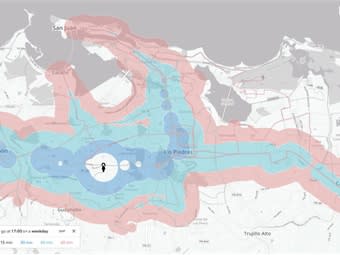
Maximizing access was a similar challenge. With bus-to-rail substitution a key feature of their strategy, PRITA wanted to show the community that the net impact of the bus service cuts was not as drastic as they might seem. To do this, PRITA needed a simple way to explain net changes in travel time between popular locales. Using an isochrone feature in Remix called Jane, PRITA gave a holistic view of how far riders could go in 15, 30, 45, and 60 minutes using only transit and walking to get there. Compared to simply displaying lines on a map, “Jane provided an easier way to explain to the public what will be the estimated travel time between municipalities in the system by using the different transit services,” Figueroa explains. “Even the Tren Urbano heavy rail and the San Juan-Cataño ferry service were simulated in Jane to show to users the potential benefit in travel-time reduction.”
3) Minimizing adverse social impact
Minimizing the adverse social impact of the service changes proved much more precise with the use of Remix’s rich layers of demographic data as well. “We needed to create a balance where we were eliminating routes to build the efficient system we were looking for, but at the same time reduce the impact on the community that uses the system,” Klein explains. Census data showing the density of low-income households overlaid on the map of San Juan kept bus service cuts from hitting the most disadvantaged areas of the metro area. The population data layer, too, ensured coverage in dense yet low-population municipalities outside of the San Juan city limits.
Ad Loading...
The Upshot
After the dust settled, 37 bus routes came down to 30, and the average peak headway plummeted from 50 minutes to about 25. The heavy rail system benefited from the bus network changes, too. “The improvements in the bus routes have increased up to 3,000 daily riders for Tren Urbano in the first months after the change was implemented,” Figueroa says.
Effect Change
Beyond the immediate goals of streamlining the bus system, PRITA saw the service changes as an opportunity to move toward their goal of shaping Puerto Rico’s fundamental attitudes toward public transit. “Unfortunately, during the last half of the 20th century, transit [in Puerto Rico] has really equaled poverty,” Klein explains. “If there’s no way you can have a car, then you ride transit. The ultimate goal is to change the impression of what transit is all about.”
PRITA used the “Jane” feature in Remix to visualize how far riders could go in a given amount of time.
If the real product of transit is the liberty to reach all the opportunities in a city, PRITA’s analyses in Remix are helping provide reliable service to those who need those opportunities most. PRITA hopes this will chip away at local sentiment that a person needs a private vehicle for dependable transportation.
Ad Loading...
Despite the challenges they faced consolidating the system under its auspices, PRITA feels the transit network as a whole is better off than before. Klein sees it as just the beginning. “Remix has been very helpful in assessing the proposed routes,” he says. “This way, we think we’re taking one step in the right direction of having a more efficient and reliable system.”
Matt Fleck is a transit planning specialist with Remix.
Best Practices
As PRITA forms the new transit agency, they have been able to apply the following four transit planning best practices:
1. Data-driven decision making for vulnerable populations: Gathering demographic information quickly to make decisions and ensure service equity for those communities.
2. A holistic network view: Visualizing PRITA’s entire transit network in one place for the first time — rather than line by line or by different modes.
3. More scenarios lead to a higher chance of success: Analyzing multiple scenarios with clear and understandable transit trade-offs builds a stronger case for ultimately choosing the best idea.
4. Collaboration across multiple departments and agencies: Creating transparency and getting everyone on the same page, leading to faster project timelines and implementation.
Contract Four is the largest in the Second Avenue Subway Phase 2 project and includes construction of station infrastructure, tracks, and signals for the subway expansion, MTA officials said. Work on Contract Four will begin in 2027.
The new regional transit authority appointed its first board chair and interim executive director while extending reduced fares across CTA, Metra, and Pace for eligible riders.
Reliability-Centered Maintenance helps transit agencies move beyond routine checklists to focus limited resources on the assets and failures that have the greatest impact on safety, reliability, and service.
The 90-day demonstration will deploy coordinated security teams at five light rail stations while testing controlled access and gathering data to guide future investments.
Learn about delivering 1300 gates at 91 stations while managing fare evasion. Explore the large scale deployment, solution customization and real-world results that affect the region. Prepare for deployment in your region now.
Between packed transit stations and team motorcoaches, see how agencies and operators across North America tackled the transportation demands of the 2026 FIFA World Cup.
The stopgap keeps federal transportation programs moving, but missing advance funding could complicate the transit and rail projects agencies are planning next.