A/C Trends: Rooftop Systems Impacting the Marketplace
Manufacturers continue to examine industry trends and requirements to provide the latest green, lightweight and efficient rooftop units in response to customer demand.
by Kelsey Nolan, Assistant Editor
July 23, 2014
Thermo King’s Athenia AMII can be mounted on CNG buses, parallel and series hybrid-electric buses, and battery and trolley buses.
6 min to read
After two years of research, engineering analysis and testing, ACT launched the RTS-75 in February.
Since the initial development of rooftop air conditioning (A/C) systems, companies industrywide have been tweaking existing technology for a more sophisticated, efficient and greener design. The result has been heavier-duty compressors, systems designed for small buses, renegotiated seals to eliminate leaks and even the successful application of units departing from their intended usage. And, as the customer demand for rooftop systems continues to grow and the environmental standards remain stringent, manufacturers are focusing their attention to the greener refrigerant, HFC 1234YF, to assess how it can complement their already existing products.
METRO spoke to industry experts to find out how these new technologies can benefit your transit agency’s vehicles in new and consistent ways.
American Cooling Technology Though American Cooling Technology is still partnered with Espar in the distribution of large rooftop A/C units, the company needed a solution suitable for smaller shuttle-bus type vehicles. Rooftop A/C systems and condensers are a great option for most buses because of the location.
Ad Loading...
Placing these units atop the bus, rather than underneath, removes the risk of picking up debris and dust, reducing maintenance intervals. Plus, the physical distance from the road surface allows the circulation of cooler and cleaner air, especially in desert cities. ACT wanted to offer this application for smaller vehicles as well.
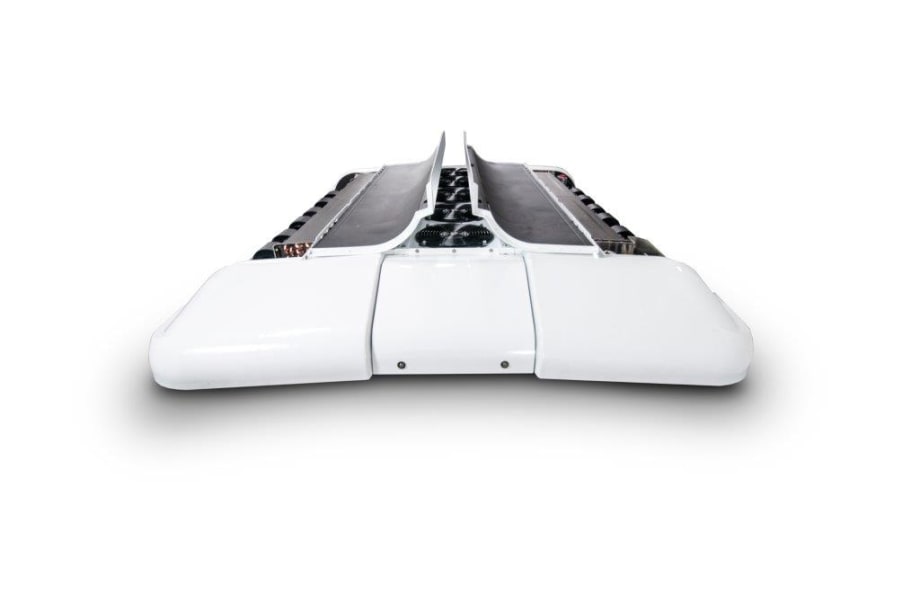
Since ACT specialized in rooftop condensers and, over the years, has created a family of condensers, producing its own rooftop A/C unit for smaller vehicles was the logical next step. The result is the RTS-75 air conditioner system. After two years of research, engineering analysis and testing, ACT launched the system in February. The A/C units are available in two capacity ranges, 75,000 BTU/hr. and 90,000 BTU/hr., and include optioning heating coils and digital driver’s display with A/C systems diagnostics. The units can also be supplied with a 12-volt or 24-volt electrical system.
According to ACT’s GM, Dave Oberdorff, while customer feedback has been positive, orders have come in for an application the company didn’t anticipate: the installation of two A/C systems on a larger bus.
He explains that often front-engine buses can be purchased with two TM21 compressors, but instead of having front and rear split system evaporator units hanging from the ceiling, customers are putting two units up on the roof. This application allows for more cooling capacity, proper draining of the evaporators and makes for a more redundant cooling system. In case one unit goes offline, there is a backup unit that operates completely independently.
“That was kind of a nice surprise to us — how many of these were sold and applied on buses using two instead of just one,” Oberdorff explains.
Rifled Air Conditioning Systems
Ad Loading...
Rifled Air’s BH-20 evaporator is designed to fit both the front and rear bulkhead of buses.
When a customer came to Rifled Air Conditioning Systems (RAC) with a drainage problem on their two-hole drain pan in the bulkhead evaporators a little over a year ago, execs at the company found a way to implement a quick and permanent solution: the BH-20 bulkhead style evaporator with a four-hole drain pan rather than the previous two-hole pan.
The BH-20 Bulkhead Style evaporator is a 60,000 BTU evaporator designed to fit the front and rear bulkhead of buses. What is nice about these evaporators is they give the appearance they are almost entirely integrated into the body of the vehicle rather than an add-on hang down passengers can hit their heads on. Plus, there are access panels on the units, enabling technicians to easily reach all the fittings and service points on the units as well the blower motors and fans.
Cheyne Rauber, GM and sales manager for RAC, explains that after live test driving the unit to pinpoint the problem, a four-hole drain pan was suggested. Since RAC does all of its metalwork in-house, Rauber and his team were able to prototype the new bulkhead within a week, and the system was in full production within three weeks. Rauber says the best part is that they eliminated the customer problem, while creating a brand new feature on RAC’s bulkhead evaporator.
The benefit of the four-hole pan is that no matter the orientation of the vehicle, there is always a positive flow. This way, there is never water building up and spilling over the pan, and thus, spilling onto passengers.
Additionally, the bulkhead unit has rivnuts mounted on the side of the units, which allows for a wide variety of mounting applications. With this variety, RAC can customize brackets and covers to fit any application in the market.
Ad Loading...
Additionally the company has seen success with its new weather pack condensers, which offer a weather tight connection at all connection points. With the new condensers, the need for exposed terminals that can be subject to corrosion, especially in snowy climates, is eliminated.
Thermo King
Thermo King’s Athenia AMII can be mounted on CNG buses, parallel and series hybrid-electric buses, and battery and trolley buses.
With a growing need for a lighter, more efficient HVAC system that is easy to service, Thermo King developed the Athenia AMII platform for buses. With brazed aluminum, micro-channel condensers, this cooling and heating combo platform is a replacement for both existing roof-mounts and rear-mounts at a lower weight and features improvements in coil design, air flow and high ambient temperatures. Though these units have been available for conventional buses since late 2013, applications for electric platforms have only recently been launched. Combined, these systems are can be mounted on compressed natural gas (CNG) buses, parallel and series hybrid-electric buses, and battery and trolley buses.
Additionally, the AMII is available with the alternator-driven all-electric HVAC as the all-electric HVAC solution for diesel and CNG buses. Steve Johnson, product manager for transit and coach HVAC at Thermo King, says these new lightweight and higher performing condensers will now be offered as the standard as the company continues to explore further improvements.
Rick Lehnert, president of Trans/Air Manufacturing, says that as the company gets more aggressive in the transit bus and motorcoach markets, it needed a rooftop A/C system that addresses the smaller market, since it already has technology for larger buses. The trend toward low-floor buses and more coach sales has increased the demand for roof-top systems. Rooftop systems also allow gentler, cleaner and quieter operation while manufacturing flow can be better with rooftops. Rooftops also can result in less installation labor.
Lehnert says the product is designed to not have a protrusion down in the center aisle, so it doesn’t impact head clearance. The two systems offer either free-blow distribution or ducted air distribution, and customers have a purchasing option based on the size of their vehicles.
Ad Loading...
The RT65 can be used on a small bus, the RT96 fits a mid-size bus and customers can put two RT65s on a large bus in place of a single unit. Plus, these rooftops can pair with the TM43 transit compressor for high performance systems.
As companies trend toward alternative fuels, Lehnert explains that customers will most likely lean more toward purchasing rooftop systems. This is, in part, because fuel tanks sometimes are in a place where skirt condensers are usually installed, so the only natural response is putting the A/C unit on top of the bus. Lehnert says Trans/Air is staying ahead of the industry trend toward the new refrigerant R1234yf, which has a low global warming potential and will keep customers informed.
Complete Parts features new branding with a new logo, a new contact telephone number, a dedicated order desk, enhanced processes and inventory, all designed to provide the parts bus operations need.
Accessible transit isn’t a feature—it’s a responsibility. This whitepaper explores how the Low-Floor Frontrunner is redefining mobility with a breakthrough design that removes barriers, empowers riders, and delivers measurable operational advantages for agencies. Discover why this next generation minibus is setting a new standard for inclusive transportation.
SEPTA was awarded $43 million in competitive grant funding from the FTA's FY25 Low and No Emission and Bus and Bus Facilities grant programs to support this procurement.
In part 1 of a two-part conversation, AC Transit’s director of maintenance joins co-hosts Alex Roman and Mark Hollenbeck to discuss his journey from the U.S. Marines to public transit and the role mentorship plays in developing the next generation of industry leaders.
When construction is complete, battery-electric buses will operate from the Arborway facility on Day One, providing cleaner, quieter, and more reliable service for riders, the MBTA said. After completion, the old facility will be demolished, and the land will be made available for redevelopment.
Nadine S. Lee, who has served as president/CEO since July 2021, said the decision comes after careful reflection on the agency’s progress and its path forward.
In this conversation, TBC’s Executive Director Ed Redfern, President Corey Aldridge, and Washington Representative Joel Rubin outline the coalition’s key policy priorities, the challenges facing transit agencies, and how industry stakeholders can work together to strengthen the voice of bus transit at the federal level.
What truly drives the cost of a paratransit fleet? Beyond the purchase price, seven operational factors quietly determine maintenance frequency, downtime, and long-term service reliability. This whitepaper explores how these factors shape lifecycle cost and what agencies should evaluate when selecting paratransit vehicles.