



3 Seattle Agencies Team Up for Trees for Rail
Sound Transit will be planting 20,000 trees and will keep the newly planted trees along the alignment for a minimum of 13 years.
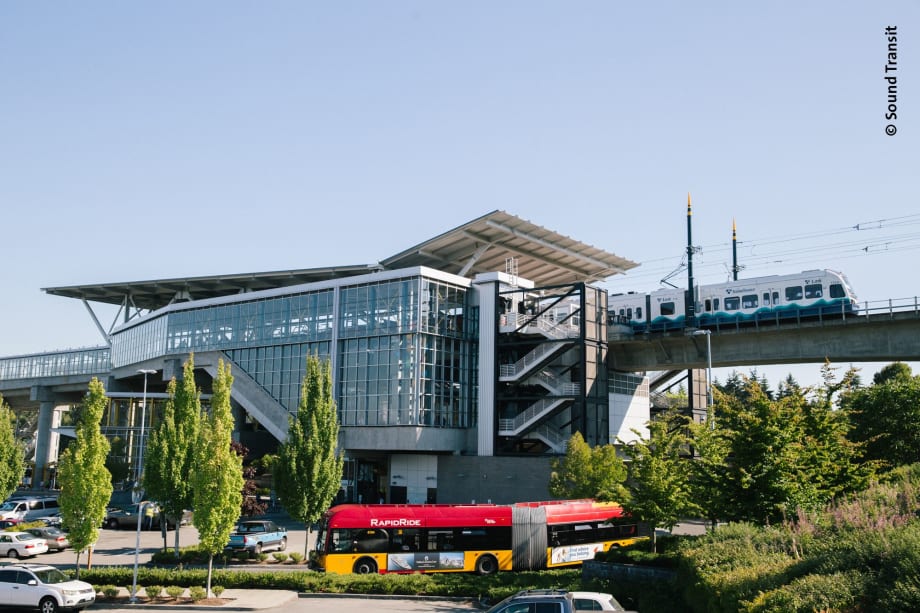
The partnership seeks to use King Conservation District’s county-wide Urban Tree Canopy program for native vegetation and tree canopy to decrease the impact on corridor-adjacent homeowners.
Sound Transit
Sound Transit, the City of Shoreline, and King Conservation District announced Trees for Rail, a partnership to re-green the Lynnwood Link light rail corridor with native trees and shrubs.
The partnership seeks to use King Conservation District’s county-wide Urban Tree Canopy program for native vegetation and tree canopy to decrease the impact on corridor-adjacent homeowners.
“This program builds on our existing commitment to plant thousands of trees along the Lynnwood Link alignment,” says Sound Transit CEO Peter Rogoff. “We think teaming up with the City of Shoreline and bringing the expertise of KCD to homeowners in these areas will be a big win for residents and the environment.”
Sound Transit will be planting 20,000 trees. The agency will keep the newly planted trees along the alignment for a minimum of 13 years. King Conservation District’s role will be to work directly with the over 200 Shoreline homeowners who were impacted.
King Conservation District will start planting later this year and eligible homeowners will be contacted by the company throughout the coming months.
Sound Transit leverages its resources and will serve to meet Shoreline’s landscaping requirements. Shoreline calls for landscape buffers between the light rail corridor and residential neighborhoods.
There is not enough space on Sound Transit owned property in some locations to plant these buffers. The parties have planned to offer trees and shrubs to be planted at nearby homes or adjacent City rights-of-way in impacted neighborhoods.
Eligible residents in parts of the Ridgecrest, North City, and Ballinger neighborhoods can volunteer to receive native trees and shrubs. They will be installed by KCD experts for free. Households can also receive training on how to care for their plants.
“We are excited about approaching rail corridor mitigation in this manner,” stated Shoreline mayor Will Hall. “This new approach reduces the number of property acquisitions needed by Sound Transit while still ensuring there are adequate landscape buffers along the light rail corridor.”
More Management

METRO Opens Submissions for 2026 Motorcoach Awards
Nominations are now being accepted for METRO Magazine’s Operator of the Year and Innovative Operator of the Year awards.
Read More →
New York MTA Advances Final Contract for Second Avenue Subway Expansion
Contract Four is the largest in the Second Avenue Subway Phase 2 project and includes construction of station infrastructure, tracks, and signals for the subway expansion, MTA officials said. Work on Contract Four will begin in 2027.
Read More →
Transit Agencies Highlight Safety Gains at National Summit
Leaders from 15 major transit systems shared crime-reduction results and safety initiatives while discussing the role of continued federal support.
Read More →

NITA Names New Leadership, Expands Reduced-Fare Program at First Board Meeting
The new regional transit authority appointed its first board chair and interim executive director while extending reduced fares across CTA, Metra, and Pace for eligible riders.
Read More →
Beyond the Checklist: A Structured Approach to Transit Maintenance
Reliability-Centered Maintenance helps transit agencies move beyond routine checklists to focus limited resources on the assets and failures that have the greatest impact on safety, reliability, and service.
Read More →
APTA 2026 Nominating Committee Selects Leadership Slate, Names Chair and Vice Chair Nominees
Leadership changes will help shape the association’s priorities and its representation of the transportation industry during the 2026–2027 term.
Read More →
DART Launches Major Security, Fare Enforcement Initiative
The 90-day demonstration will deploy coordinated security teams at five light rail stations while testing controlled access and gathering data to guide future investments.
Read More →
Advancing Fare Collection Through Technology and Innovation
Learn about delivering 1300 gates at 91 stations while managing fare evasion. Explore the large scale deployment, solution customization and real-world results that affect the region. Prepare for deployment in your region now.
Read More →
Game Day in Motion: Moving Millions During the 2026 World Cup
Between packed transit stations and team motorcoaches, see how agencies and operators across North America tackled the transportation demands of the 2026 FIFA World Cup.
Read More →
Surface Transportation Extension Averts Shutdown, Leaves Transit Funding Gap
The stopgap keeps federal transportation programs moving, but missing advance funding could complicate the transit and rail projects agencies are planning next.
Read More →