




Read More: Alstom Launches EC6, Outlines Future Plans
Georgia DOT Celebrates Connected Vehicle Technology Integration
The Georgia Department of Transportation currently has more than 700 intersections and interstate installations ready to deploy C-V2X technology
August 28, 2023
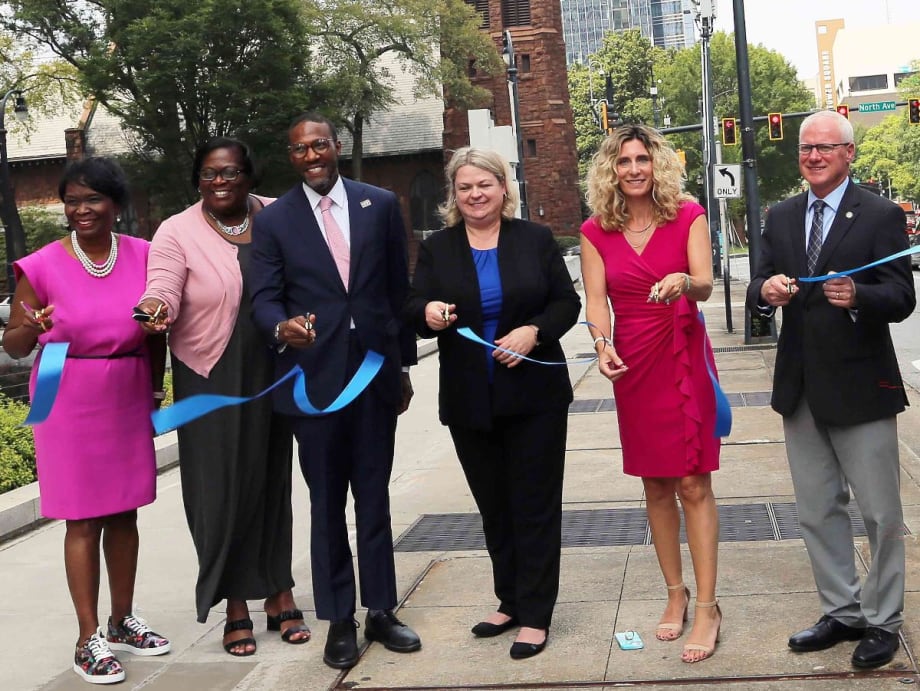
From left to right: State Transportation Board Member Stacey Key (CD 5), State Transportation Board Member Dana Lemon (CD 13), Atlanta DOT Commissioner Solomon Caviness, Georgia Division Administrator for FHWA Sabrina David, ITS America President and CEO Laura Chace, Georgia DOT Commissioner Russell R. McMurry, P.E.
Photo: Georgia DOT
2 min to read
Georgia Department of Transportation (Georgia DOT) recently held a ribbon-cutting to celebrate Cellular Vehicle-to-Everything (C-V2X) waivers granted by the Federal Communications Commission (FCC) allowing Georgia DOT to integrate C-V2X technology across the state, according to the agency's news release.
The ceremony featured Georgia DOT Commissioner Russell R. McMurry, P.E., Atlanta DOT Commissioner Solomon Caviness, Georgia Division Administrator for the Federal Highway Association Sabrina David, and ITS America President and CEO Laura Chace.
State Transportation Board members Stacy Key (Congressional District 5) and Dana Lemon (Congressional District 13) were also in attendance.
Examples of C-V2X Technology
C-V2X technology enables data sharing between vehicles, transportation infrastructure, pedestrians, and mobile networks to improve traffic flow, reduce congestion, and increase road safety.
Practical examples of this technology include:
Emergency vehicle prioritization: Communication with traffic systems to ensure that first responders have priority on the roadway improving response times through congested corridors.
Reduced emissions: Communication with traffic signals can reduce idling at intersections helping to reduce emissions by 20%.
Improved safety: Communications with other vehicles and transportation infrastructure can provide motorists with real-time information (hard braking, work zones, red light violation warnings, green light optimal speed advisory) that can prevent accidents and reduce fatalities.
How Georgia DOT Will Implement C-V2X Tech
In 2021, Congress passed the Bipartisan Infrastructure Law allowing for technology funding in transportation and the Federal Highway Administration (FHWA) has supported Georgia DOT as it worked to secure the necessary FCC waivers and implement the C-V2X technology on Georgia’s roadways.
“Georgia is on the leading edge of deploying connected vehicle technology to make their roads safer for all: cyclists, pedestrians, construction crews, and drivers,” said Shailen Bhatt, FHWA Administrator. “That is critical to advancing our shared mission of delivering a world-class transportation system -- in Georgia and across the entire country – that is safer, more efficient, more sustainable, and more equitable for all.”
Georgia DOT currently has more than 700 intersections and interstate installations ready to deploy C-V2X technology, in addition to the over 1200 signalized intersections already deployed with connected vehicle technology.
Additionally, the department has developed a V2X roadmap that outlines a 10-year funding program to equip all signalized intersections on the state route system.
More Technology

From Hardware to Digital Partner: Luminator Charts Its Next Chapter
CEO Magnus Friberg discusses Luminator’s shift toward becoming a digital partner, the growing importance of software and interoperability, and how AI can help agencies improve operations and passenger experience.
Read More →
Beyond the Checklist: A Structured Approach to Transit Maintenance
Reliability-Centered Maintenance helps transit agencies move beyond routine checklists to focus limited resources on the assets and failures that have the greatest impact on safety, reliability, and service.
Read More →
NJ TRANSIT Advances Bus Technology Upgrades Across Statewide Fleet
More than 1,500 buses now feature upgraded technology designed to improve arrival predictions and provide free Wi-Fi, with deployment expected to reach nearly 2,000 buses by the end of 2026.
Read More →

Building a Flexible Path to Transit Electrification
John Hroncich discusses BAE Systems’ modular and scalable approach, lessons learned from decades of real-world operations, and how agencies can identify electrification strategies that fit their fleets.
Read More →
Biz Briefs: Alstom Lands Canadian Contract, LYT to Supply California TSP, and More
In METRO's latest installment, we take a look at recent news from Complete Coach Works, Beep, FlixBus, and more partnerships making headlines across the transportation sector.
Read More →
Sponsored•September 8, 2026
From Legacy Silos to Conversational Intelligence
What if transit leaders could ask any operational question and get a trusted answer in seconds? Conversational AI is transforming how agencies use their data.
Read More →
USDOT Announces Rail Vehicle Replacement Grants, Chattanooga AV Shuttle Funding
More than $191 million in federal funding will help three transit agencies replace aging rail vehicles and support a new autonomous shuttle service in Chattanooga.
Read More →
Bus Tech Talk: Keeping Transit Technicians Ahead of the Technology Curve
LA Metro’s Obed Mejia discusses technician training, evolving maintenance technology, fleet replacement, and strategies for getting the most out of today’s transit fleets.
Read More →
Biz Briefs: RIPTA Unveils New Frontrunners, Clevland RTA Adds New Siemens, and More
In METRO's latest installment, we take a look at recent news from Siemens, Prevost, Dodge, and more partnerships making headlines across the transportation sector.
Read More →
Why Simulating Pedestrian Movement Has Become Essential for Modern Rail Stations
Pedestrian microsimulation is helping rail planners identify bottlenecks, test station designs, and prepare complex transit hubs for growing passenger volumes.
Read More →