



5 Passive Design Strategies to Help Condition Transit Facilities
Establishing a function-first facility that then integrates passive design strategies can lead to more operationally and energy efficient transit facilities.
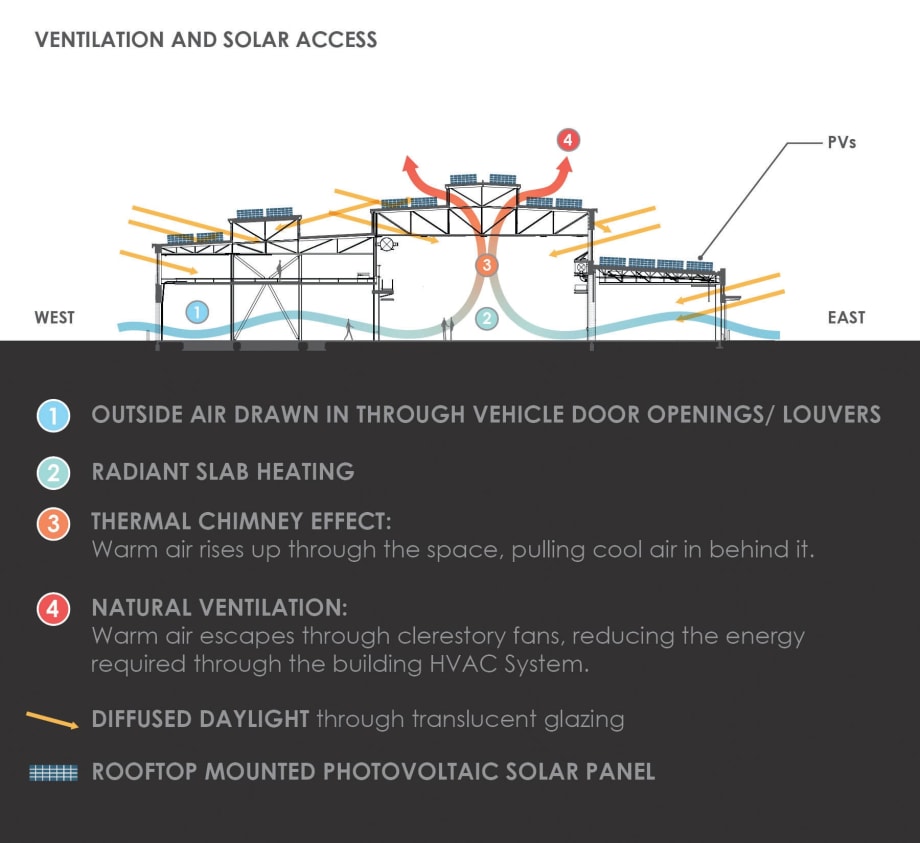
Graphic: RNL
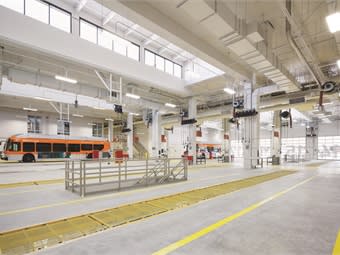
Photo: Chang Kim Photography
In this age of smart devices, smart buildings and smart cities, it can be easy to forget that the smartest approach to any problem is often a return to first principles. Architects in the Roman Empire leveraged the sun, wind, and thermodynamics to effectively heat and cool their buildings (and they didn’t need an app to accomplish it).
In fact, the ancient Romans even had underfloor heating, which is today one of the most popular choices for high-performing buildings. Building orientation, layout, use of thermal mass materials, and the heat capacity of air and water are all elements of ancient buildings that now form the basis of modern day “passive solar design,” and should be the starting point for any building design.
Establishing a function-first facility that then integrates passive design strategies can lead to more operationally and energy efficient transit facilities.
The high-bay, large volume buildings typically found in operations and maintenance facilities are ideal for passive strategies that rely on moving air up a vertical height, or require large flat areas of thermal mass. At the same time, their deep floor plans are a challenge for moving the needle on widespread daylight, or passively heating or cooling the large volumes of air required to ventilate these spaces.
Here are five steps for incorporating passive design strategies in to your next facility:
1 Know Your MICRO-Climate
The first step in passive design is recognizing the different needs and criteria of each micro-climate that your facilities are located in. Your design team will be able to use energy modeling software to generate a quick, general climate analysis for any site based on the coordinates and the ASHRAE-designated climate zone. However, it will not have the sensitivity to identify specific geographic features in the immediate surroundings that may have a significant impact on the microclimate. The more extensive the passive design features of your facility, the more it will both benefit and be impacted by slight variations in sun exposure and wind patterns. Look at where the nearest EPA monitoring station is to your site, or consider setting up your own weather monitoring apparatus directly on the site for a few months (ideally a year). For existing buildings or sites your agency already owns, have a discussion with your design team about any characteristics of the site you have noticed over the years. In summary, use the generic climate analysis as an introduction, but know that digging deeper to understand the microclimate can make a substantial difference to your operations.
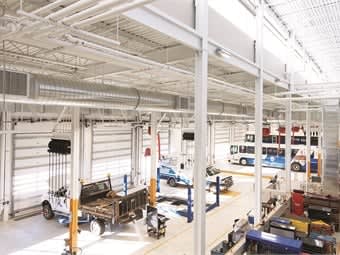
Photo: LaCasse Photography
2 Building orientation
Building orientation is possibly the most important design decision, impacting everything from how much daylight enters your building and how effective natural ventilation will be, to whether drive-through bays will work in winter, or opening roll-up doors will cause wind tunnel issues. The orientation of vehicle maintenance or parking bays is critical to the operations and circulation patterns of large vehicles on your site. While that conversation is taking place, layer in the patterns of sun and wind on the site, and consider the daily and seasonal relationship.
Graphic: RNL
3 Optimizing daylight
The most obvious passive solar design strategy is optimizing daylight in your facility. Optimizing means finding the right balance between the light and the heat from the sun for each space type and climate. In general, the aim is enough daylight in spaces where people spend a significant amount of time (offices, maintenance bays, break rooms) that electric lights are rarely needed. You can exploit large areas of thermally massive materials (e.g. concrete floors in maintenance bays) to absorb solar heat during the day and release it at night in winter. Patterns of light and dark animate spaces letting people see the passing of time and seasons. Too much daylight can lead to glare problems, overheating damage to materials and blinds-down-lights-on syndrome. Talk with your design team about where daylight is coming from — north-facing clerestories are the most forgiving in terms of quality of light entering a space — and the materials used in the space (light-colored floors and ceilings make a significant impact in large maintenance bays). Diffuse the light with translucent glazing options, which provide a bright and uniform distribution of light throughout the space. Large overhead doors are a great source of daylight, particularly when combined with translucent glazing.
Graphic: RNL
4 Solar heat gains
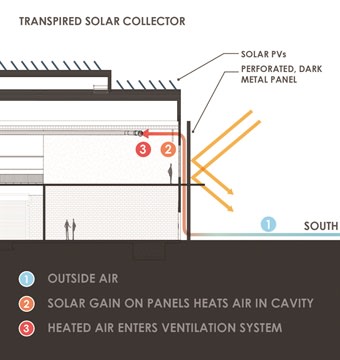
If you have a large area of uninterrupted south-facing wall in relatively close proximity to your mechanical room, you’ll want to have a conversation with your design team about transpired solar collectors (TSCs). Simple, proven to be effective and low cost, transpired solar collectors use solar heat gain to preheat incoming ventilation air, a significant energy load in high-bay, large-volume maintenance facilities. Typical TSCs consist of dark-colored, perforated-metal panels mounted a few inches off of the structural wall. As sun falls on the dark surface, air in the cavity behind the panels heats up, rises and is drawn into the building’s ventilation system by a fan. TSCs have been shown to increase air temperature by as much as 40°F. And the best thing about TSCs is that they are virtually maintenance free. Even in the mountains of Colorado at 9,200 feet elevation, this passive solar strategy has proven effective. Temperatures over a 100°F have been recorded in the pre-heat supply stream when the outside temperature was in the high 10s and low 20s. Solar orientation (i.e., south) is critical to the success of these systems. They can be installed continuously from ground level to roof, above overhead doors to roof or in partial configurations that blend with alternative exterior materials.
Another way of exploiting natural convection, particularly suited to high-bay spaces, is to create a thermal chimney. You don’t need to create an actual chimney, though a volume in that shape would be most effective (and useful for the agency holiday party). At its most simple, this means placing air inlets at ground level, outlets at high level for warm air to escape, and accelerating the movement of air up through the space by heating up surfaces at the ceiling level through solar gain via clerestories. Hot air exhausting out of the space pulls in more cool air at low level to replace it. The effectiveness depends on the relative size of the openings, the vertical height difference and the amount of heat generated. By simply partially opening the large bay doors, the required low air supply source can be established. Natural ventilation can be assisted with fans or operable windows controlled by thermostats.
5 Delayed benefits of thermal mass
Maintenance and parking facilities often have large areas of exposed concrete (walls and floors) or masonry (walls) that absorb heat from the sun during the day and, due to their heat capacity, release it back to the space slowly at night once the sun goes down. This is a benefit in facilities that are occupied during nighttime hours. This is most useful in climates that have a large temperature difference between day and night (e.g. Phoenix) but could actually be detrimental in climates where temperatures are high 24/7 in summer and cold 24/7 in winter. Ideally, any exposed mass would be located where it is heated by the winter sun, shaded from the summer sun and insulated to encourage heat to be released back into the space you are trying to warm in winter (e.g. for floors, insulating the underside of the concrete slab to avoid heat loss to the ground). If the mass is a floor, light colored walls will help reflect light into the space.
The Takeaways
Orientation, geometry, surface finishes, and evaluation of whether the strategy is the best for the climate are common principles of any passive approach, whether it is the sun or wind you are relying on. Obviously, facilities need to function first, especially operationally. Including your operations and maintenance staff in the early design considerations is essential. Operations differ from one transit agency to the next, but establishing a function-first facility that then integrates passive design strategies can lead to more operationally and energy efficient transit facilities.
Rachel Bannon-Godfrey is Associate AIA, LEED AP BD+C, B Corp Ambassador, Director, Sustainability and Merlin Maley is Associate Principal, Western Region Transit Director for RNL (www.rnldesign.com).
More Technology

From Hardware to Digital Partner: Luminator Charts Its Next Chapter
CEO Magnus Friberg discusses Luminator’s shift toward becoming a digital partner, the growing importance of software and interoperability, and how AI can help agencies improve operations and passenger experience.
Read More →
Beyond the Checklist: A Structured Approach to Transit Maintenance
Reliability-Centered Maintenance helps transit agencies move beyond routine checklists to focus limited resources on the assets and failures that have the greatest impact on safety, reliability, and service.
Read More →
NJ TRANSIT Advances Bus Technology Upgrades Across Statewide Fleet
More than 1,500 buses now feature upgraded technology designed to improve arrival predictions and provide free Wi-Fi, with deployment expected to reach nearly 2,000 buses by the end of 2026.
Read More →

Building a Flexible Path to Transit Electrification
John Hroncich discusses BAE Systems’ modular and scalable approach, lessons learned from decades of real-world operations, and how agencies can identify electrification strategies that fit their fleets.
Read More →
Biz Briefs: Alstom Lands Canadian Contract, LYT to Supply California TSP, and More
In METRO's latest installment, we take a look at recent news from Complete Coach Works, Beep, FlixBus, and more partnerships making headlines across the transportation sector.
Read More →
From Legacy Silos to Conversational Intelligence
What if transit leaders could ask any operational question and get a trusted answer in seconds? Conversational AI is transforming how agencies use their data.
Read More →
USDOT Announces Rail Vehicle Replacement Grants, Chattanooga AV Shuttle Funding
More than $191 million in federal funding will help three transit agencies replace aging rail vehicles and support a new autonomous shuttle service in Chattanooga.
Read More →
Bus Tech Talk: Keeping Transit Technicians Ahead of the Technology Curve
LA Metro’s Obed Mejia discusses technician training, evolving maintenance technology, fleet replacement, and strategies for getting the most out of today’s transit fleets.
Read More →
Biz Briefs: RIPTA Unveils New Frontrunners, Clevland RTA Adds New Siemens, and More
In METRO's latest installment, we take a look at recent news from Siemens, Prevost, Dodge, and more partnerships making headlines across the transportation sector.
Read More →
Why Simulating Pedestrian Movement Has Become Essential for Modern Rail Stations
Pedestrian microsimulation is helping rail planners identify bottlenecks, test station designs, and prepare complex transit hubs for growing passenger volumes.
Read More →