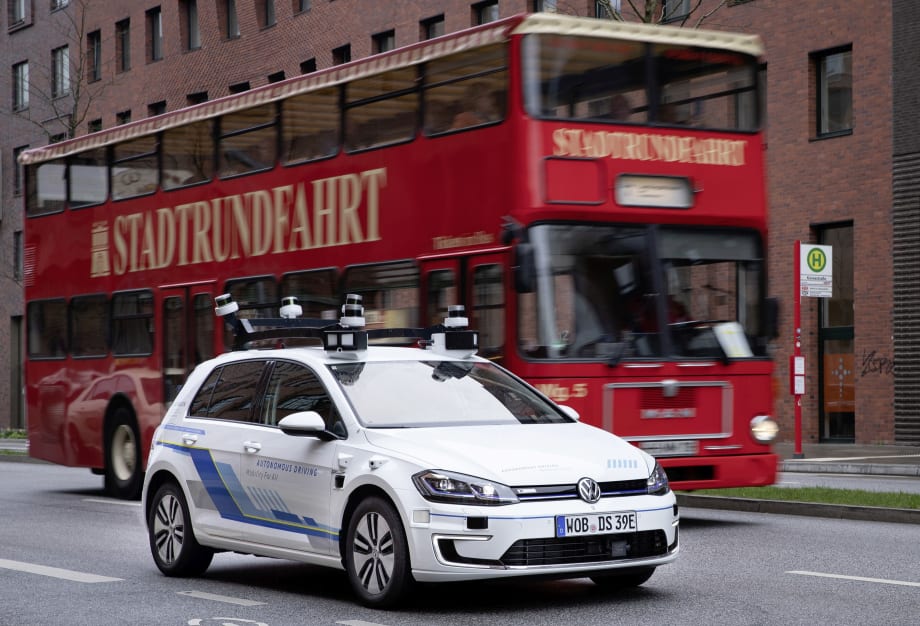
The e-Golf configured by Volkswagen Group Research have 11 laser scanners, seven radars, and 14 cameras.
Volkswagen
3 min to read
The e-Golf configured by Volkswagen Group Research have 11 laser scanners, seven radars, and 14 cameras.
Volkswagen
Volkswagen Group Research is testing automated vehicles in urban traffic in Hamburg, Germany. This is the first time Volkswagen has begun to test automated driving to Level 4 at real driving conditions in a major German city.
From now, a fleet of five e-Golf, equipped with laser scanners, cameras, ultrasonic sensors, and radars, will drive on an approximate two-mile section of the digital test bed for automated and connected driving in the Hanseatic city. The results of the test drives, which will be continuously evaluated taking full account of all data protection rules, will be incorporated in the Group’s numerous research projects on automated driving, and will test customer-centric services and optimize individual transport.
Ad Loading...
An approximate 5.6-mile long test track for automated and connected driving (TAVF) is being created in the city of Hamburg and will be upgraded to infrastructure-to-vehicle (I2V) and vehicle-to-infrastructure (V2I) communication by 2020. It is characterized by realistic and thus demanding traffic situations. The test track is an open platform for vehicle manufacturers, technology companies, and research institutions to trial innovative mobility services in real traffic conditions on public roads.
With the test track, the Free and Hanseatic City of Hamburg is creating a user-independent and technology-neutral application laboratory on which vehicle manufacturers, technology companies, and research institutions can test innovative mobility services free of charge in real traffic on public roads. Interested companies and research institutions can apply at any time. The TAVF coordination center together with the Free and Hanseatic City of Hamburg takes various criteria like the impact of innovation, benefits for traffic flow, and traffic safety or environmental effects on air quality into account.
With 1.8 million inhabitants, Hamburg is Germany’s second largest city. The City of Hamburg is promoting state-of-the-art technologies with the aim of becoming a showroom for innovative mobility.
The e-Golf configured by Volkswagen Group Research have 11 laser scanners, seven radars, and 14 cameras. Up to five gigabytes of data are communicated per minute during the regular test drives, each of which lasts several hours. Computing power equivalent to some 15 laptops is tucked away in the trunk of the e-Golf. This computing capacity, combined with state-of-the-art sensor technology, ensures that data on pedestrians, cyclists, other cars, intersections, rights of way, parked vehicles, and lane changes in moving traffic are captured over the shortest distances and in milliseconds.
Despite the diversity and complexity of the information, the artificial intelligence used in the vehicle software must register all relevant objects and respond to them without triggering any false alarms. Several different artificial intelligence approaches are used: these include deep learning, neural networks, and pattern recognition.
Ad Loading...
For safety reasons, specially-trained test drivers will be seated behind the steering wheel during all test drives in Hamburg to constantly monitor all driving functions and intervene in an emergency. Furthermore, all data protection rules will be fully taken into account.
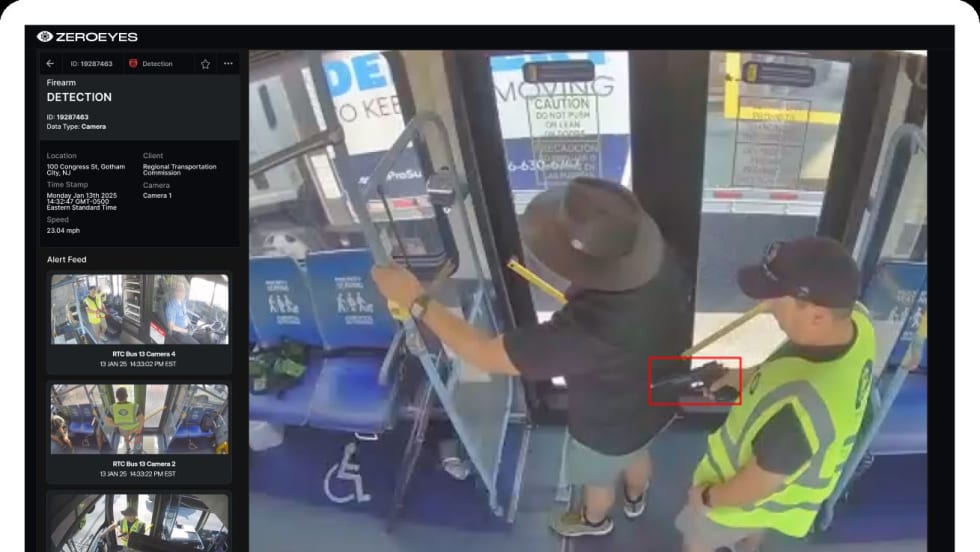
The project, finalized on February 12, provides the city with two different configurations of high-definition cameras to outfit 16 buses in the Pretzel City Area Transit fleet.
The proposed acquisition of a company with deep digital expertise and expected 2026 revenues of over $220 million marks a significant step in Hitachi Rail’s strategy to operate as a leading global digital mobility player, the company said.
The board authorized a five-year contract, with two one-year options, to Tolar Manufacturing Company Inc., for the fabrication and installation of upgraded passenger amenities at bus stops across the DART Service Area.
As motorcoaches navigate increasingly congested urban corridors filled with pedestrians, cyclists, scooters, and distracted drivers, safety leaders across the industry are confronting a growing challenge: visibility.
In this edition of Biz Briefs, we highlight the latest developments shaping the future of mobility — from manufacturers and technology providers to transit agencies and motorcoach service operators.