



Rail Station Redevelopment to Redefine Philadelphia for 21st Century
Built in 1933, the 30th Street Station is the third-busiest Amtrak station in the U.S., handling an estimated 30,000 intercity travelers and regional commuters daily.

Images courtesy SOM / © Amtrak

Images courtesy SOM / © Amtrak
The 30th Street Station District Plan to transform Philadelphia’s historic train station and the surrounding community into a vibrant urban neighborhood promises to become one of the city’s defining projects for the 21st century.
Shortly after its public release in June 2016, the District Plan — the largest transit-oriented development (TOD) plan in Philadelphia — was formally accepted by the Philadelphia City Planning Commission. Work is underway on several projects outlined in the plan, which won the American Institute of Architects’ 2017 Honor Award for Regional and Urban Design.
Building 21st Century Capacity
Built in 1933, the 30th Street Station is the third-busiest Amtrak station in the U.S., handling an estimated 30,000 intercity travelers and regional commuters daily. In addition to Amtrak and the Southeastern Pennsylvania Transportation Authority (SEPTA), the station also serves as the terminus of NJ TRANSIT’s Atlantic City line.
Many major highways and streets pass adjacent to or near the Station, including Market Street, the Schuylkill Expressway (Interstate 76), the Vine Street Expressway (Interstate 676) and John F. Kennedy Boulevard. The station is within walking distance of Center City Philadelphia and the many institutional, commercial, and cultural attractions in West Philadelphia’s University City District, most prominently Drexel University and the University of Pennsylvania.
A Major Civic Effort
The District Plan, which began development in 2014, is the centerpiece of a major civic effort intended to rejuvenate the area surrounding the station. The plan proposes the creation of 40 acres of open space and 18 million square feet of new development, covering 175 acres. The plan includes a mixed-use urban neighborhood to be built on top of the 88-acre rail yard, which is located along the west bank of the Schuylkill River.
Amtrak’s District Plan for the 30th Street Station District was created in partnership with Brandywine Realty Trust, Drexel University, PennDOT (Pennsylvania Department of Transportation) and SEPTA, and developed by SOM in association with WSP USA, OLIN, and HR&A Advisors.
The District Plan
The approved District Plan addresses the development of transportation, the station and facilities, and commercial opportunities in the 30th Street Station District. Additionally, it details an approach to meeting current and forecasted intercity, high-speed rail and commuter rail service on Amtrak’s Northeast Corridor (NEC) and improving transit, pedestrian, and traffic accommodations for the horizon year 2040. The plan also addresses the future needs of Amtrak, SEPTA and NJ TRANSIT rail passenger facilities, railroad operations, and rolling stock maintenance and rail administrative facilities at the 30th Street Station through 2040. The plan identifies possibilities to generate revenue, improve linkages to the community, utilize existing properties and air rights, and define partnerships with neighboring entities to optimize planning of future develop
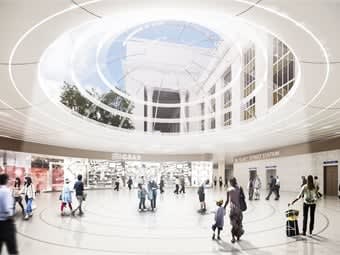
One of the top priorities expressed by the public for the plan’s development was a convenient, weather- and traffic-protected underground connection between the SEPTA 30th Street trolley and subway station and Amtrak’s 30th Street Station.
ment.
One of the top priorities expressed by the public during the five open houses for the plan’s development was a convenient, weather- and traffic-protected underground connection between the SEPTA 30th Street trolley and subway station and Amtrak’s 30th Street Station. Preliminary design of a new above-ground facility is underway by SEPTA, with an investigation of options for re-establishing the underground connection between these two areas to follow.
Similarly, on the surface streets, a feasibility study is underway for the reconfiguration of the I-76 and I-676 ramps near the station. Led by PennDOT, this project would not only improve the flow of traffic on the roads surrounding the station, it is also a predecessor activity for the construction of an intercity bus facility immediately north of the 30th Street Station. Additional projects are being advanced within and surrounding the station, including preliminary conceptual design for a reactivated north station concourse, improved station retail, and improvements to Station Plaza — transforming the public areas on all four sides of the station to an “active urban perimeter.”
Several other projects are currently underway and slated for completion within the first 15 years of the plan. Immediately to the west of the station, Brandywine Realty Trust, and Drexel University are collaborating on Schuylkill Yards, a six-million-square-foot mixed-use development. Amtrak is also advancing state of good repair improvements to the station and overbuild development on an Amtrak-owned parcel located west of the station. In light of these projects, PennDOT and SEPTA are involved in complementary efforts to improve their roadway and transit assets adjacent to the station in light of the anticipated growth and future development.
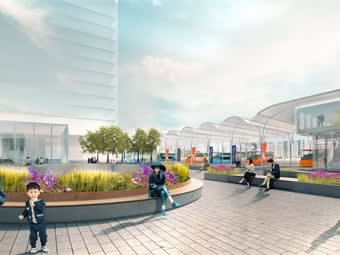
The 30th Street Station District Plan identifies possibilities to generate revenue, improve linkages to the community, utilize existing properties and air rights, and define partnerships with neighboring entities to optimize planning of future development.
Project ridership growth
Projected growth in ridership has made the NEC a focal point of planning studies prepared by both the Federal Rail Administration (FRA) and Amtrak. The transportation component of the District Plan reflects the findings and conclusions of these studies, which include the NEC FUTURE study prepared under the aegis of the FRA, Amtrak’s Northeast Corridor Infrastructure Master Plan, and other related studies and projects. Indeed, between 2003 and 2014, Amtrak experienced a surge in ridership: in 10 of those past 11 years, Amtrak trains in the NEC carried a record number of passengers. In fiscal year 2014, 11.6 million people used Amtrak’s NEC service, making the 30th Street Station the third busiest in the Amtrak national network.
Thus, the District Plan’s comprehensive 2040 transportation operations program addresses rail, transit, traffic, and pedestrian requirements. Three conceptual alternatives for overbuild development were created that addressed the requirements of a multimodal transportation network, including bicycle and pedestrian connections. The alternatives considered anticipated traffic volumes, passenger demand, institutional feasibility, and cost, along with an evaluation of potential factors that could influence structural options involving existing Amtrak and SEPTA rail lines, future SEPTA surface routes, and existing soil and groundwater conditions. Through stakeholder and public input, the three alternatives were refined into a singular vision for a station-anchored urban neighborhood.
For example, potential strategies to address SEPTA’s future needs include new bi-level coaches and locomotives, additional cars during rush hour, and limited changes in schedules to add capacity to address growth in regional rail service. Phased operations were developed for curbside operations around the station, including near-term plaza construction and related operational improvements, as well as the longer-term realignment of Schuylkill Avenue and construction of the north concourse. The 2040 transportation network also considers street design, and includes street connections in the rail yard overbuild development to the existing city grid, overlaid with a bicycle network.
A key objective of the plan is the identification of facility and operational improvements required to optimize rail, transit and pedestrian traffic at the 30th Street Station and the surrounding neighborhoods through 2040. The station-related considerations include: passenger volumes; access/egress modes and conditions; platform conditions; passenger movement in the Amtrak concourse and in the corridor connecting the Amtrak and SEPTA concourses; travel paths/walking paths/chokepoints; waiting and queuing conditions; vertical circulation; baggage handling for long-distance trains; travel group characteristics; demographics and trip purpose by time of day; and passenger accommodation weaknesses (crowding, clarity, comfort, services, etc.).
Peter Denitz, AICP, a sr. project manager with WSP USA, is principal-in-charge of WSP USA's contribution to the 30th Street Station District Plan.
More Rail

New York MTA Advances Final Contract for Second Avenue Subway Expansion
Contract Four is the largest in the Second Avenue Subway Phase 2 project and includes construction of station infrastructure, tracks, and signals for the subway expansion, MTA officials said. Work on Contract Four will begin in 2027.
Read More →
San Diego MTS Breaks Monthly Trolley Ridership Record
Agency officials said July’s ridership indicates MTS’s continued recovery from the pandemic.
Read More →
Report Examines NJ TRANSIT Reliability, Funding Challenges
The Garden State Initiative analysis examines the roles of Amtrak infrastructure, fleet management, and agency operations while recommending a more performance-based approach to improving reliability.
Read More →
Stadler, CapMetro Sign Long-Term Rail Fleet Support Agreement
Beginning in 2027, Stadler will provide on-site technical expertise, spare parts support, training, and obsolescence management to help extend the reliability and longevity of CapMetro’s GTW fleet.
Read More →
Biz Briefs: Alstom Lands Canadian Contract, LYT to Supply California TSP, and More
In METRO's latest installment, we take a look at recent news from Complete Coach Works, Beep, FlixBus, and more partnerships making headlines across the transportation sector.
Read More →
CATS Gold Line Marks 5 Years of Service, 2.8M Passenger Trips
With a six-mile expansion planned, the Charlotte streetcar is positioned to connect more neighborhoods and major transit hubs across the region.
Read More →
Why Simulating Pedestrian Movement Has Become Essential for Modern Rail Stations
Pedestrian microsimulation is helping rail planners identify bottlenecks, test station designs, and prepare complex transit hubs for growing passenger volumes.
Read More →
Amtrak Begins Major Construction at New York’s Sunnyside Yard
The new maintenance facility will support Amtrak’s Airo trainsets while improving maintenance efficiency and turnaround times in New York.
Read More →
Chicago Leaders Unveil Plans for O’Hare Airport Express Train
The privately developed project would offer a 15-minute trip between downtown and O’Hare’s Terminal 2, with trains operating every 15 minutes on a dedicated track. The service would use battery-electric trains and three existing freight rail rights-of-way.
Read More →
OCTA Maps Out 30-Year Strategy to Protect Coastal Rail Corridor
The draft feasibility report identifies strategies to protect the coastal rail line for decades as the agency continues near-term stabilization and sand placement efforts.
Read More →