



Berlin launches electric buses equipped with Bombardier charging system
The four Solaris Urbino 12 buses charge wirelessly and contactless. At the end stops, Bombardier's inductive Primove technology enables the buses to recharge in just a few minutes.

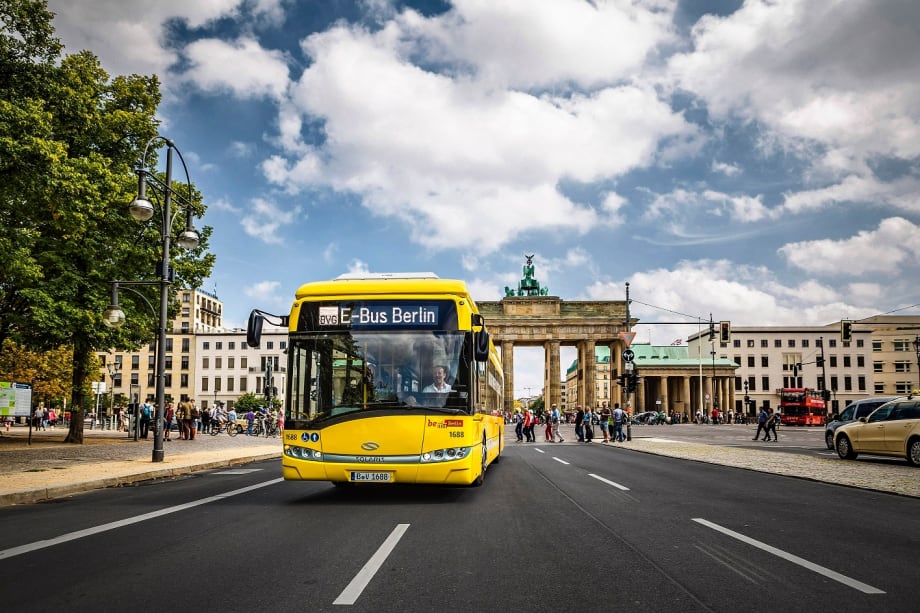
A milestone has been reached in the development of electric mobility in Berlin with the commissioning of the world's first wirelessly charged electric bus in a capital city. The Berlin Transport Authority, Berliner Verkehrsbetriebe (BVG), has introduced four Solaris Urbino 12 electric buses equipped with the Bombardier Primove inductive charging system and traction equipment from . The project is funded by the Federal Ministry of Transport and Digital Infrastructure.
BVG already transports around two-thirds of its passengers electrically with subways or trams, as well as with its four solar-powered ferries. Starting Monday, Aug. 31, Germany's biggest transport company now also runs electric buses. Line 204 between Sudkreuz and Zoologischer Garten (Hertzallee) now operates exclusively with electric buses. In addition to being emission-free, the buses, equipped with Vossloh Kiepe's electric drive produce low vibration and noise.
The buses charge wirelessly and contactless. At the end stops, Bombardier's inductive Primove technology enables the buses to recharge in just a few minutes.
On the 3.7-mile long route through the inner city, passengers now have 18 stops to get on and off and to enjoy the e-buses' quiet and smooth ride. The Primove battery system, with a total capacity of 90 kilowatt hours, offers sufficient energy reserves to handle even Berlin's most demanding routes, according to officials. In addition, the wireless charging system is well shielded so that the electromagnetic radiation is lower than that of a conventional induction cooker.
To fully charge the batteries overnight and air condition the passenger compartment before starting operation, four stationary and one mobile charging station were also installed by Vossloh Kiepe at the BVG depot. There the buses are supplied with power via charging cables.
Like all BVG's electric powered vehicles, the new Solaris Urbino 12 electrics are powered exclusively with green electricity. Within one year, the four electric buses on the line 204 will cover at a total of approx. 124,000 miles, saving 260 tons of CO2 emissions. Approximately 250 private cars would have to be electrified to reach the same effect. Furthermore, because the e-bus is as quiet as an average car, noise pollution has been reduced as well. As a precaution, an external speaker has been installed enabling the driver to announce the approach to a stop.
More Technology

From Hardware to Digital Partner: Luminator Charts Its Next Chapter
CEO Magnus Friberg discusses Luminator’s shift toward becoming a digital partner, the growing importance of software and interoperability, and how AI can help agencies improve operations and passenger experience.
Read More →
Beyond the Checklist: A Structured Approach to Transit Maintenance
Reliability-Centered Maintenance helps transit agencies move beyond routine checklists to focus limited resources on the assets and failures that have the greatest impact on safety, reliability, and service.
Read More →
NJ TRANSIT Advances Bus Technology Upgrades Across Statewide Fleet
More than 1,500 buses now feature upgraded technology designed to improve arrival predictions and provide free Wi-Fi, with deployment expected to reach nearly 2,000 buses by the end of 2026.
Read More →

Building a Flexible Path to Transit Electrification
John Hroncich discusses BAE Systems’ modular and scalable approach, lessons learned from decades of real-world operations, and how agencies can identify electrification strategies that fit their fleets.
Read More →
Biz Briefs: Alstom Lands Canadian Contract, LYT to Supply California TSP, and More
In METRO's latest installment, we take a look at recent news from Complete Coach Works, Beep, FlixBus, and more partnerships making headlines across the transportation sector.
Read More →
From Legacy Silos to Conversational Intelligence
What if transit leaders could ask any operational question and get a trusted answer in seconds? Conversational AI is transforming how agencies use their data.
Read More →
USDOT Announces Rail Vehicle Replacement Grants, Chattanooga AV Shuttle Funding
More than $191 million in federal funding will help three transit agencies replace aging rail vehicles and support a new autonomous shuttle service in Chattanooga.
Read More →
Bus Tech Talk: Keeping Transit Technicians Ahead of the Technology Curve
LA Metro’s Obed Mejia discusses technician training, evolving maintenance technology, fleet replacement, and strategies for getting the most out of today’s transit fleets.
Read More →
Biz Briefs: RIPTA Unveils New Frontrunners, Clevland RTA Adds New Siemens, and More
In METRO's latest installment, we take a look at recent news from Siemens, Prevost, Dodge, and more partnerships making headlines across the transportation sector.
Read More →
Why Simulating Pedestrian Movement Has Become Essential for Modern Rail Stations
Pedestrian microsimulation is helping rail planners identify bottlenecks, test station designs, and prepare complex transit hubs for growing passenger volumes.
Read More →