



3 spatial tools to help you maintain your wayside PTC assets
With thousands of pieces of new infrastructure, railroads are asking: How are we going to manage all these safety-critical PTC assets?
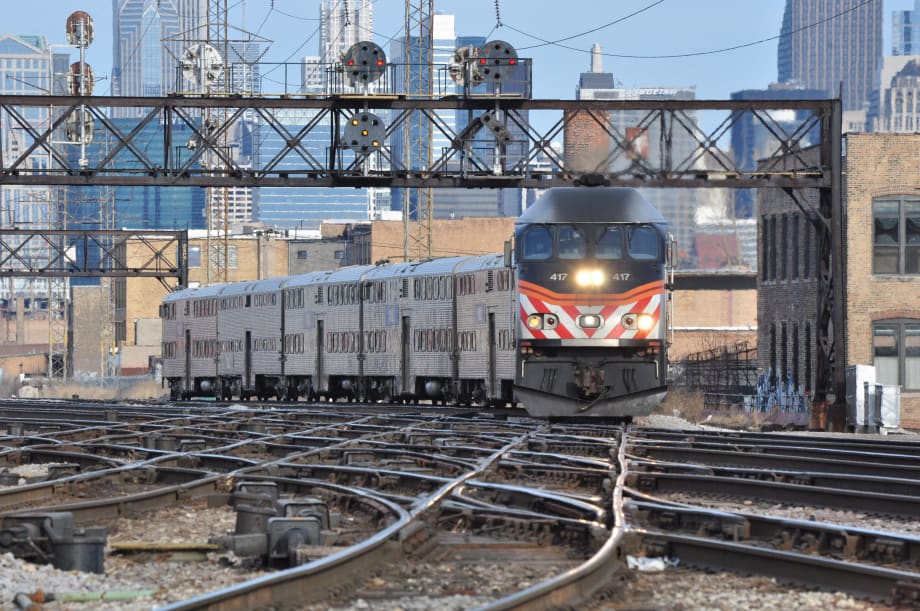
With thousands of pieces of new infrastructure, railroads are asking a key question: How are we going to manage all these safety-critical PTC assets?
Metra
With thousands of pieces of new infrastructure, railroads are asking a key question: How are we going to manage all these safety-critical PTC assets?
Metra
In recent years, few topics have garnered as much attention in rail as Positive Train Control (PTC). It makes sense. PTC is the FRA-mandated collision-avoidance system that each railroad must implement to ensure passenger safety. With North American agency’s working feverishly to finalize their PTC deployments, the industry is quickly approaching a watershed moment in railroad safety.
PTC is a network of equipment that gets installed in three places: wayside, vehicles (onboard), and central server/back office (Some systems also utilize a satellite/GPS component). With thousands of pieces of new infrastructure, railroads are asking a key question: How are we going to manage all these safety-critical PTC assets?
More specifically, the FRA requires you to track the asset’s configuration management. What this means is you must be able to track the following historical data about each asset, over their entire lifetime:
What is the equipment’s:
Physical location?
Compliance status? (Version? Is it fully-updated to the current, approved engineering configuration?)
Configuration now, and at any point in its history (last month, last year, etc.)?
Change history? (What is its detailed work and inspection history? Who/what/when/how?)
This complexity is compounded even further for wayside equipment (e.g., transponders). Wayside assets are numerous and geographically dispersed along the rail alignment. Imagine you have a PTC signal that needs a critical firmware update. You can’t waste time wandering the track, not knowing where it is. So, here are three critical spatial functions that a rail asset management solution needs to effectively manage wayside assets: a linear reference system (LRS), GIS mapping, and mobile.
A linear reference system (LRS) is the foundation of any good wayside asset management system. One simple way to think of your rail alignment is as a series of rulers, where each ruler represents one of your operational lines, and each tick (fractions of an inch or millimeters) shows you how far you are from the start of the line. In LRS terminology, the tick marks are your engineering markers (mileposts or chaining) for measuring precise distances from a fixed “zero point.” Things like overhead catenary poles or intersection/level crossings can also be markers.
So, why is an LRS so important for managing PTC wayside assets? Because, as a railroad, your LRS is the precise reference system that is even more valuable than just GPS (latitude/longitude). It tells you exactly where your assets are along the operational line — transponder #274 is 10 feet from milepost 14+70, which is 1,470 feet from chaining zero. The LRS in your software allows you, your inspectors, and your mobile apps to locate your PTC assets with precision.
Geographic information system (GIS) software allows you to view the location of all your PTC assets on maps. Looking at an aerial view of your track, you can quickly locate all your assets with just a few mouse clicks. Combined with an LRS, your GIS maps increase the speed it takes to find the relevant PTC assets. Do you need to inspect a single transponder? Easy — find the one you need on the map and create a work order to inspect it. Need to generate a campaign across many of them? Also, easy — just click-and-drag over the map area to “lasso” them and begin workflow against them all. Mapping makes interacting with your PTC data simple and intuitive.
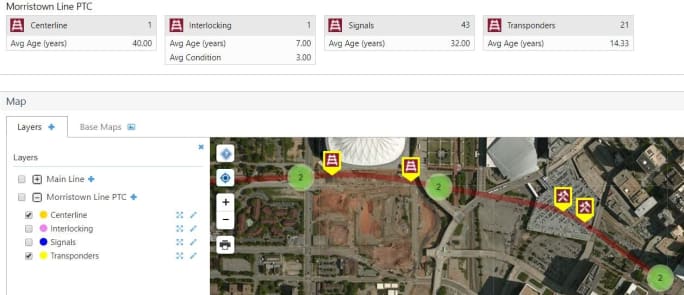
Mobile with GPS. Whether it’s track walkers performing inspections or technicians repairing a signal, wayside work is by-definition in the field. By putting vital information into the hands of your field workers, mobile apps are a critical tool for effectively managing railroad PTC systems. They are the best way to eliminate inefficient and unreliable paper-based workflows while maximizing the accuracy of data captured.
Leading wayside mobility solutions leverage the power of GIS mapping and real-time global positioning system (GPS) location information to lock-in automatically on your actual physical location along the right-of-way (five feet from milepost 14+30 at New Haven rail station), all in the palm of your hand. By capturing the exact geo-location of the PTC defect you have found (or work performed), using these systems guarantee better data quality and compliance with PTC regulations.
Additionally, make sure to choose a system that works seamlessly in both online and offline mode (a local database keeps the information stored on the device until it reconnects to the network). This way you can continue work, even when you’re in an area with bad or no service (e.g., in a tunnel).
Combined functionality. The FRA mandates active management of your wayside PTC equipment. The combined functionality of linear reference system, GIS mapping, and mobile with GPS are the key features to look for in a PTC-ready asset management system. They empower your workforce with the information and location-precision to manage complex, geospatial assets. These types of tools make your PTC workers more efficient and their results more reliable, resulting in an improved PTC maintenance culture that ensures regulatory compliance while maximizing safety. And that’s a no-brainer.
Brett Koenig is Industry Solutions Manager, Enterprise Asset Management, at Trapeze.
More Rail
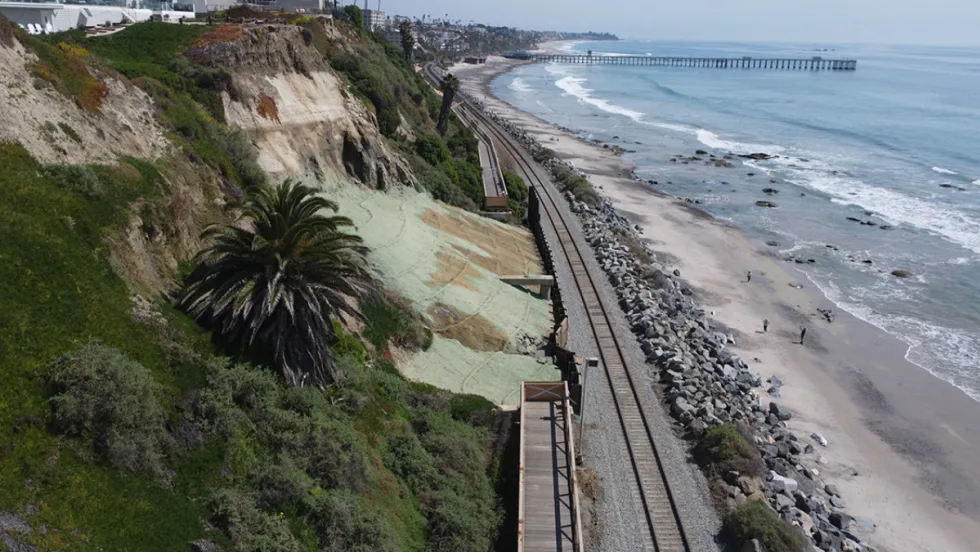
OCTA Declares Emergency to Protect Rail Corridor From Coastal Erosion
The California agency is accelerating shoreline protection and plans to place approximately 690,000 cubic yards of sand along the San Clemente coast to protect a key passenger and freight rail link.
Read More →
More Than a Summer Job: Building the Next Generation of Transit Talent
The Delaware River Port Authority and PATCO have transformed their internship program into a hands-on professional development experience that introduces students to the breadth of transportation careers — and creates a pipeline for future employees.
Read More →
Airo Trains Make Their Amtrak Cascades Debut in the Pacific Northwest
Effective immediately, two cutting-edge Airo trainsets will join the Amtrak Cascades route, operating four daily trips between Vancouver, B.C., Seattle, Portland, and Eugene, Oregon, marking the first introduction of Airo trains into passenger service anywhere in the country.
Read More →
Florida's Brightline Announces Financial Restructuring
Brightline Florida says train operations will continue as normal as certain parent entities enter Chapter 11 and financial stakeholders provide $490 million in new long-term capital.
Read More →
ENC Lands MATA Contract and More in Biz Briefs
In this edition of Biz Briefs, we spotlight the latest developments shaping the future of mobility.
Read More →
Strada360’s Steve Lassey on Turning Transit Data Into Better Decisions
From breaking down data silos to preparing for AI, Strada360 CEO Steve Lassey discusses how transit agencies can use technology to improve operations, customer information, and long-term decision-making.
Read More →
SEPTA Details Accelerate Vision for Transit System
The plan outlines investments in trolley modernization, new Metro and Regional Rail vehicles, accessible stations, and more frequent bus and rail service.
Read More →
FTA Ends Direct Oversight of MBTA Safety Actions
The federal agency closed its remaining special directive to the Massachusetts Department of Public Utilities following a safety review that began in 2022.
Read More →
Amtrak, CN Reach Agreements to Strengthen Passenger Rail Service, Safety
The agreement resolves a more than decade-long proceeding before the Surface Transportation Board concerning the terms and conditions for Amtrak services, such as the City of New Orleans, Illini/Saluki, and Wolverine.
Read More →
New York MTA Advances Final Contract for Second Avenue Subway Expansion
Contract Four is the largest in the Second Avenue Subway Phase 2 project and includes construction of station infrastructure, tracks, and signals for the subway expansion, MTA officials said. Work on Contract Four will begin in 2027.
Read More →