



American Seating to begin Applying Antimicrobial Coating to Products
Aegis bonds to the surface and creates an environment that prevents organisms from attaching and thriving on treated surfaces.
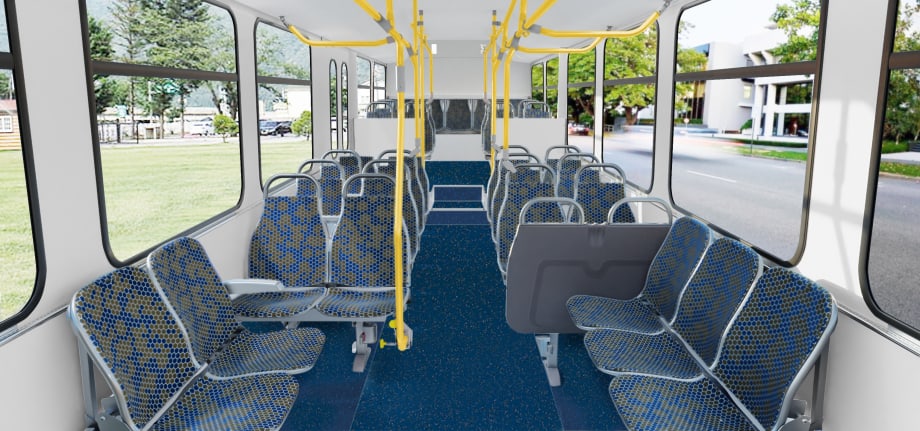
For reapplication or application to existing transit vehicles, American Seating also is offering five-gallon containers of ready-to-use Aegis Microbe Shield.
American Seating
American Seating will begin applying antimicrobial coating to all high-touch surfaces of its seating and securement solutions starting June 29. The coating treatment will be applied to American Seating products prior to shipment.
The company has selected Aegis Microbe Shield, an EPA-registered surface coating that provides an invisible barrier to inhibit the growth of bacteria, mold, and mildew, with continuous protection for one year. Aegis bonds to the surface and creates an environment that prevents organisms from attaching and thriving on treated surfaces.
For reapplication or application to existing transit vehicles, American Seating also is offering five-gallon containers of ready-to-use Aegis Microbe Shield.
The antimicrobial coating will keep American Seating products cleaner, fresher, and even lengthen durability longer than other untreated solutions on the market. The coating also will make seats easier to clean and improve cleanliness between cleanings.
Aegis Microbe Shield forms a protective coating that molecularly bonds with surfaces upon application. Bacteria are attracted to the coating’s positive charge, and, upon coming into contact with the treated surface, they quickly die.
When applied to surfaces, Aegis forms a colorless, odorless, positively charged polymer that attracts, then electrocutes and ruptures, a microbe’s negatively charged cell membrane. Aegis inhibits the growth of microbes on surfaces by utilizing a charge-disruption mode of action.
Aegis is attracted to the microbe’s cell wall and neutralizes the cell wall’s natural protection by interacting with cellular proteins needed to maintain cell wall integrity. Its charge-disruption mode of action leads to the eventual breakdown of the microbial cell (also known as lysis), eliminating odor, stains, and deterioration.
Aegis is not a disinfectant but rather a nanoscopic biostatic surface protectant that protects surfaces between cleaning. Its use complements daily disinfection and only needs to be applied once a year.
More Security and Safety

Transit Agencies Highlight Safety Gains at National Summit
Leaders from 15 major transit systems shared crime-reduction results and safety initiatives while discussing the role of continued federal support.
Read More →
DART Launches Major Security, Fare Enforcement Initiative
The 90-day demonstration will deploy coordinated security teams at five light rail stations while testing controlled access and gathering data to guide future investments.
Read More →
RTD Launches NextRide App to Consolidate Trip Planning, Fares, Security Reporting
The app expands on RTD’s existing NextRide web application and allows customers to view real-time vehicle locations and service alerts, purchase and store digital fares, and access customer support.
Read More →

TAPTCO Updates OSHA Compliance Training for Transit Maintenance Operations
The revamped program addresses 26 OSHA standards for maintenance facilities, with TAPTCO pointing to training, documentation, and everyday shop hazards as continuing challenges for transit operations.
Read More →
How VaporVision Adds Value to Transit Door Systems
Wabtec engineers explain how the system improves doorway detection, strengthens diagnostics and gives transit agencies and OEMs greater operating flexibility.
Read More →
FRA Announces $5.3B in Rail Investments, Including $2B for Amtrak
Funding will support grade-crossing improvements, infrastructure upgrades, and new Amtrak equipment in 23 states.
Read More →
Chicago, Maryland Expand Non-Law-Enforcement Safety, Rider Support
The CTA and MTA are launching new programs aimed at de-escalation, crisis response, rider assistance, and greater transparency.
Read More →
LA Metro, City of West Hollywood, and Partners Advance Smarter Bus Lane Enforcement
The award-winning partnership combines AI-powered detection with human oversight to improve bus reliability, accessibility, and enforcement efficiency.
Read More →
LA Metro Reports 57% Decline in Homelessness on Transit System Since 2024
The agency's latest homelessness count offers new data on how care-based services and cross-sector partnerships can complement traditional transit security strategies.
Read More →
FTA Launches 'Transit Moves America' Dashboard to Highlight Agency Safety and Performance
The online dashboard transforms National Transit Database information into a public-facing resource that allows users to compare transit agencies on key operational and safety metrics.
Read More →