



L.A. Metro Marks the Start of the Final Section of Its Purple Line Extension
The project will connect two previous subway sections through Koreatown, Beverly Hills, and Century City and extend it another two-and-a-half miles to Westwood.
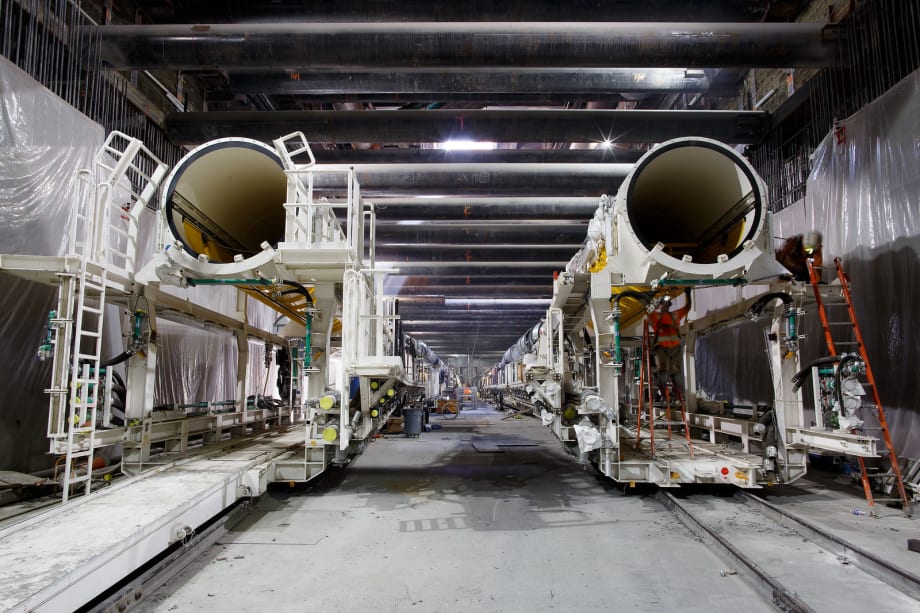
Prior “pre-construction” work to date has consisted of final design, advanced utility relocation and Tunnel Boring Machine assembly and component testing, among others.
LA Metro
The Los Angeles County Metropolitan Transportation Authority (Metro) held a ceremonial groundbreaking with the Federal Transit Administration (FTA), U.S. Department of Veteran Affairs, UCLA, and key local and federal officials to mark the start of major construction on the third and final section of the Purple (D Line) Extension Project, which will connect downtown L.A. and the Westside via a high-speed, high-capacity subway in 2027.
FTA Deputy Administrator Nuria Fernandez was in attendance to celebrate the $3.6-billion Section 3 project, which has received a $1.3-billion federal grant from the U.S. Department of Transportation. The project will connect two previous subway sections through Koreatown, Beverly Hills, and Century City and extend it another two-and-a-half miles to Westwood. Metro will build new stations at Westwood/UCLA to serve Westwood Village and UCLA and another at Westwood/VA Hospital to serve the hospital campus just west of the I-405 freeway.
Contractor Tutor-Perini/O&G’s near-term work for the future Westwood/VA Hospital station includes a piling operation to create a temporary support structure for the underground station. Drill rigs will dig 100-foot-deep holes into the ground and a crane will place steel beams known as “piles” into each hole. After the pile is put in place, each hole will be filled with concrete to provide support for the station walls. Following completion of piling later this year, Metro’s contractor will then begin excavating the subway station box.
Prior “pre-construction” work to date has consisted of final design, advanced utility relocation and Tunnel Boring Machine (TBM) assembly and component testing, among others.
The FTA’s $1.3-billion federal grant will be delivered through a multi-year agreement known as a Full Funding Grant Agreement that is governed by the FTA’s Capital Investment Grant program, popularly referred to as “New Starts.” It is a stand-alone grant agreement, with no required loans for Metro to pay back as in previous funding agreements for first two project extensions. The remaining funds needed to build the project will come from Metro’s own local voter-approved transportation sales tax measures.
“The Federal Transit Administration is proud to partner with Metro and the entire Los Angeles region to bring more transportation options to residents, veterans, students and visitors to the 2028 Summer Olympics through the Purple Line extension,” said FTA Deputy Administrator Nuria Fernandez. “This project is an excellent example of a transformational infrastructure investment that the Biden-Harris Administration supports. It will improve access and mobility for millions of people traveling in one of Los Angeles County’s most congested corridors.”
The $9.5-billion project was able to secure approximately half of the total project cost from the FTA.
Metro is now actively building all three sections of the subway extension, which are planned to open in 2024, 2025, and 2027, respectively. The first section between Wilshire/Western and Beverly Hills is nearly 70% complete. Section 2 is now nearly 45% complete. Section 3, including pre-construction work, has reached 20% completion.
The subway extension to the Westwood/VA Hospital station will garner about 49,300 daily weekday boardings at the seven new stations. There will be about 78,000 new daily trips on the full Metro Rail System through the opening of the line.
More Rail

New York MTA Advances Final Contract for Second Avenue Subway Expansion
Contract Four is the largest in the Second Avenue Subway Phase 2 project and includes construction of station infrastructure, tracks, and signals for the subway expansion, MTA officials said. Work on Contract Four will begin in 2027.
Read More →
San Diego MTS Breaks Monthly Trolley Ridership Record
Agency officials said July’s ridership indicates MTS’s continued recovery from the pandemic.
Read More →
Report Examines NJ TRANSIT Reliability, Funding Challenges
The Garden State Initiative analysis examines the roles of Amtrak infrastructure, fleet management, and agency operations while recommending a more performance-based approach to improving reliability.
Read More →
Stadler, CapMetro Sign Long-Term Rail Fleet Support Agreement
Beginning in 2027, Stadler will provide on-site technical expertise, spare parts support, training, and obsolescence management to help extend the reliability and longevity of CapMetro’s GTW fleet.
Read More →
Biz Briefs: Alstom Lands Canadian Contract, LYT to Supply California TSP, and More
In METRO's latest installment, we take a look at recent news from Complete Coach Works, Beep, FlixBus, and more partnerships making headlines across the transportation sector.
Read More →
CATS Gold Line Marks 5 Years of Service, 2.8M Passenger Trips
With a six-mile expansion planned, the Charlotte streetcar is positioned to connect more neighborhoods and major transit hubs across the region.
Read More →
Why Simulating Pedestrian Movement Has Become Essential for Modern Rail Stations
Pedestrian microsimulation is helping rail planners identify bottlenecks, test station designs, and prepare complex transit hubs for growing passenger volumes.
Read More →
Amtrak Begins Major Construction at New York’s Sunnyside Yard
The new maintenance facility will support Amtrak’s Airo trainsets while improving maintenance efficiency and turnaround times in New York.
Read More →
Chicago Leaders Unveil Plans for O’Hare Airport Express Train
The privately developed project would offer a 15-minute trip between downtown and O’Hare’s Terminal 2, with trains operating every 15 minutes on a dedicated track. The service would use battery-electric trains and three existing freight rail rights-of-way.
Read More →
OCTA Maps Out 30-Year Strategy to Protect Coastal Rail Corridor
The draft feasibility report identifies strategies to protect the coastal rail line for decades as the agency continues near-term stabilization and sand placement efforts.
Read More →