



New York’s MTA to Increase Mask Enforcement Throughout the System
The goal of heightened enforcement is to increase mask usage across all agencies, and to return to 2020 and early 2021 compliance levels where nearly 100% of riders wore masks onboard subways, buses, commuter railroads, and paratransit vehicles.
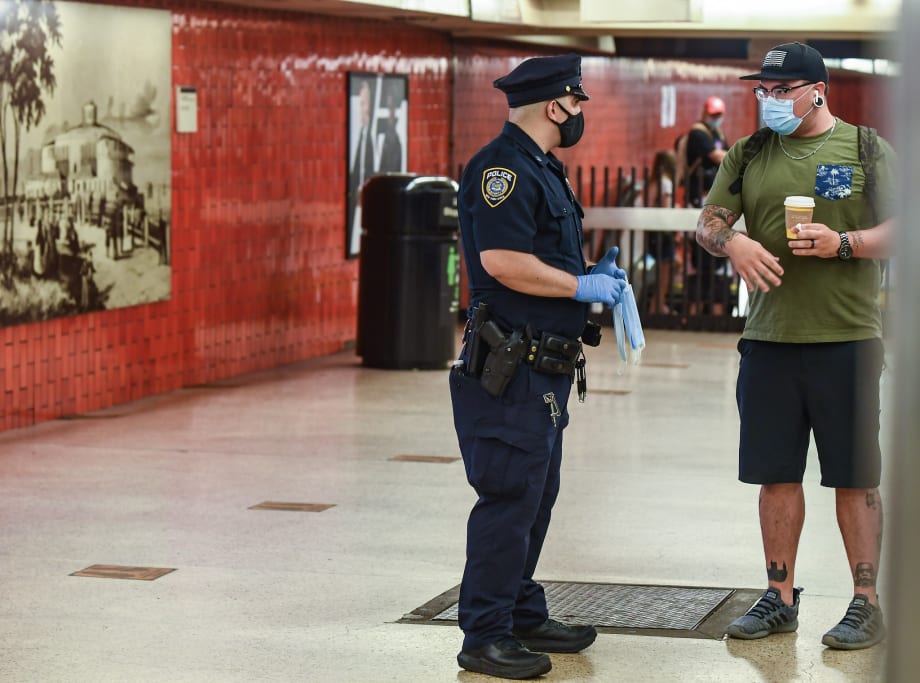
Since the mask blitz began at key transit hubs, mask usage has increased.
Marc A. Hermann
New York’s Metropolitan Transportation Authority (MTA) is stepping up mask enforcement throughout the system and those who do not comply with mask requirements will be more likely to face a $50 fine. Mask-wearing is a federal requirement on trains, buses, and paratransit vehicles.
Following Labor Day, the MTA began on a blitz of mask distribution, with MTA staff and police officers strategically stationed at subway and railroad hubs, and bus terminals, distributing tens of thousands of free masks to unmasked riders. This continues an approach established in September 2020, when the MTA implemented a $50 fine to help increase mask compliance in response to the COVID-19 pandemic.
The goal of heightened enforcement is to increase mask usage across all agencies, and to return to 2020 and early 2021 compliance levels where nearly 100% of riders wore masks onboard subways, buses, commuter railroads, and paratransit vehicles. Since the $50 fine was implemented on Sept. 14, MTA police officers have had over 88,000 positive encounters with customers. This has included the distribution of more than 50,000 free masks overall, 25,000 in the two weeks since the blitz began on September 7.
“Promoting mask usage is an important component to protecting one another,” said Patrick Warren, MTA chief safety officer. “To support the use of masks we have provided tens of millions of free masks to customers, complemented by a robust communication endeavor. These efforts have seen mask usage recently rise on buses and trains. This next phase of our blitz will reinforce that wearing a mask is not optional. Vaccinated or not, you must wear a mask when traveling on public transit.”
Since the mask blitz began at key transit hubs, mask usage has increased. Latest surveys show that mask compliance onboard buses are approximately 94%, 87% on subways, 92% on the LIRR, and 95% on Metro-North.
To date the MTA has made 11.1 million masks available for customers. Through the authority’s trailblazing Mask Force, which launched in July 2020, more than 800,000 free masks have been distributed to customers.
More Security and Safety

Transit Agencies Highlight Safety Gains at National Summit
Leaders from 15 major transit systems shared crime-reduction results and safety initiatives while discussing the role of continued federal support.
Read More →
DART Launches Major Security, Fare Enforcement Initiative
The 90-day demonstration will deploy coordinated security teams at five light rail stations while testing controlled access and gathering data to guide future investments.
Read More →
RTD Launches NextRide App to Consolidate Trip Planning, Fares, Security Reporting
The app expands on RTD’s existing NextRide web application and allows customers to view real-time vehicle locations and service alerts, purchase and store digital fares, and access customer support.
Read More →

TAPTCO Updates OSHA Compliance Training for Transit Maintenance Operations
The revamped program addresses 26 OSHA standards for maintenance facilities, with TAPTCO pointing to training, documentation, and everyday shop hazards as continuing challenges for transit operations.
Read More →
How VaporVision Adds Value to Transit Door Systems
Wabtec engineers explain how the system improves doorway detection, strengthens diagnostics and gives transit agencies and OEMs greater operating flexibility.
Read More →
FRA Announces $5.3B in Rail Investments, Including $2B for Amtrak
Funding will support grade-crossing improvements, infrastructure upgrades, and new Amtrak equipment in 23 states.
Read More →
Chicago, Maryland Expand Non-Law-Enforcement Safety, Rider Support
The CTA and MTA are launching new programs aimed at de-escalation, crisis response, rider assistance, and greater transparency.
Read More →
LA Metro, City of West Hollywood, and Partners Advance Smarter Bus Lane Enforcement
The award-winning partnership combines AI-powered detection with human oversight to improve bus reliability, accessibility, and enforcement efficiency.
Read More →
LA Metro Reports 57% Decline in Homelessness on Transit System Since 2024
The agency's latest homelessness count offers new data on how care-based services and cross-sector partnerships can complement traditional transit security strategies.
Read More →
FTA Launches 'Transit Moves America' Dashboard to Highlight Agency Safety and Performance
The online dashboard transforms National Transit Database information into a public-facing resource that allows users to compare transit agencies on key operational and safety metrics.
Read More →